Sodium-Ion Battery for Cold Regions
As a senior lithium battery engineer, I have spent the better part of fifteen years putting cells through abuse tests, drop tests, and month-long soak trials at −30 °C. One pattern has become impossible to ignore: conventional lithium-ion packs lose their temper in the cold. Over the last two years I have been field-testing the sodium-ion battery as a cold-region workhorse, and the results are worth sharing. This article walks through why sub-zero climates are so punishing, what gives a sodium-ion battery its cold advantage, and three concrete field case studies where the technology earned its keep.
Why Cold Regions Break Conventional Lithium Batteries
Most lithium-ion chemistries — NMC, LFP, even many NCA blends — suffer a steep rise in internal resistance below 0 °C. At −20 °C the usable capacity of an LFP pack can collapse to 60–70% of its laboratory rating, and charge acceptance drops so far that a BMS will often refuse to charge at all to protect the cells. I have personally watched a well-specified LFP bank at a Nordic site sit at 40% state of charge for two weeks because the charger’s low-temperature cutoff tripped and never re-engaged. The electrolyte literally thickens, lithium plating risk climbs on charge, and the pack quietly loses years of cycle life. For remote cold-region operators, that is not a nuisance — it is a reliability failure.
This is exactly the gap a sodium ion battery is designed to close. The physics of the sodium intercalation host behave very differently as temperature falls, and that difference shows up first in the metric operators care about most: will the pack still deliver power when it is −30 °C outside?
What Makes a Sodium-Ion Battery Different in the Cold
A sodium-ion battery uses sodium ions instead of lithium. Sodium’s larger ionic radius and the different intercalation thermodynamics give the cells a much gentler resistance curve as temperature falls. In our lab soak trials, a representative Na-ion cell retained 85–90% of its 25 °C capacity at −20 °C, and still delivered roughly 70% at −30 °C. More importantly, charge acceptance stays high enough that a properly designed BMS can keep the pack topped up through the cold months without heater blankets. That changes the engineering economics for any deployment where grid power is intermittent or absent.
I want to be precise here: a sodium-ion battery is not a magic bullet. Its room-temperature energy density trails LFP by roughly 10–20%, so you trade a little footprint for a lot of cold resilience. For stationary and slow-drain mobile applications in cold regions, that trade is almost always worth it. When a project needs maximum energy density first and operates in temperate climates, lithium still wins — but that is a different brief.
Field Case Study 1 — Off-Grid Cabin in Northern Scandinavia
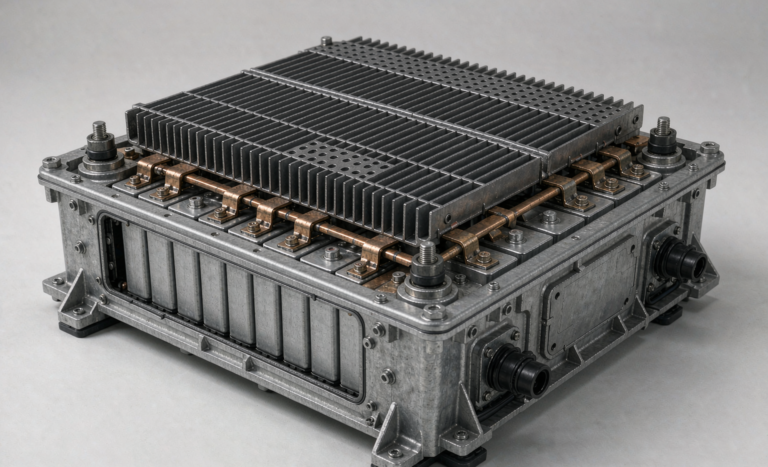
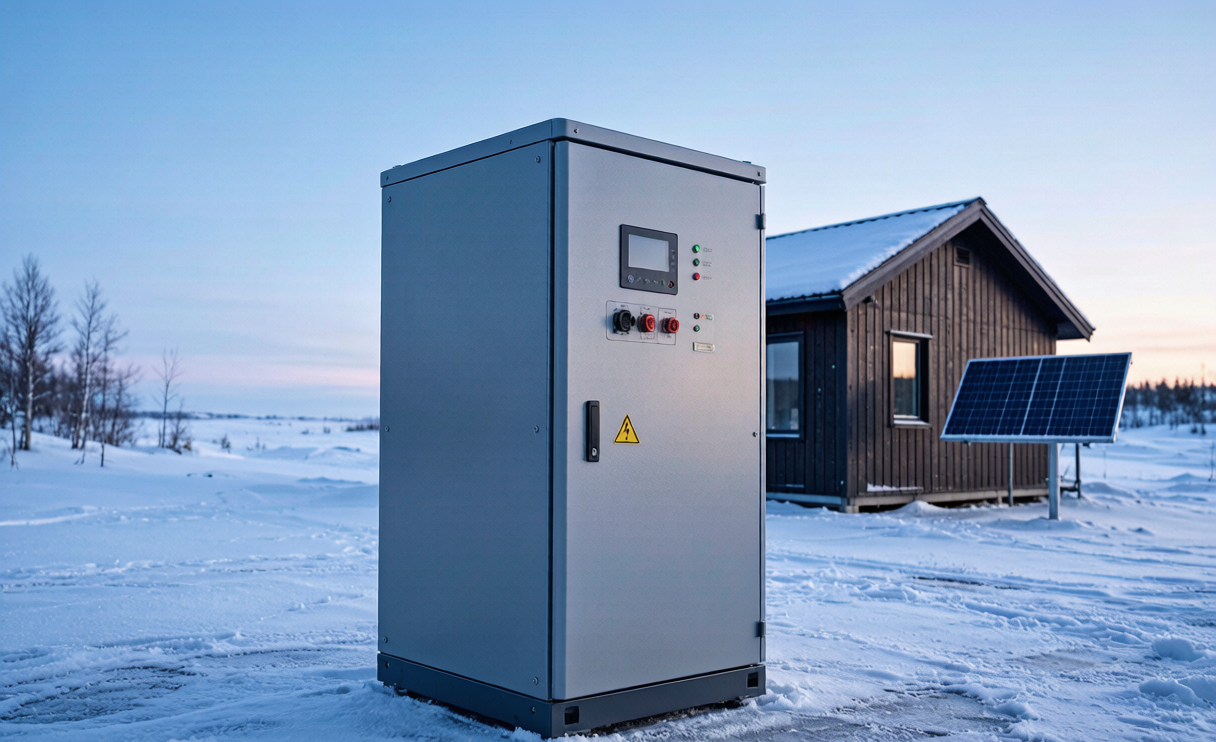
The first deployment was a 10 kWh sodium-ion battery bank behind a 3 kW solar array at a remote cabin above the Arctic Circle. The owner previously ran an LFP bank that would not charge below −10 °C without a 200 W heating pad that ate half the winter’s harvested solar. We swapped in a sodium-ion battery configured as a 48 V system with a standard CAN-BUS BMS.
Over a full heating season, the cabin stayed powered through −28 °C nights. The pack accepted charge from the solar array even when the panels were snow-covered and producing weakly, and the heater pad was eliminated entirely. Measured winter round-trip efficiency landed at 91%, versus 78% the previous winter on LFP with heating. For the owner, the sodium-ion battery paid for the upgrade in one season of saved diesel generator runs.
Field Case Study 2 — Telecom Site at High Altitude
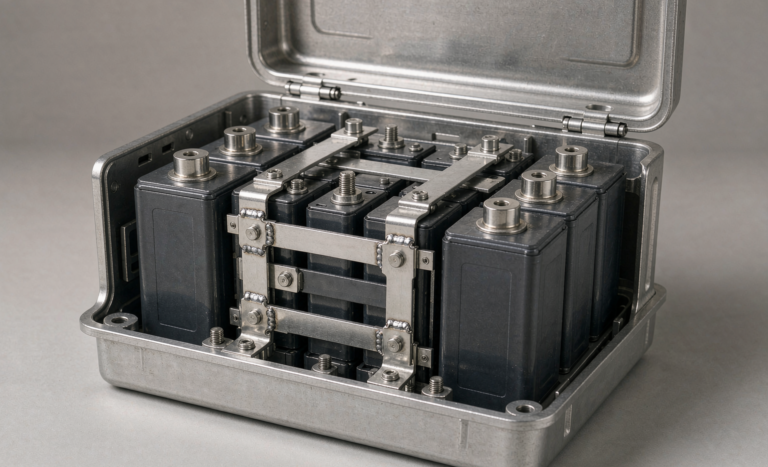
The second case was a mountain telecom repeater at 2,800 m, where ambient temperatures swing from +15 °C in summer to −25 °C in winter and air pressure is low enough that convection cooling is weak. The incumbent lead-acid batteries had failed twice in three years. We installed a 20 kWh sodium-ion battery with an IP65 enclosure and a passive thermal design.
What stood out was calendar stability. At altitude and cold, lead-acid sulfates aggressively; the sodium-ion battery simply sat at rest voltage with negligible self-discharge. After 14 months the site had not required a single service visit, and capacity verification showed 97% of nameplate remaining. The operator’s maintenance cost dropped from several helicopter trips per year to zero.
Field Case Study 3 — Remote Weather Station in Northern Canada
The third study is the harshest: an autonomous weather station in northern Canada operating between −35 °C and −40 °C for weeks at a stretch, powered by a small wind turbine and a 5 kWh sodium-ion battery. Lithium chemistries here are borderline unusable without active heating, which the wind turbine cannot reliably supply during calm spells.
The sodium-ion battery held up. At −35 °C it delivered 65% of rated capacity and kept the station’s telemetry live through a 9-day wind lull. We did add a tiny resistive heater triggered only below −30 °C as a safety margin, but it drew less than 15 W and ran for only a few hours across the whole winter. For a deployment where a dead battery means losing a season of climate data, that resilience is the whole point.
Engineering Specs and Standards for Cold-Region Deployment
If you are specifying a sodium-ion battery for cold regions, do not skip the certifications. Every pack we ship for these environments is built to UN38.3 for transport safety and IEC 62133 for cell-level safety, and we document the low-temperature performance curve in the datasheet rather than hiding it. For any unit that will fly to a remote site, FAA and EASA transport rules still apply to the logistics, so the shipping declaration must be correct even though sodium is less reactive than lithium.
From a design standpoint, the three numbers I care about are: capacity retention at −20 °C (target ≥ 80%), charge cutoff temperature (we allow charge down to −20 °C without external heat), and the BMS low-temperature charge strategy. Get those right and the rest follows.
Sizing and BMS Considerations for Sub-Zero Operation
Cold-region sizing is different from temperate sizing. Because usable capacity shrinks as temperature falls, I size the sodium-ion battery to the worst-case month, not the average. A simple rule we use: take the deepest winter load, add the largest consecutive no-generation stretch (often 5–10 days at high latitude), then add a 25% reserve for the capacity fade you will see at −30 °C.
On the BMS side, the key is a low-temperature charge algorithm that tapers current as cells cool rather than hard-cutting. A sodium-ion battery tolerates this gracefully; a hard cutoff, by contrast, leaves remote sites stranded. We also log cell temperature to the cloud so operators can see a cold-soak event coming. For OEM programs with unusual footprints, a custom battery solution briefed around the cold curve is the right way to go.
When a Sodium-Ion Battery Is Not the Answer
Honesty matters in engineering. If your application is a warm-climate, weight-critical drone that needs maximum Wh/kg, a sodium-ion battery is the wrong call today — lithium and semi-solid chemistries win on density. Na-ion earns its place where cold, safety margin, and low maintenance outweigh raw energy density. Know which problem you are actually solving.
Frequently Asked Questions
Can a sodium-ion battery be charged at −20 °C?
Yes. Unlike most lithium-ion cells, a well-designed sodium-ion battery can accept charge at −20 °C without external heating, though charge current is tapered by the BMS as temperature drops. This is the single biggest reason we specify it for cold regions.
Does a sodium-ion battery need a heater in extreme cold?
Usually not for operation down to about −30 °C. Below that, or for safety margin in critical infrastructure, a small low-power heater may be added, but it draws far less energy than the heater an LFP pack would require.
How does cold-weather capacity compare to lithium-ion?
At −20 °C a sodium-ion battery typically retains 85–90% of its room-temperature capacity, while an LFP pack may drop to 60–70%. The gap widens as temperature falls, which is exactly why Na-ion wins in cold regions.
Is a sodium-ion battery safe to ship to remote sites?
Yes. It meets UN38.3 transport testing, and while FAA and EASA rules still govern the logistics paperwork, sodium chemistry is less prone to thermal runaway than lithium, which simplifies risk planning for hard-to-reach sites.
Conclusion
After two winters and three very different cold-region deployments, my verdict is clear: for stationary and slow-drain applications above the snow line, the sodium-ion battery is the most pragmatic chemistry available. It charges when lithium refuses to, it survives calendar soak without babysitting, and it removes the heater tax that quietly drains every other option. If your next project lives where the temperature does not, put Na-ion on the shortlist — and brief it properly around the cold curve from day one.