Sodium-Ion Battery Manufacturing Retrofit
When I walk a customer through a sodium-ion battery project, the question that comes up faster than chemistry is almost always plant-related: do we build a brand-new line, or do we convert the lithium-ion line we already own? After running pilot conversions on three cell formats over the past eighteen months, my answer has settled into something practical. For most B2B buyers and OEMs, a sodium-ion battery manufacturing retrofit of existing Li-ion assets is the fastest and cheapest path to volume — if you know exactly which stations can stay and which have to change. This article distills what my team has learned converting coating, assembly, and formation lines from lithium-ion to Na-ion production.
The appeal is simple. Sodium is abundant, cheap, and geographically diversified compared to lithium and cobalt. But the real business case for retrofitting is time-to-volume. A greenfield gigafactory takes 24 to 36 months to permit, build, and qualify. A retrofit of a parked or under-utilized Li-ion line can be live in 6 to 12 months. That gap is often the difference between catching a storage or e-mobility contract and missing it.
Why Retrofitting Matters in 2026
Demand for sodium-ion has moved from lab curiosity to procurement line item. Stationary storage, low-speed EVs, and forklift fleets are all signing multi-year offtake deals that need capacity now, not in 2030. The constraint is rarely cathode or anode know-how — it is qualified, audited manufacturing floor space.
Most lithium-ion lines built between 2018 and 2023 are sitting at 40–60% utilization. Converting even a portion of that capacity to a sodium ion battery product line lets a factory serve both chemistries from one site, share overhead, and amortize the original capex. As an engineer I like this because it keeps the high-value, hard-to-replicate assets — cleanrooms, dry rooms, automated winding, formation chambers — fully utilized.
What’s Shared Between Li-Ion and Na-Ion Lines
The good news for any plant manager: the backbone of a cell line is chemistry-agnostic. The processes below transfer almost directly when you move from lithium-ion to Na-ion:
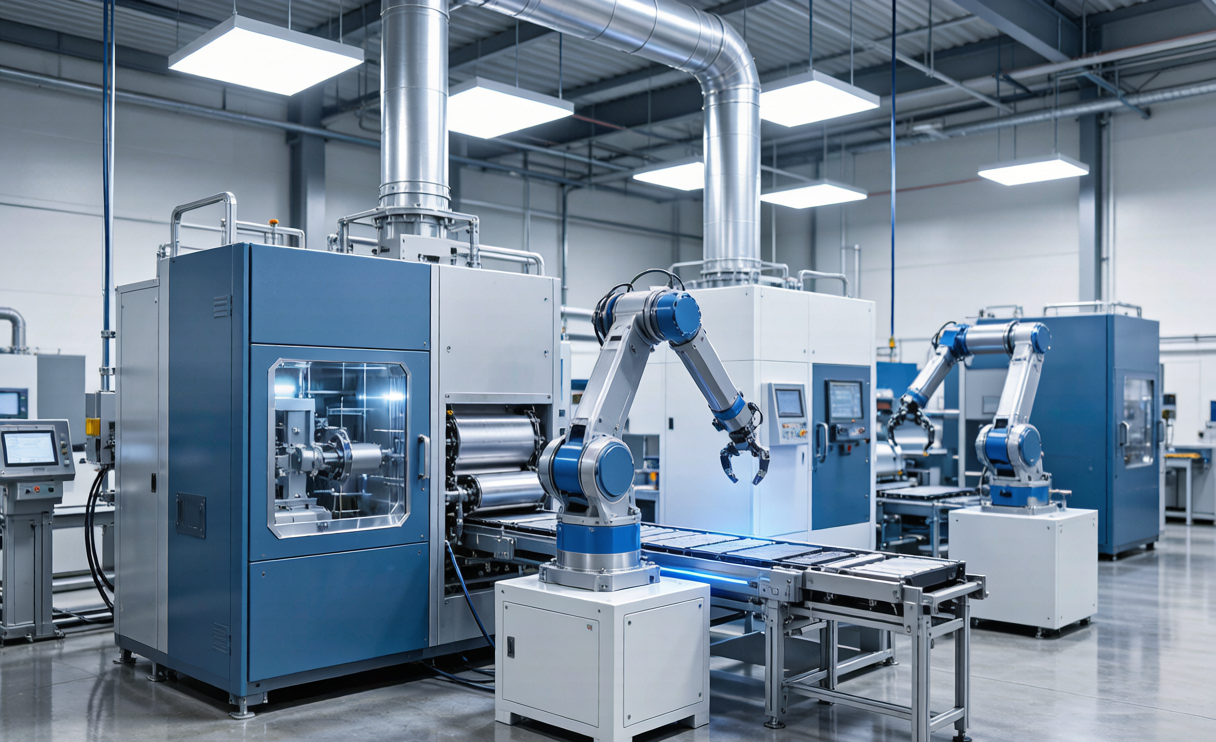
- Electrode coating and calendering – the same slot-die coaters, ovens, and roller presses handle Na-ion slurries with parameter changes rather than new machines.
- Cell assembly – winding, stacking, tab welding, and enclosure sealing are nearly identical for cylindrical, prismatic, and pouch formats.
- Formation and aging – the constant-current/constant-voltage (CC-CV) formation racks and environmental chambers are reused; only the voltage windows and soak times change.
- Material handling and MES – conveyors, vision inspection, and manufacturing execution systems carry over with recipe updates.
In a typical retrofit I estimate 60–75% of the installed equipment value is reusable. That is the number that makes the payback work.
What Must Change: Slurry, Coating and Drying Windows
This is where engineering discipline matters. Sodium-ion electrodes behave differently, and pretending otherwise is how pilot lines produce puffed, low-yield cells.
For hard-carbon anodes and layered-oxide or polyanionic cathodes, the slurry solids loading, binder system, and solvent mix differ from graphite/LFP. Coating grammage targets shift, and — critically — the drying window changes. Na-ion cathodes can be moisture-sensitive during processing, so we often tighten the dry-room dew point and slow line speed by 10–20% on the first coating pass until coating uniformity stabilizes.
Calendering pressure also needs re-tuning. Sodium-ion electrodes are frequently softer than their lithium counterparts, so over-pressing cracks the active layer and kills cycle life. We validate electrode density against a target compaction curve before locking the recipe. A sodium-ion battery line that skips this step will show capacity fade by the 200th cycle.
Cell Assembly: Winding, Stacking and Sealing
Mechanically, assembly is the easiest part of a retrofit. The same winding mandrels, stacking jigs, and laser welders produce Na-ion cells. Two cautions from the field:
- Electrolyte fill volume – Na-ion cells often need a different fill weight and a longer soak before sealing. We adjust the peristaltic dosing pumps and add a vacuum pre-wetting dwell.
- Sealing profiles – pouch and prismatic lids are chemistry-independent, but the internal stack thickness can differ, so we re-validate crimp and weld parameters on the first production lot.
None of this requires new machinery. It requires updated standard work and a disciplined first-article inspection.
Formation, Aging and the UN38.3 / IEC 62133 Compliance Path
Formation is where a retrofit earns its certification credibility. The same CC-CV racks used for lithium-ion handle Na-ion, but the voltage ceiling is lower (roughly 2.0–3.9 V for most Na-ion versus 3.0–4.2 V for NMC). We re-map the formation recipe and the safety cutoffs, then run a full qualification batch.
For global B2B shipments, every cell still must clear UN38.3 transport testing — altitude simulation, thermal, vibration, shock, external short, impact, overcharge, and forced discharge. For stationary and industrial applications we also align to IEC 62619 (industrial cells) and reference IEC 62133 for portable cell safety. If the product is air-freighted, the logistics team must follow FAA and EASA dangerous-goods provisions. A retrofit line that reuses formation hardware but keeps legacy test records will fail audit — the qualification file must be chemistry-specific.
Cost, Capex and Payback of a Retrofit Line
From projects I have scoped, a full greenfield prismatic Na-ion line runs into the hundreds of millions of dollars. A retrofit of an equivalent idled Li-ion line typically lands at 25–40% of that capex, concentrated in coating re-tooling, electrolyte dosing, and recipe re-qualification. Payback against storage and forklift contracts we have modeled is commonly under 24 months.
The trade-off is flexibility. A dedicated line optimizes for one chemistry; a retrofit line carries changeover overhead. My recommendation for most OEMs: retrofit first to capture volume and cash flow, then lay greenfield capacity once the product mix is proven.
Conclusion
A sodium-ion battery manufacturing retrofit is not a compromise — done with the right engineering guardrails, it is the smartest way to reach sodium-ion volume in 2026. Reuse 60–75% of your Li-ion assets, respect the coating and formation differences, and qualify to UN38.3 and IEC standards per chemistry. If you are scoping a conversion, bring us the existing line layout and we will map a custom battery solution that balances capex, yield, and time-to-market.
Frequently Asked Questions
Can any lithium-ion production line be retrofitted for sodium-ion?
Most pouch, prismatic, and cylindrical lines built in the last decade can be converted, because coating, assembly, and formation are largely chemistry-agnostic. The exceptions are lines purpose-built around very specific lithium chemistries with fixed, non-adjustable coating or formation recipes. A site audit of the dry room, coaters, and formation racks tells you quickly whether retrofit or greenfield is the better call.
How long does a sodium-ion battery manufacturing retrofit take?
From kickoff to qualified production we typically see 6 to 12 months, versus 24 to 36 months for a greenfield gigafactory. The timeline is dominated by equipment re-qualification and cell certification (UN38.3, IEC 62619/62133), not by the physical conversion work.
Does converting a line change the safety certifications required?
The certification framework stays the same — UN38.3 for transport, IEC standards for product safety, and FAA/EASA rules for air shipping — but the test records and formation recipes must be chemistry-specific. You cannot reuse lithium-ion qualification files for sodium-ion cells; each chemistry needs its own validated batch.
What is the biggest risk in a Li-ion to Na-ion retrofit?
The biggest risk is treating electrodes as interchangeable. Sodium-ion slurries, drying windows, compaction pressures, and formation voltage ceilings differ from lithium-ion. Skipping the coating and calendering re-validation is the fastest route to swollen cells and early capacity fade. Tight process control on the first lots prevents it.