Sodium-Ion Battery Safety Testing
Over the past three years I have signed off on more battery safety dossiers than I care to count. I’m Karl Huang, Senior lithium battery Engineer at Horizon Power, and most of my early career was spent qualifying lithium-ion packs for drones, forklifts and industrial equipment. Lately, sodium-ion has moved from the conference poster to the production line, and the question I hear most from procurement teams is deceptively simple: “Is the safety testing the same as lithium?” The honest answer is mostly, but not exactly — and that gap is precisely where a product can stall at customs or fail a factory audit. In this guide I walk through the safety testing standards we apply to every sodium-ion battery before it earns a certification mark, and what buyers should verify on their own.
Why Sodium-Ion Safety Testing Is Its Own Discipline
A sodium-ion battery is not a lithium-ion cell with the label swapped. The anode is hard carbon rather than graphite, the cathode is a layered oxide or polyanionic compound, and there is no metallic lithium anywhere in the system. That changes the failure physics. Sodium does not plate dendrites the way lithium does, so the dreaded internal short from over-discharge is far less likely. But a sodium-ion battery is still an energetic electrochemical system, and the hard carbon, the electrolyte and the cathode each have their own abuse modes. We therefore test it the way we would test a lithium pack — with a few added checks that are specific to sodium chemistry.
In my lab the baseline sodium-ion cell we qualify lands at roughly 100 to 160 Wh/kg. That is below NMC lithium, but the thermal margin is wider, which shows up directly in abuse testing. I have personally watched a Na-ion cell walk away from a nail-penetration test that would have turned an NMC cell into a blowtorch, and that experience is why I take sodium-ion safety seriously rather than treating it as a soft option.
The Compliance Stack Every Na-Ion Cell Must Climb
Before a single cell ships, it has to clear a stack of standards. For a sodium-ion battery the short list is:
- UN38.3 — the UN Manual of Tests and Criteria transport test, mandatory for any cell or battery moved by air, sea, road or rail.
- IEC 62133-2 — safety requirements for portable cells and batteries containing alkaline or other non-acid chemistries.
- IEC 62619 — safety for industrial stationary secondary cells and batteries (the one most B2B buyers ask about).
- IEC 62620 — performance and safety for large-format industrial cells.
- UL 1642 / UL 1973 — the North American cell and stationary-battery standards that many US buyers require.
We treat this stack as non-negotiable. If a buyer tells me they “just need CE,” I push back, because CE is a declaration that bundles these underlying standards — you still have to actually run them. A sodium ion battery that skips IEC 62619 is a liability the moment it enters an industrial site.
UN38.3: The Transport Gate
UN38.3 is the gate that sits between your factory and every port. It runs eight tests, and a sodium-ion battery must pass the full set, the same as lithium:
- T.1 Altitude simulation — 11.6 kPa for six hours at -40°C, to mimic unpressurised hold conditions.
- T.2 Thermal test — 72°C ±2°C for six hours, then -40°C ±2°C for six hours; the cell must not leak, vent, rupture or ignite.
- T.3 Vibration — swept sinusoidal, three axes.
- T.4 Mechanical shock — 150 G half-sine for cells, lower for batteries.
- T.5 External short circuit — less than 0.1 ohm at 55°C ±2°C for at least one hour.
- T.6 Impact / crush — a 15.8 mm diameter bar and a 9.1 kg mass dropped onto the cell.
- T.7 Overcharge — typically 2× the recommended charge voltage or 10 V, whichever is appropriate.
- T.8 Forced discharge — to verify the cell survives being driven below zero.
The common misconception is that sodium-ion gets a free pass here. It does not. We submit real production cells, not prototypes, and we keep the UN38.3 test summary on file for every batch, because carriers and customs officers can request it years later. For a sodium ion battery heading to a European or North American customer, that paperwork is half the battle.
Cell-Level Abuse Testing: Nail, Overcharge, Short and Heat
Above and beyond transport, we run the abuse set that tells us how a sodium-ion battery behaves when something goes wrong. This is where the chemistry difference becomes visible:
- Nail penetration — a 3 mm diameter nail driven through the cell centre at 5 to 8 mm/s. We log peak temperature and whether the cell vents or ignites. On Na-ion we typically see peak temperatures of 180 to 250°C, against 400 to 600°C for an NMC lithium cell.
- External short — less than 0.1 ohm at 55°C, observed for one hour.
- Overcharge — pushed to 200% state of charge or 10 V.
- Thermal abuse — heated at 5°C/min up to 130 to 150°C to find the onset of thermal runaway.
The lower peak temperatures are real and useful, but I warn buyers not to read them as “safe to ignore.” A 220°C venting event will still wreck surrounding electronics and injure anyone nearby. The data only tells you how much margin your enclosure and BMS have to work with; it does not remove the need for them.
Module and Pack Level: Where the BMS Does the Heavy Lifting
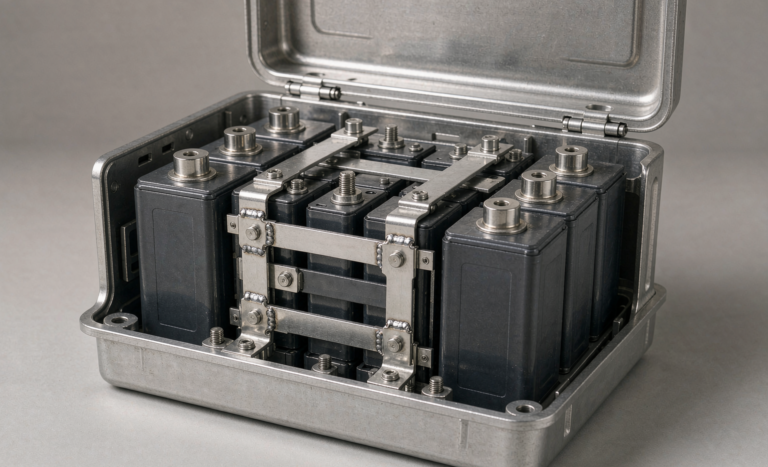
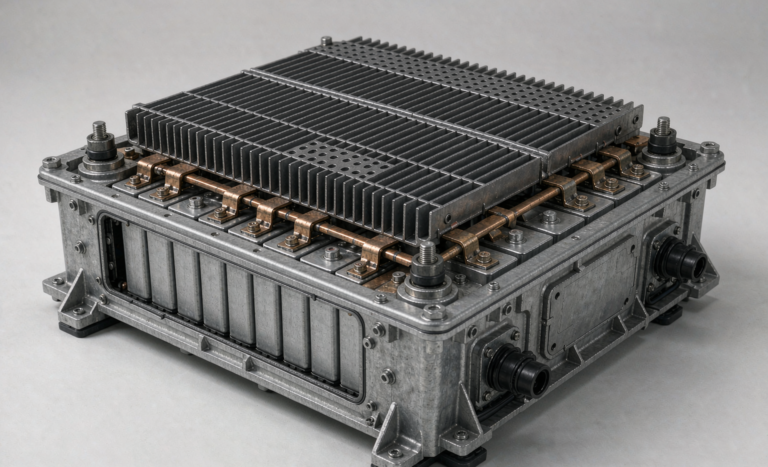
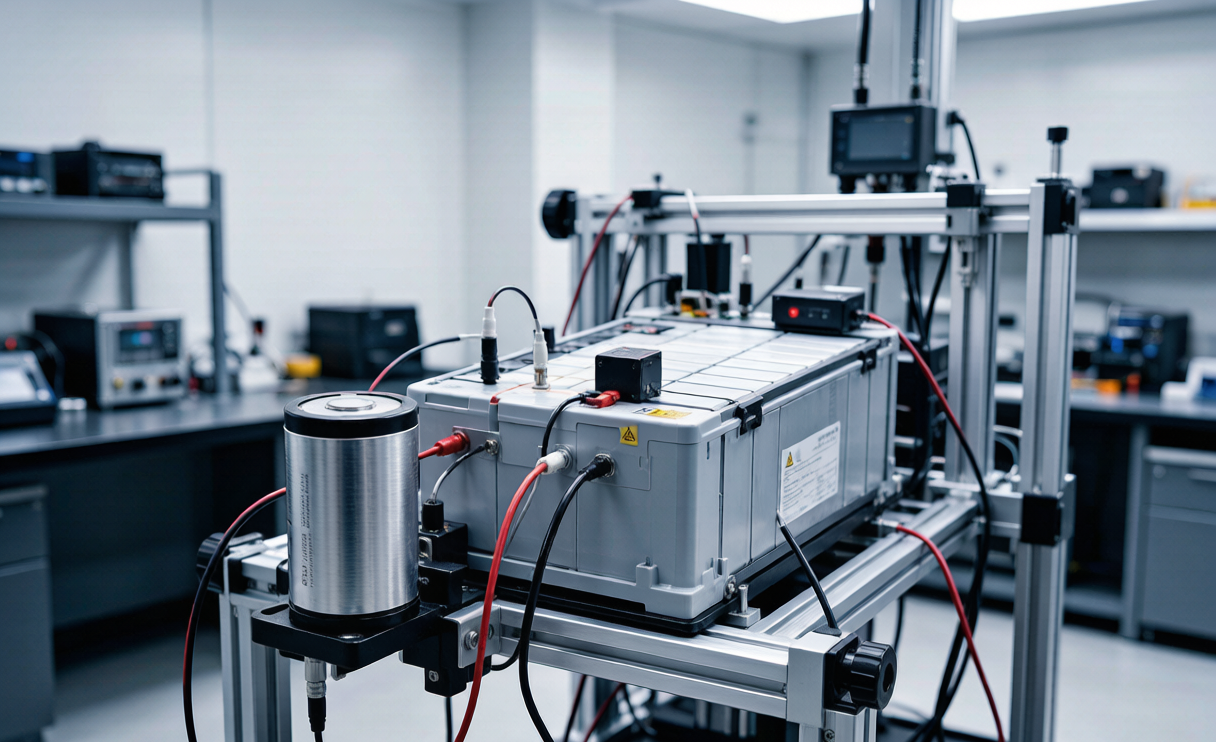
At pack level the battery management system becomes the primary safety device. We verify overcharge protection, over-discharge cut-off, over-current limits, temperature windows and cell balancing on every pack we build. Then we run propagation testing: if one cell enters thermal runaway, does the event cascade to its neighbours? Sodium-ion’s lower heat release gives us more design margin, but spacing, insulation and venting paths still decide pass or fail. I have watched two near-identical packs get opposite results purely because one used a 2 mm wider cell gap. For a sodium-ion battery in a drone or a forklift, that gap is the difference between a contained incident and a fire.
Air Transport: FAA and EASA Rules for Sodium-Ion
For air cargo, the IATA Dangerous Goods Regulations incorporate UN38.3, and both the FAA and EASA enforce it. Sodium-ion currently ships under the same Class 9 miscellaneous provisions that lithium uses, and carriers still expect a valid UN38.3 test summary before they accept the shipment. State-of-charge limits that apply to lithium cargo — often 30% SoC or less — should be confirmed with the carrier for Na-ion, because the dedicated UN number and SoC rules for sodium chemistry are still maturing. My standing advice to buyers: never assume; get the written confirmation from the airline before you book the flight. A sodium ion battery held at a cargo hub for missing paperwork costs more than the test ever did.
How We Build the Test Matrix at Horizon Power
Our internal process is deliberately boring, because boring is what passes audits:
- Step 1 — Sample plan. We pull A-grade and B-grade cells from a real production lot, never hand-picked heroes.
- Step 2 — Cell abuse. Nail, short, overcharge, thermal abuse on a statistically meaningful count.
- Step 3 — Pack with BMS. Propagation, over-current and environmental testing on finished packs.
- Step 4 — Documentation. A test summary and certificate per chemistry and construction, kept for the product’s life.
A full UN38.3 plus IEC 62133 / IEC 62619 campaign runs about six to ten weeks if the cells pass first time. Every re-test adds two to three weeks, so getting the cell design right up front is the cheapest speed you will ever buy. When a customer asks how soon their sodium-ion battery can be certified, my answer is always “however long it takes to get the cell right.”
What Buyers Should Verify Before Signing
When a supplier hands you a sodium-ion battery, ask for the actual UN38.3 test summary and the IEC certificate number, then check the certificate is for your exact cell construction, not a “similar” one. Confirm the BMS specification in writing, and ask which standard covers the pack you are buying. A certified cell in an uncertified pack is still an uncertified product, and that distinction has ended more than one shipment at the loading dock.
Frequently Asked Questions
Is a sodium-ion battery safer than lithium-ion?
Intrinsically, yes in some ways — no lithium plating, lower abuse temperatures — but it is not safe by default. Real safety comes from testing, a competent BMS and sound mechanical design, not from the chemistry name on the datasheet.
Does sodium-ion still need UN38.3 to ship?
Yes. Every cell and battery moved by any mode of transport requires UN38.3. There is no sodium exemption, and carriers will refuse loads without a valid test summary.
At what temperature does sodium-ion thermal runaway start?
Onset is typically 150 to 200°C depending on the cathode, well above the 0 to 60°C operating window. That wide margin is one of sodium-ion’s genuine safety advantages, but it is a margin, not a guarantee.
How long does a full safety certification take?
About six to ten weeks for UN38.3 plus IEC 62133 / IEC 62619, assuming first-time pass. Each re-test adds two to three weeks.
Can I reuse lithium test data for a sodium-ion product?
No. The standards require testing the actual chemistry and construction. A lithium dossier tells a certifier nothing about how your Na-ion cell behaves, and they will reject it.
Conclusion
Sodium-ion battery safety testing is mostly the same rigorous gauntlet we run on lithium, with a few chemistry-specific checks that reflect its different failure physics. The lower abuse temperatures are a real benefit, but they do not replace disciplined testing, a capable BMS and honest documentation. If you are specifying a sodium-ion battery for your product, ask for the certificates, verify the pack, and keep the UN38.3 summary on file — that is what turns a promising cell into a product you can actually ship.