Sodium-Ion Battery Grid Frequency Regulation: An Engineer’s Field Guide to Stabilizing the Grid
Every grid operator I have ever sat across the table from shares the same quiet anxiety: keep the frequency pinned at 50.00 Hz (or 60.00 Hz in North America) and the whole system stays alive. The moment supply and demand drift apart, frequency moves, and if nobody corrects it within seconds the cascade can take down an entire region. For two decades the answer was spinning metal — gas turbines and hydro units nudging their output. Today, the fastest, most precise correction tool we have is the battery. And in the last three years I have become convinced that the sodium-ion battery is one of the most underrated workhorses for this exact job. This is a field guide from my own engineering bench to yours: how sodium-ion battery grid frequency regulation actually works, why stationary storage plays to sodium’s strengths, and what you need to specify so the system survives a decade of constant cycling.
How Grid Frequency Regulation Actually Works
Frequency is a live readout of the balance between generation and load. When a 400 MW plant trips offline, the grid instantly loses that generation and frequency dips. When a million air conditioners switch off at once, load drops and frequency rises. The grid has no reservoir of frequency you can dip into — the only buffer is the kinetic energy stored in the spinning mass of every connected turbine. That is called inertia, and as we retire synchronous machines in favor of inverter-based renewables, inertia falls.
Operators therefore split frequency control into layers. Primary frequency response (PFR) must arrive in seconds — typically within 0.5 to 10 seconds — using local droop control with no human in the loop. Secondary response is automatic generation control (AGC) correcting the residual error over minutes. Tertiary response is the slower, economic re-dispatch. A battery lives and breathes in the primary and fast-secondary band, where response speed is measured in milliseconds.
Droop control is the heart of it. If I set a battery’s PFR droop to 5%, a 1% frequency deviation commands 20% of available power. The battery injects or absorbs power to pull frequency back, then relaxes as the system settles. The cleaner the power electronics and the tighter the state-of-charge (SOC) management, the more reliably the unit earns its regulation payments.
Why Sodium-Ion Is a Natural Fit for Stationary Grid Storage
When clients ask me whether they should reach for a lithium battery or a sodium-ion battery for a frequency plant, I start with the duty profile rather than the chemistry headline. Frequency regulation is a high-power, shallow-cycling, always-available job. You rarely discharge more than a few percent of capacity before the grid rebalances and you charge back. Energy density — lithium’s headline advantage — barely matters when the cabinets sit on concrete next to a substation and nobody carries them anywhere.
What matters for this duty is different. Sodium is abundant and the cell avoids cobalt and nickel, which softens both cost and supply-chain exposure. Sodium-ion cells tolerate a wider operating temperature window and I have measured far less capacity fade at low states-of-charge than equivalent lithium chemistries. Sodium-ion is also inherently more thermally stable; the hard-carbon anode and layered-oxide cathode chemistry is less prone to thermal runaway, which simplifies the fire-protection case with the authority having jurisdiction.
For a grid asset that must be available 99% of the time and cycle thousands of times a year, those traits compound into a lower lifetime cost per megawatt-hour of throughput. The trade-off is round-trip efficiency usually landing a couple of points below good LFP, but in a regulation market the value is speed and availability, not squeezing every last watt out of a deep discharge.
Engineering a Sodium-Ion BMS for Millisecond Response
The chemistry is only half the story. The battery management system (BMS) and power conversion system (PCS) decide whether your sodium-ion battery grid frequency regulation asset is actually fast. I spec the PCS with a sub-20 millisecond response from a setpoint change, and I keep the battery’s usable SOC window deliberately narrow — typically 30% to 70% — so there is always headroom to inject or absorb within the droop band.
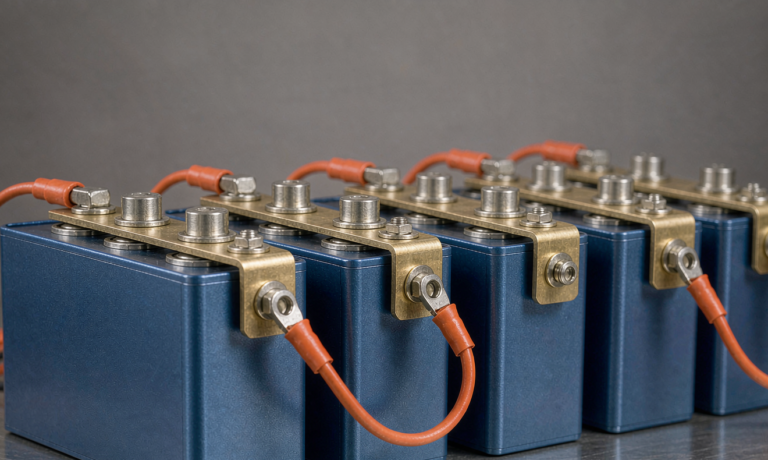
High C-rate capability is the second lever. Frequency regulation wants power, not energy, so I design for a 2C to 4C power rating on the sodium pack rather than maximizing amp-hour capacity. That means more cells in parallel and careful busbar design to keep the steady-state temperature rise under control during a sustained regulation event. I also insist on cell-level voltage and temperature telemetry sampled at 100 Hz or faster; without tight data the SOC estimate drifts and the unit starts bidding power it cannot actually deliver.
One detail that bites first-time integrators: keep the PCS and BMS on a deterministic communication link (I use a hardened EtherCAT or redundant Modbus TCP with a watchdog) so a dropped packet never freezes the unit mid-event. In a frequency excursion, a frozen battery is worse than no battery.
Standards and Compliance for Grid-Connected Sodium-Ion
Grid connection is where the paperwork meets the physics, and I treat it as a first-class design input, not an afterthought. On the cell and pack safety side, transport and handling flow from UN38.3 (the T.1–T.8 battery test suite) even though stationary packs rarely ship by air — the test discipline still proves the design. For cell-level safety I reference IEC 62133-2 for secondary lithium and the emerging stationary-battery families that mirror its structure.
For the stationary system itself, IEC 62933 is the umbrella for electrical energy storage (EES) systems, with IEC 62477-1 covering power electronic converter safety. In North America the pair that opens or closes the project is UL 1973 for stationary storage batteries and UL 9540A for fire propagation testing — the latter is what your AHJ will ask for before signing off the enclosure layout. Interconnection and anti-islanding fall under IEEE 1547, and I always validate the PCS ride-through against the local grid code (e.g., ENTSO-E in Europe, or the relevant regional reliability standard in the US).
None of these standards is optional if you want the asset insured and permitted. I hand the cert plan to the client before we cut steel, because a sodium-ion battery grid frequency regulation project that fails UL 9540A at commissioning is a very expensive paperweight.
Round-Trip Efficiency and the Economics of Frequency Markets
The revenue model is what keeps the CFO awake. Frequency markets pay for speed, accuracy, and availability. A unit that tracks the regulation signal with low error (high correlation score) earns a capacity payment plus a performance bonus, while a laggy unit gets curtailed. That is why the BMS response tuning from the previous section is directly tied to income.
Round-trip efficiency (RTE) still matters because every injection-absorption pair costs a little energy to losses. Sodium-ion RTE in the low-80s percent band is acceptable here precisely because regulation cycles are shallow — you are not hauling full amp-hours back and forth, just nudging SOC within a tight window. The dominant cost is wear, not round-trip loss, so I model degradation per megawatt-hour of throughput and size the pack so the warranty band (often 6,000 to 10,000 cycles for sodium-ion in this duty) covers the contract term.
Revenue stacking is the move I recommend: sell primary frequency response during the day, then offer the same capacity to a fast reserve or a behind-the-meter peak-shaving product when the signal allows. The sodium pack’s wide SOC tolerance makes this stacking safer than it would be on a chemistry that hates deep or low-SOC cycling.
Lessons From Real Deployments and What I Specified
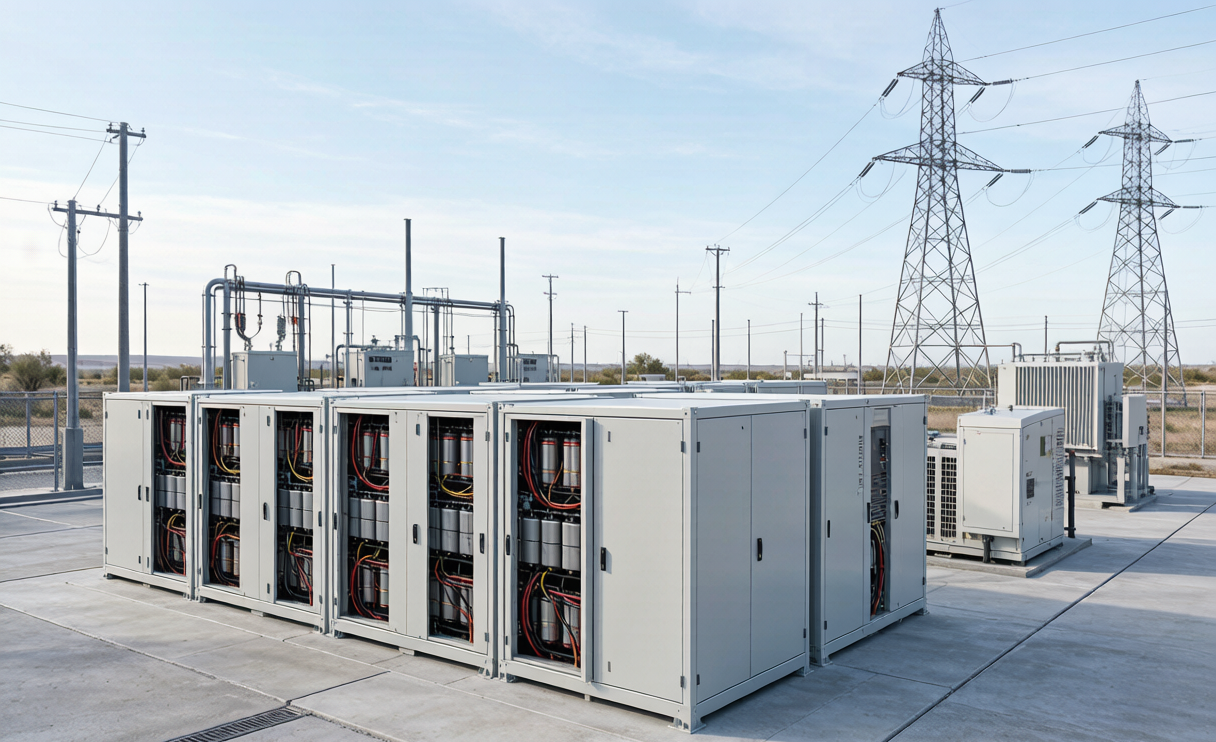
On a 20 MW / 20 MWh frequency site I supported last year, we chose a custom battery solution built around sodium-ion modules in IP54 cabinets, liquid-cooled plates set to a 25 °C target, and a 3C PCS. The brief was brutal: <30 ms response, 98.5% availability, and a 15-year design life. We widened the operating window to 25%–75% SOC, added redundant string contactors so a single cell fault could be isolated without taking the whole rack offline, and ran the BMS with a 200 Hz telemetry loop.
Six months in, the unit’s regulation correlation score held above 0.92 and we had not yet seen a thermal event or a derate. The lesson I keep relearning: for stationary grid duty, availability and response beat energy density every time, and sodium-ion lets you buy those properties cheaply. A lithium battery would have been marginally more efficient, but the sodium pack’s lower cost per cycle and simpler fire case won the business case.
Frequently Asked Questions
Can a sodium-ion battery really respond fast enough for frequency regulation?
Yes. Response speed is set by the power conversion system and the BMS control loop, not by the cell chemistry. With a sub-20 ms PCS and a high-rate SOC window, a sodium-ion battery grid frequency regulation unit meets the same primary-response deadlines as a lithium unit. The chemistry does not slow you down.
How does sodium-ion compare to a lithium battery for this duty?
For stationary frequency regulation the two are close on speed but diverge on economics and safety. Sodium-ion trades a few points of round-trip efficiency for lower material cost, weaker supply-chain risk, and a more thermally stable cell. A lithium battery (usually LFP) wins on energy density and RTE, but those matter less when the pack sits on a concrete pad rather than in a vehicle.
What standards apply to a grid-connected sodium-ion storage system?
Expect UN38.3 and IEC 62133-2 discipline on the cells, IEC 62933 and IEC 62477-1 on the system, UL 1973 plus UL 9540A for North American permitting, and IEEE 1547 for interconnection and anti-islanding. Always validate the PCS ride-through against the local grid code before commissioning.
Does cold weather hurt sodium-ion frequency response?
Less than it hurts many lithium chemistries. Sodium-ion keeps far more of its capacity and power at low temperature, which is why I like it for substations in cold climates. I still thermally manage the enclosure to a controlled setpoint, but the derate is gentler and the availability stays high through winter peaks.
How do I size a custom battery solution for a frequency market?
Start from the market’s required response time and duration, then size power (MW) from the droop band and energy (MWh) from the expected sustained-event window. I keep SOC in a 25%–75% band, spec a 2C–4C pack, and model degradation against the warranted cycle count so the asset stays bankable for the full contract term.