Home Energy Storage for New Construction Builds: An Engineer’s Design Guide
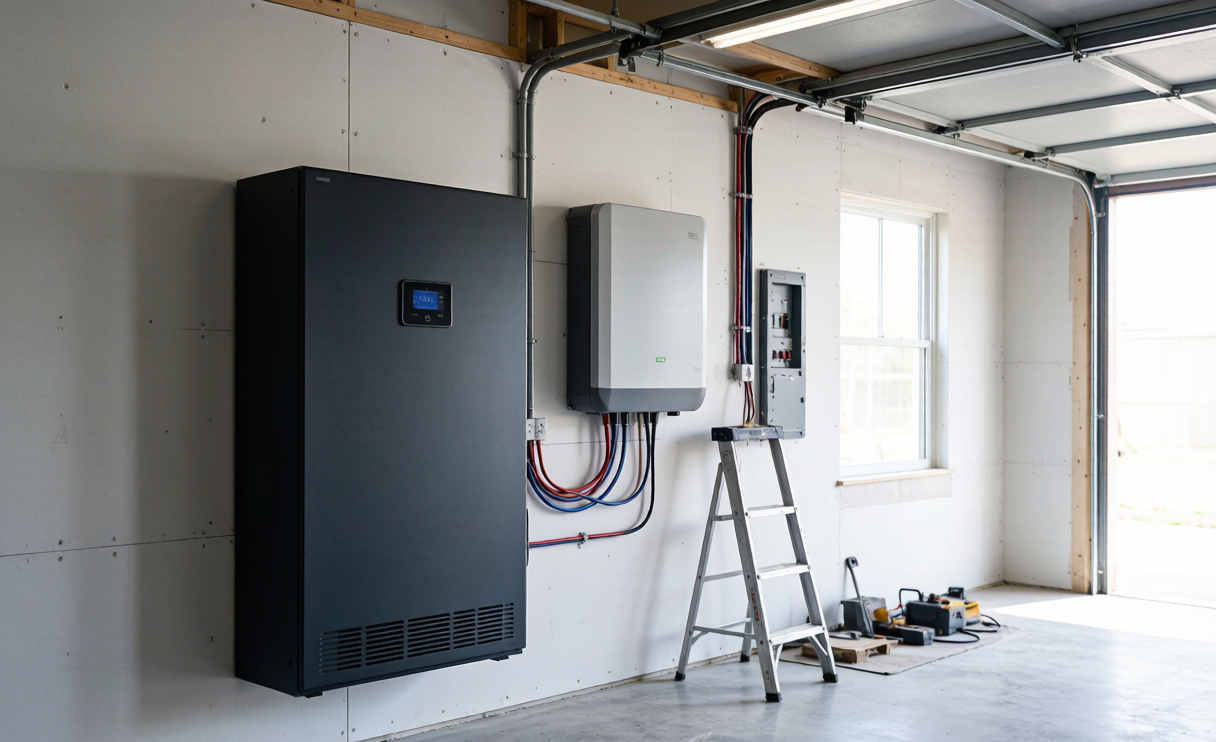
Every year I get called into a handful of projects where a builder has already poured the slab, framed the walls, closed up the drywall, and only then asked where the battery goes. I am Karl Huang, a senior lithium battery engineer, and I have spent the better part of a decade specifying cells, packs and enclosures for residential and light-commercial deployments. The single most expensive mistake I see in this segment is treating home energy storage new construction build planning as a retrofit problem. It is not. When storage is designed into a house at the electrical rough-in stage, the installed cost drops by roughly 20 to 35 percent compared to bolting the same system onto a finished home, and the thermal and safety performance is measurably better.
This article walks through what I actually specify on new-build projects: where the battery lives, how the enclosure and cell chemistry interact with the building envelope, which standards the inspector will hold you to, and the design details that separate a system that runs for fifteen years from one that starts throwing balancing faults in year three.
Why New Construction Changes the Entire Storage Equation
A home energy storage system designed alongside the house behaves like a different product from the same hardware installed afterwards. In a retrofit, the battery is a guest. It has to accept whatever wall, whatever panel location, whatever ambient temperature the existing house offers. In a new build, the battery is a design input, and that inverts the whole engineering conversation.
Three things become cheap when you plan early. First, conductor runs. On a retrofit I routinely see 12 to 18 metres of oversized DC or AC cable snaking through an attic because that was the only viable path. On a new build with the storage location fixed before rough-in, that same run is typically 3 to 5 metres. At 48 V DC and a 100 A continuous discharge, every extra metre of undersized copper costs real round-trip efficiency — roughly 0.3 to 0.5 percent per metre pair on a marginal conductor. Over a fifteen-year life at 250 full cycles a year that is thousands of kilowatt-hours simply heating a wall cavity.
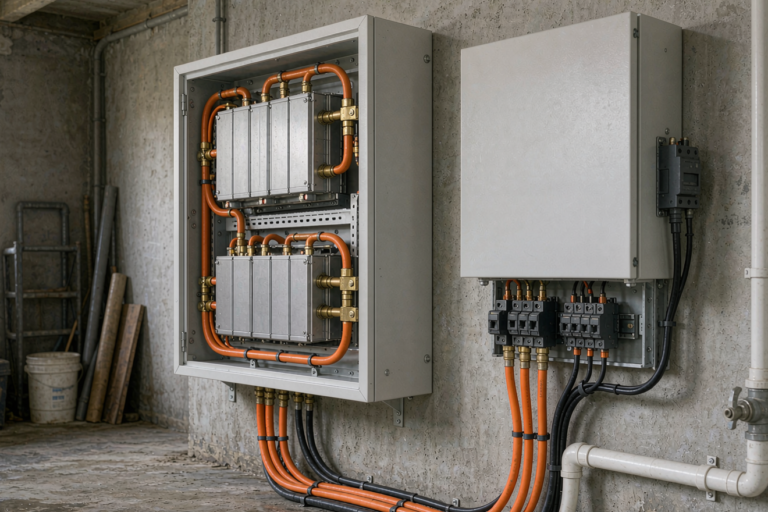
Second, the critical loads subpanel. Retrofits almost always require a second panel and a load-shedding contactor because the original panel was never split between essential and non-essential circuits. On a new build the electrician simply lands the refrigerator, well pump, furnace blower, network gear and selected lighting circuits on a dedicated backup panel from day one. That is a few hundred dollars of extra breakers rather than a full panel swap.
Third, thermal siting. This is the one that matters most for cell life and the one builders understand least. A lithium battery pack degrades roughly twice as fast for every 10 °C rise above 25 °C in sustained storage temperature. Putting a cabinet on a west-facing uninsulated garage wall in a hot climate is not a code violation — it is simply a decision to buy a new battery in year eight instead of year fifteen.
Chemistry Selection: Why LFP Dominates Residential New Builds
For residential fixed storage I specify lithium iron phosphate (LFP) in essentially every case, and I want to be precise about why, because the reasoning is different from what drives drone battery or portable pack design.
In a drone battery the dominant constraint is gravimetric energy density — every gram of pack mass is a gram not carried as payload, so high-nickel NMC and its 250 to 300 Wh/kg wins despite a narrower thermal margin. A house does not fly. Volumetric density matters somewhat; gravimetric density barely matters at all. What matters in a fixed installation is cycle life, thermal runaway onset temperature, and calendar ageing.
The numbers that drive my recommendation:
- Cycle life: quality prismatic LFP cells deliver 4,000 to 6,000 cycles to 80 percent state of health at 0.5C and 25 °C. Comparable NMC in the same duty cycle lands around 2,000 to 3,000.
- Thermal runaway onset: LFP typically initiates around 200 to 270 °C versus roughly 150 to 210 °C for NMC, and LFP decomposition releases far less oxygen, which materially changes how a fire propagates inside a dwelling.
- Calendar ageing: at 25 °C and 50 percent state of charge, well-managed LFP loses roughly 1.5 to 2.5 percent capacity per year of pure calendar ageing.
- Cost stability: LFP avoids cobalt entirely, which has kept its cost curve considerably less volatile.
The honest trade-off is cold weather. LFP charge acceptance below 0 °C is poor, and charging a lithium battery below freezing causes lithium plating on the anode — permanent, irreversible capacity loss and a genuine safety hazard. Any pack I sign off on for a cold-climate new build includes either integrated self-heating film with BMS-gated charge inhibit below 0 °C, or a conditioned installation space. This is a solvable problem, but it must be solved at specification time, not discovered in January.
Siting and Enclosure: The Details That Survive Inspection
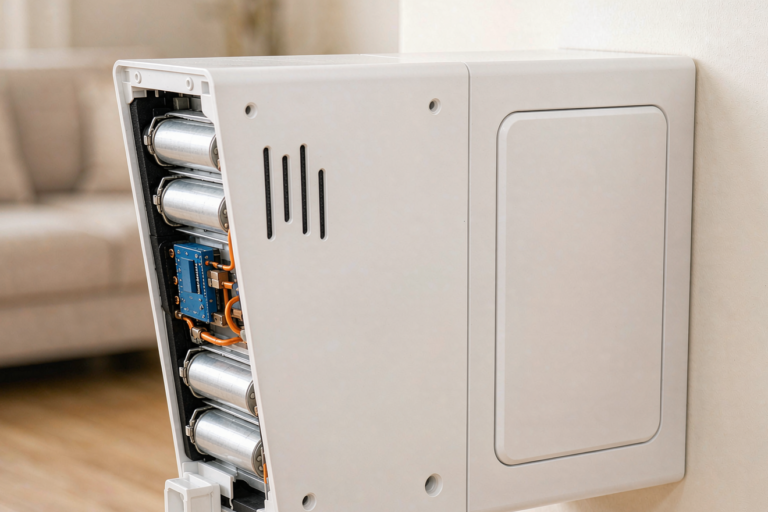
Where the home energy storage cabinet physically goes drives more of the project cost than the cells themselves. My decision hierarchy for a new build, in order of preference:
- Conditioned interior utility room adjacent to the service entrance. Best thermal environment, shortest conductor runs, easiest service access.
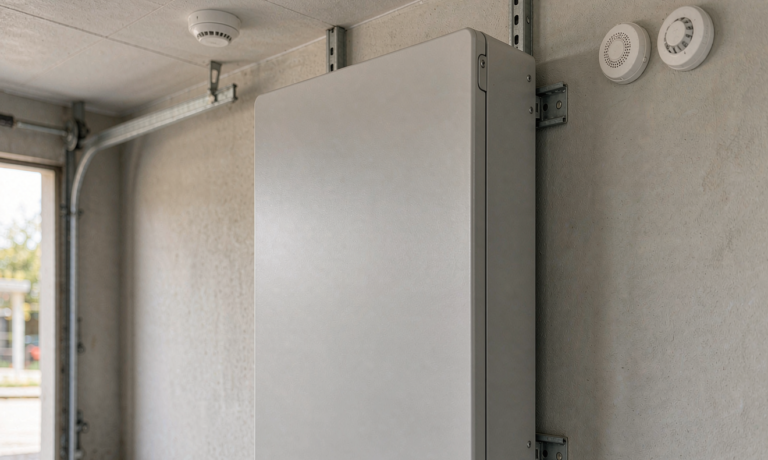
- Attached garage, interior-facing insulated wall. Acceptable in most climates provided the wall assembly is rated appropriately and the space is not subject to extreme swings.
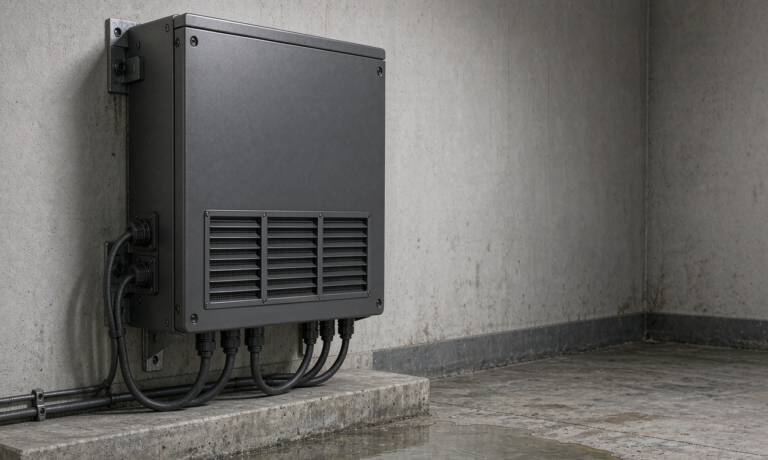
- Exterior wall-mount in an IP65-rated enclosure with a shade hood. Workable, but expect a 3 to 8 percent annual throughput penalty in hot climates from thermal derating.
- Unconditioned attic. I decline these. Summer attic temperatures of 50 to 65 °C will destroy a residential pack.
Separation distances are where inspectors focus. The prevailing residential energy storage provisions limit individual units to 20 kWh with an aggregate cap that varies by jurisdiction, require a minimum separation between units, and mandate that battery cabinets not be installed in sleeping rooms or in the closets and spaces opening directly into them. Design the utility room with the clearances drawn on the plan set — arguing them after drywall is a losing position.
One detail builders forget: structural blocking. A 15 kWh wall-mounted LFP cabinet weighs 120 to 160 kg. That load needs solid blocking between studs specified during framing. Retrofitting blocking into finished drywall is ugly and expensive.
Standards and Compliance: What Actually Gets Checked
The compliance stack for a residential system is deeper than most builders expect, and I would rather have this conversation at permit stage than at final inspection.
Cell and pack level. Cells should carry IEC 62133-2 certification for the lithium secondary cell safety baseline. For the stationary system I look for UL 1973, which is the standard for batteries used in stationary and motive auxiliary power applications and covers electrical, mechanical, environmental and abuse testing at the pack level. IEC 62619 serves a similar role for industrial secondary lithium applications in markets that follow IEC.
System and fire behaviour. UL 9540 covers the complete energy storage system including inverter and controls, and UL 9540A is the large-scale fire propagation test method. UL 9540A is not a pass/fail certification — it is a test methodology that generates data authorities having jurisdiction use to set installation separation and location requirements. If a supplier tells you they “passed UL 9540A,” ask to see the report, not the claim.
Transport. Every lithium battery pack shipped to the jobsite must have UN 38.3 qualification covering the eight-test sequence — altitude simulation, thermal cycling, vibration, shock, external short circuit, impact or crush, overcharge and forced discharge. This is non-negotiable for any freight movement, and a missing UN 38.3 test summary will strand your pallet at a freight terminal.
Grid interconnection. In North America, IEEE 1547-2018 defines distributed energy resource interconnection performance, and UL 1741 SA/SB certifies inverter compliance with the required grid-support functions. Utilities increasingly require this documentation before granting permission to operate.
Worth noting for anyone reading this from the aviation side of our business: the FAA Part 107 and EASA transport-of-dangerous-goods rules that govern a drone lithium battery in the field are a separate regime entirely. A house battery and a flight pack share cell chemistry ancestry and almost nothing else in their compliance path.
Sizing the System Against Real Load Data
Sizing by rule of thumb produces systems that are either wastefully oversized or disappointing in an outage. I size against three separate numbers, and they are not the same number.
Backup energy requirement. Sum the daily kilowatt-hours of the loads on the critical panel and multiply by the target autonomy in days. A typical single-family critical load set — refrigeration, well pump, furnace blower, lighting, networking, a few outlets — runs 4 to 8 kWh per day. Two days of autonomy therefore implies 8 to 16 kWh of usable capacity. Note usable: an LFP pack rated 15 kWh nominal at a 90 percent depth of discharge limit gives 13.5 kWh usable, and you should not plan around the nameplate.
Peak power requirement. This is where systems fail in practice. A well pump or an air conditioning compressor draws a locked-rotor inrush of 3 to 7 times running current for 100 to 300 milliseconds. If the inverter cannot deliver that surge the motor stalls and the system faults. Check the continuous rating and the surge rating separately, and confirm the surge duration window.
Solar self-consumption or arbitrage requirement. If the house has PV, the battery should be able to absorb the midday export surplus. On a 10 kW array in a good solar region that surplus is commonly 15 to 25 kWh on a clear day, which usually means the arbitrage sizing exceeds the backup sizing.
I take the largest of the three, then add 10 to 15 percent headroom for capacity fade so the system still meets its design intent in year ten. On multi-unit or unusual load profiles this is where a custom battery solution earns its keep — a standard 10 or 15 kWh module simply may not map onto the actual demand curve, and forcing it to fit wastes both capacity and money.
Wiring, Balancing and Commissioning
A few engineering details that matter far more than their line-item cost suggests.
Conductor sizing and voltage drop. Design DC runs for under 1 percent voltage drop at maximum continuous current, not the 3 percent the code allows. The code number is a safety floor; the 1 percent target is an efficiency decision that pays back over the system life.
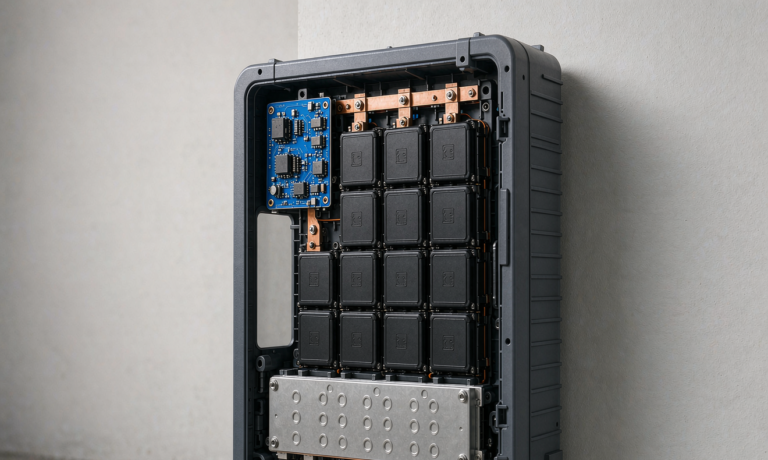
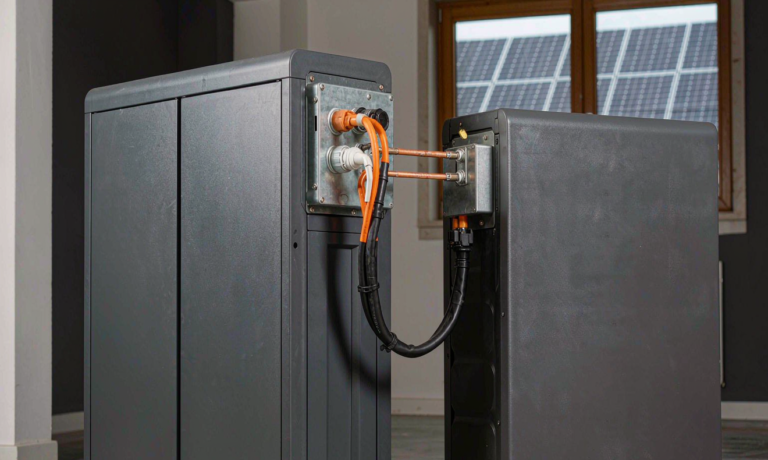
Cell balancing architecture. Passive balancing — bleeding charge off high cells through resistors — is standard and adequate for residential duty where balance currents of 50 to 200 mA can correct drift over normal cycling. Active balancing, which shuttles charge between cells, is worth specifying on larger packs or where deep partial-state-of-charge operation is expected. What matters more than the topology is whether the BMS logs per-cell voltage and reports drift. A pack whose cell delta grows past 50 mV at rest is telling you something, and you want to hear it before it becomes a capacity problem.
Communications. Specify the BMS-to-inverter protocol at purchase order stage. CAN bus at 500 kbps is the common denominator, but the message set is vendor-specific and mismatches are the single most common commissioning delay I encounter. Confirm the specific inverter model is on the battery vendor’s compatibility list in writing.
Commissioning record. Capture a baseline at handover: full-charge per-cell voltages, internal resistance if the BMS reports it, a timed capacity discharge, and the firmware versions of both BMS and inverter. This baseline is what makes a warranty claim provable four years later.
Frequently Asked Questions
How much does it cost to include home energy storage in a new construction build?
Integrating storage at the design stage typically runs 20 to 35 percent below an equivalent retrofit, because you avoid panel replacement, long conductor runs, drywall repair and structural remediation. The battery hardware cost is the same; the installation labour and ancillary work is what shrinks. Budget the storage as part of the electrical package rather than as a later add-on.
Should I run the whole house off the battery or just critical loads?
For the vast majority of homes, a critical loads subpanel is the right answer. Whole-home backup requires both the energy capacity to carry the full load and the inverter power to handle simultaneous surges, which commonly doubles or triples the system cost. The exception is a home with a very well-behaved load profile and no large motor loads. Decide this before rough-in, because the panel layout follows from it.
What temperature range does a residential lithium battery need?
Target a sustained 15 to 30 °C ambient. Discharge is generally permitted from around −20 to 55 °C, but charging below 0 °C must be blocked by the BMS or gated behind an integrated heater to prevent lithium plating. Sustained operation above 35 °C accelerates calendar ageing significantly — roughly doubling the degradation rate for each 10 °C above 25 °C.
Can the same battery technology be used for both my house and my equipment fleet?
The cell chemistry family overlaps but the pack engineering does not. A drone lithium battery optimises for gravimetric energy density and high discharge rate with a deliberately short service life, while a home pack optimises for cycle life, thermal margin and cost per kilowatt-hour. They also fall under entirely different certification and transport regimes. If you need both, treat them as two separate specifications from a supplier capable of delivering a custom battery solution in each domain.
How long will a new-build home battery actually last?
A properly sited LFP system cycled once daily at moderate depth should retain 70 to 80 percent of original capacity after 10 to 15 years. The dominant variables are temperature and depth of discharge, not the brand on the cabinet. Most residential warranties reflect this with a 10-year term and a 70 percent end-of-warranty capacity guarantee, often with a throughput cap expressed in megawatt-hours — read that cap, because on a heavily cycled arbitrage system it can bind before the calendar term does.
What should be in the plan set before the permit application?
Battery location with dimensioned clearances, structural blocking detail, the critical loads panel schedule, conductor sizes and routing, the disconnect locations and labelling, and the certification listings for the cells, the pack and the complete system. Include the UL 9540A test report reference if the jurisdiction requires it. Submitting a complete package the first time typically saves several weeks in the permit cycle.
Closing Thoughts
The pattern I have seen across dozens of projects is simple: the technical performance of a residential storage system is decided long before anyone energises it. Chemistry choice, siting temperature, conductor length, panel architecture and structural blocking are all locked in at the framing and rough-in stage, and every one of them is cheap to get right then and expensive to fix later. Builders who treat storage as part of the electrical design rather than an appliance delivered at the end consistently end up with systems that cost less, perform better and last longer.
If you are specifying storage for a development or a custom home and want a second set of eyes on the sizing and enclosure strategy, that is the conversation I most enjoy having — ideally while the walls are still open.