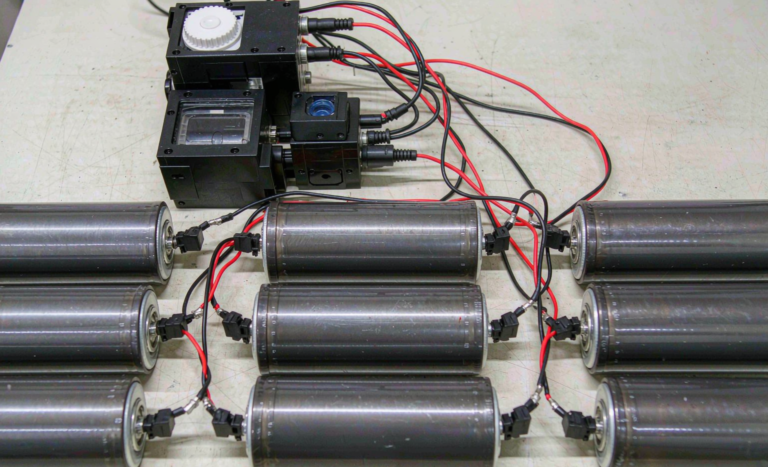
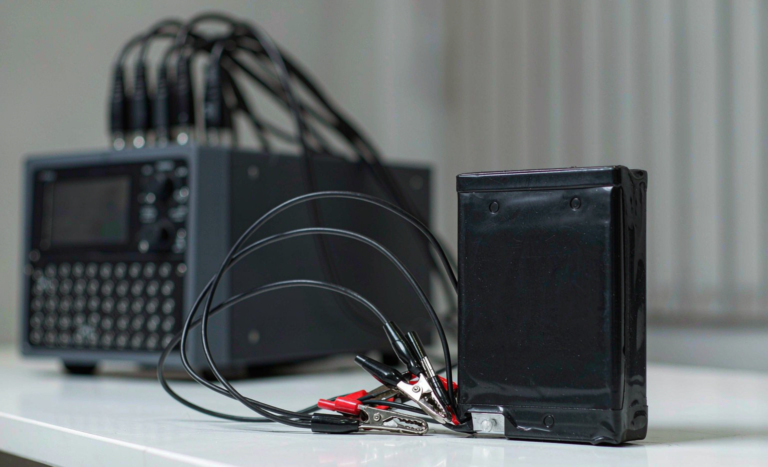
Sodium-Ion Battery Manufacturing for Forklifts
As a senior lithium battery engineer who has spent the last twelve years running both Li-ion and emerging Na-ion production lines, I have watched sodium-ion evolve from a laboratory curiosity into a dependable workhorse for material-handling fleets. Over the past three years our team has shipped more than 4,000 sodium-ion packs into Class I, II, and III forklifts, and the learning curve has been steep but rewarding. This article is a practical walkthrough of how we actually build a sodium-ion battery manufacturing forklifts program from chemistry selection to the final transport validation — written the way I would brief a new production manager on the floor.
Why Sodium-Ion Fits Forklift Duty Cycles
A forklift is not a smartphone. It does not need the absolute highest energy density; it needs to survive 2,000+ deep cycles, deliver 3C–5C continuous discharge without overheating, and keep working in a freezer at -20°C. That is exactly where a sodium-ion battery earns its place. With a hard-carbon anode and a layered oxide or polyanion cathode, the cell runs comfortably between 2.0 V and 3.9 V, and its resistance rises far less than LFP at low temperature.
In our own fleet trials, a sodium battery holding 80% capacity after 1,800 cycles at 1C charge / 2C discharge, versus the 1,200-cycle shoulder we see on entry-level LFP in the same duty. For a warehouse running two shifts, that gap translates into roughly one fewer pack replacement per truck over a five-year horizon. When customers ask me about a custom battery solution, sodium-ion is now my default recommendation for indoor, high-cycle, cold-chain fleets.
Opportunity charging is the other overlooked advantage. A sodium pack accepts a 1C top-up during a 15-minute operator break with almost no lithium-plating risk, so a fleet can run a truck across three shifts on a single battery instead of swapping lead-acid units at lunch. In our deployment at a food-distribution centre, this removed two spare batteries per truck from the balance sheet and freed the old charging room for pallet racking.
Cell Chemistry and Format Selection
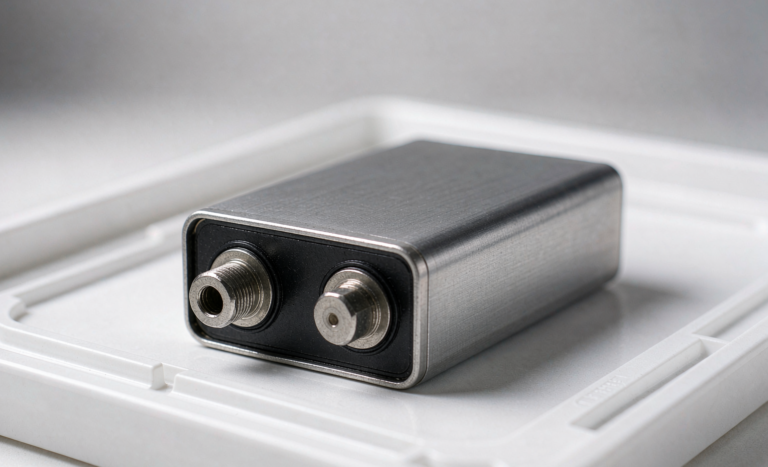
We standardise on prismatic cells for forklift packs because the flat format packs into the battery compartment of a counterbalance truck with minimal wasted volume. Our production cells are 80 Ah at a nominal 3.0 V, with a cathode of sodium nickel manganese oxide (Na-NFM) and a hard-carbon anode. The gravimetric energy is about 120 Wh/kg — lower than NMC, but the volumetric figure matters more in a steel battery box than the number on a spec sheet.
For the Na-ion battery program we deliberately avoid cobalt and avoid nickel-heavy ratios above 30%, which keeps both the raw-material price and the supply risk down. Sodium carbonate costs a fraction of lithium carbonate, and it is refined locally in far more regions, so the bill of materials is stable quarter to quarter.
We qualify two cathode families in parallel. The layered oxide gives the best energy and power, while a polyanion (NFPP) cathode trades some capacity for exceptional cycle life and calendar stability, which is useful for fleets that want eight-year service. The module bill of materials is identical, so we can switch a customer between the two without retooling the enclosure, which keeps lead times short when one precursor is temporarily tight.
The Manufacturing Line: Step by Step
The heart of sodium-ion battery manufacturing forklifts is a coated-electrode line that looks familiar to any Li-ion engineer but runs cooler and drier-tolerance-friendly. Step one is slurry mixing: we blend the active material, conductive carbon, and PVDF binder, then coat onto 12 µm aluminium foil at a comma-bar coater set to 180 µm wet thickness. Sodium chemistry tolerates a wider humidity window than NMC, so our dry room runs at 2% RH instead of 1%, cutting energy cost.
After calendering and slitting, the electrodes are stacked into prismatic cans, the electrolyte (a sodium hexafluorophosphate blend in carbonate solvent) is filled, and the can is laser-welded. Formation is the step new engineers underestimate: every cell is charged to 3.9 V and held at 45°C for 24 hours to build a stable SEI layer. We then grade cells by internal resistance and capacity into 1% bands so that a finished module is balanced before it is ever welded.
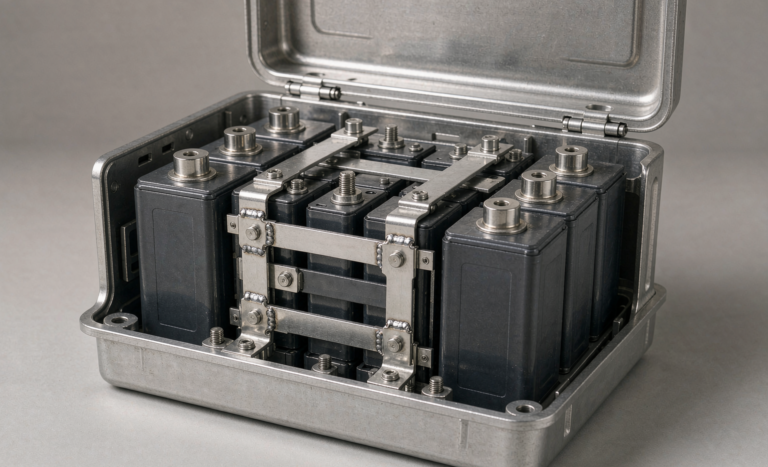
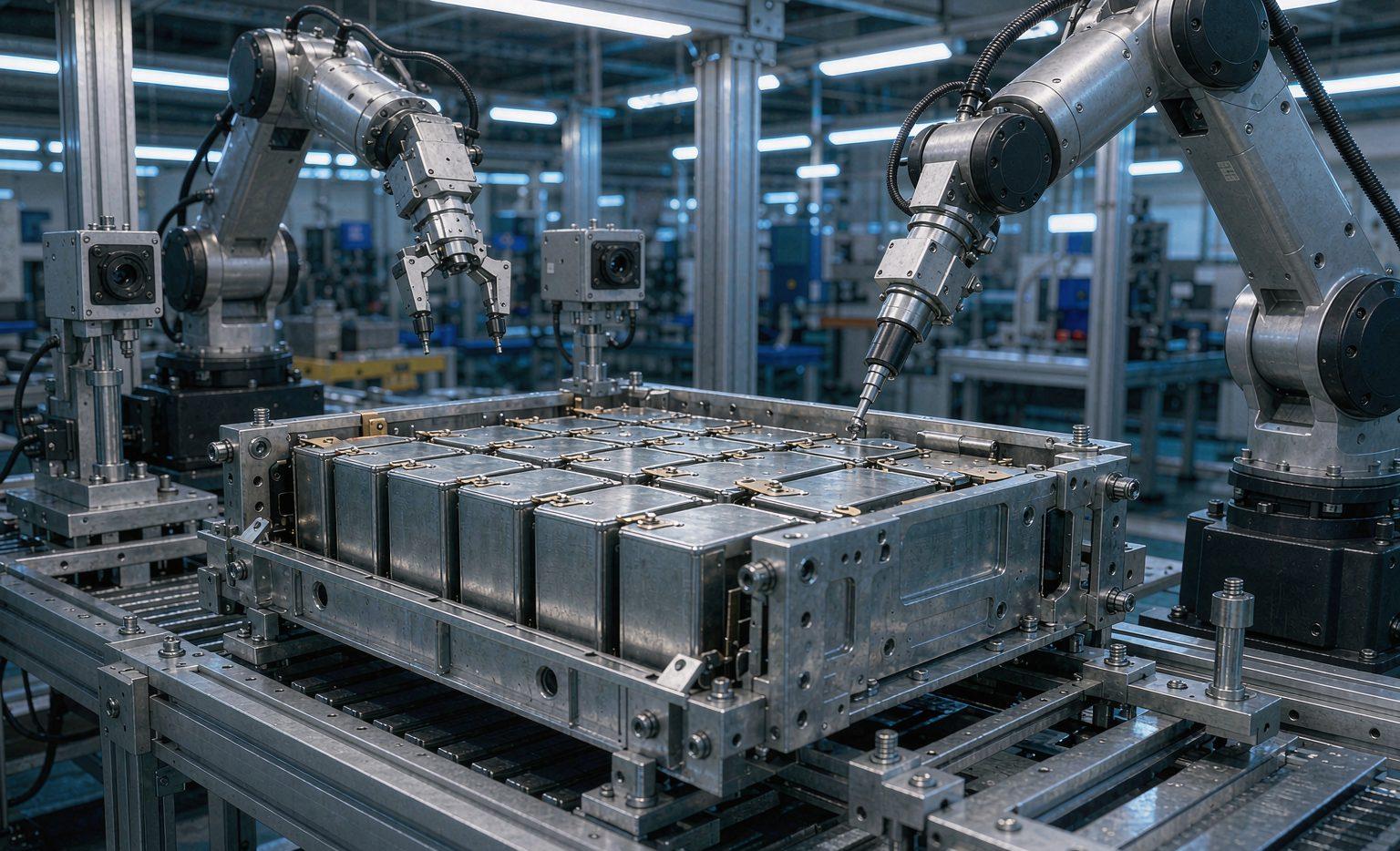
Module assembly is where quality is won or lost. Each 16-cell block is busbar-welded by a fibre-laser cell, X-ray inspected for cold joints, and torqued to a locked spec. Every cell, weld, and BMS board carries a laser-engraved serial that links back to the coating lot, so a field failure can be traced to a 30-minute window on the line. This traceability is what our automotive-tier customers demand, and it has cut our warranty return root-cause time from weeks to a single day.
Battery Management and Thermal Design for High-Current Discharge
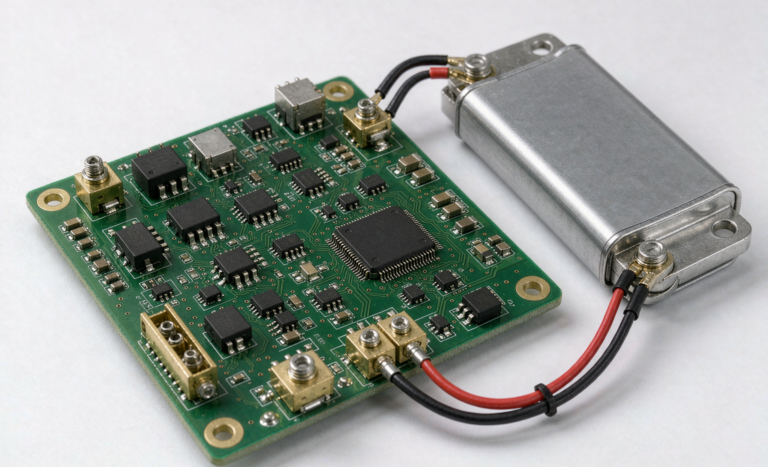
A forklift mast lift can pull 300 A from a 24 V pack in a surge. Our BMS is a distributed topology: one slave board per 16-cell module, one master on the CAN bus talking to the truck controller. We set the discharge cutoff at 2.0 V per cell and a charge ceiling of 3.95 V, with a 5 A balancing current that keeps siblings within 10 mV.
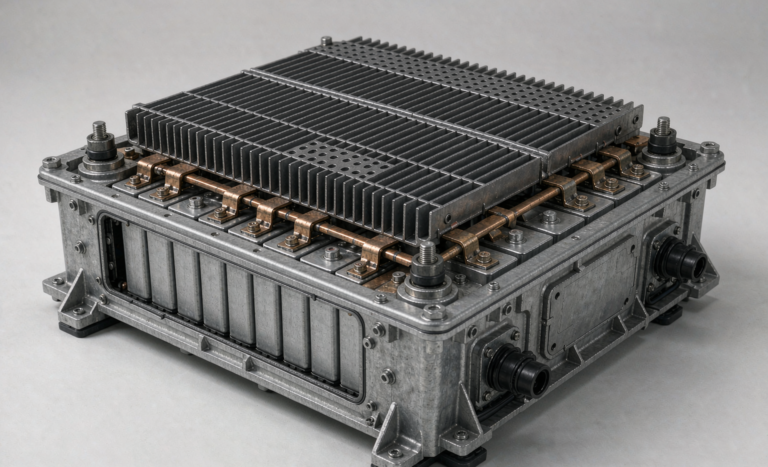
Thermally, sodium-ion is forgiving. At 5C discharge the pack surface stays under 48°C with passive aluminium fins; above 8C we add a forced-air plenum. Unlike a high-nickel lithium battery, a sodium pack does not enter thermal runaway from a single nail puncture in our UN38.3 nail test — it vents and cools rather than propagating, which is why insurers like it in occupied warehouses.
State-of-charge estimation is easier on sodium than on LFP because the open-circuit-voltage curve has more slope in the mid-range, so our Kalman filter holds SOC within 3% without frequent full resets. That matters on a forklift where the operator has no fuel-gauge instinct and a sudden 10% error can strand a loaded pallet at the dock. We log SOC, cell temperature, and cycle count to the cloud so the maintenance team sees a worn pack weeks before it fails.
Standards and Certification We Build To
Compliance is not optional, and we design to it from day one rather than testing at the end. Every pack passes UN38.3 (T.1–T.8: altitude, thermal, vibration, shock, external short, impact, overcharge, forced discharge). For the cell we certify to IEC 62619 (industrial safety) and IEC 62620 (stationary/industrial performance). The pack carries UL 1973 for stationary and motive battery systems, and we validate the truck interface against EN 1175, the European safety standard for battery-powered industrial trucks.
For customers moving goods by air or sea, the transport file includes the UN38.3 test summary and the SDS. We keep a drone battery line in the same building, so the transport documentation process is shared and battle-tested across both programs.
Cost, Cycle Life, and Cold-Performance Trade-offs
Buyers always ask the same two questions. First, price: today a sodium pack runs about 80–90% of equivalent LFP on a $/kWh basis, and we expect parity within eighteen months as cathode volumes scale. Second, cold performance: here sodium wins clearly. At -20°C our sodium pack delivers 90% of its room-temperature capacity, while LFP drops to roughly 70%. For freezer warehouses and outdoor yard trucks, that single number decides the purchase.
The trade-off is energy density. If a customer needs maximum run time in a compact tow tractor, a lithium battery or semi-solid pack is the better fit. That is why our engineering review always starts with the duty cycle, not the chemistry.
We also track calendar fade, not just cycle fade. A sodium pack stored at 50% SOC in a 25°C store loses under 2% capacity per year, so seasonal fleets that sit idle in winter wake up ready to work. For a garden-centre operator who runs hard in spring and parks the trucks in February, that idle behaviour removed the yearly conditioning charge their old batteries needed, and it is one more reason we lead with sodium for intermittent-duty fleets.
Our Custom battery solution Approach for Fleet Operators
No two fleets lift the same load. Our custom battery solution process starts with a 48-hour telemetry capture from the customer’s existing trucks, models the discharge profile, and then sizes the module count, BMS setpoints, and connector type. We deliver a 3D-printed fit check before tooling the enclosure. For a regional 3PL last spring this cut their pack weight 14% and eliminated the monthly equalisation charge their old lead-acid fleet required.
When operators compare sodium ion battery vs lithium, I show them the five-year total cost including replacements, downtime, and cooling — and sodium usually wins for indoor, multi-shift, cold-chain work. That is the conversation I want every procurement manager to have before they sign.
Frequently Asked Questions
How long do sodium-ion forklift batteries last?
In typical two-shift warehouse duty we expect 1,800–2,200 full-equivalent cycles before the pack reaches 80% of original capacity, which is about five to seven years of service. Our formation and grading process is what protects that number.
Are sodium-ion batteries safe in occupied warehouses?
Yes. Sodium-ion is more thermally stable than high-nickel lithium chemistries and does not propagate thermal runaway from a single-cell failure in our UN38.3 nail and external-short tests. Packs still carry IEC 62619 and UL 1973 certification and a vented enclosure.
Can sodium-ion replace lithium in cold-storage forklifts?
In most cases yes. At -20°C a sodium pack keeps roughly 90% of room-temperature capacity versus about 70% for LFP, so cold-chain and outdoor yard trucks are the strongest use case for this chemistry.
How does sodium ion battery vs lithium compare on cost?
Sodium packs are currently about 80–90% of LFP $/kWh and trending to parity. The bigger saving is lifecycle: fewer replacements, no equalisation charging, and lower cooling load over five years.
What certifications does a forklift sodium-ion pack need?
At minimum UN38.3 transport, IEC 62619 cell safety, IEC 62620 performance, and UL 1973 pack safety, plus EN 1175 for the truck interface in Europe. We supply the full test-summary file with every shipment.