Sodium-Ion Battery Safety for Forklifts: An Engineer’s
I am Karl Huang, Senior lithium battery Engineer at Horizon Power. Over nine years I have signed off on motive-power packs for Class I, II and III electric industrial trucks, and forklift batteries fail differently than almost anything else we build. A drone battery gets treated like a precision instrument. A forklift pack gets slammed into rack uprights, hosed down at the wash bay, opportunity-charged by three shifts, and left at 100% state of charge over a long weekend. When customers ask about sodium-ion battery safety forklifts programs, they are asking a harder question: what happens to this pack on its worst day, in the hands of an operator who is behind on picks?
This article is the engineering answer: why sodium-ion chemistry gives a genuinely wider safety margin in warehouse duty, what abuse tests we run before a pack leaves our line, how we build barriers into the tray, and which standards actually apply to a battery-powered industrial truck. The numbers come from our own validation reports and from packs now running in cold stores and beverage distribution centers.
Why Forklift Duty Cycles Make Safety a Different Engineering Problem
A forklift battery is a structural component. In a counterbalance truck the pack is the counterweight, so we are designing a 900 kg to 1,600 kg steel-cased assembly that must also survive continuous vibration and repeated impact. Our field logging on 48 V and 80 V trucks shows sustained vibration in the 5 Hz to 200 Hz band with peaks above 3 g over dock plates and expansion joints — far harsher than the 1.5 g sine sweep people assume from portable battery testing.
Three duty-cycle realities drive the safety envelope:
- Multi-shift opportunity charging. A three-shift pack sees 1,400 to 1,800 partial charge events per year, many at 1C or higher.
- High continuous current with brutal peaks. A 48 V, 600 Ah class pack sees 80 A to 150 A average during travel and lift, and 600 A to 900 A peaks when a loaded mast is raised from a standstill.
- Environmental abuse. Cold-store trucks cycle between minus 25 degrees C aisles and plus 20 degrees C staging areas many times per shift, driving condensation into any enclosure that is not properly sealed and vented.
Each condition attacks a different failure mode. Vibration loosens busbar torque and fatigues weld joints. Opportunity charging pushes cells to their upper voltage limit while still warm. Thermal cycling pumps moisture past weak gaskets and creates the leakage paths that cause insulation faults. A credible sodium ion battery safety program has to address all three, not just cell chemistry.
The Intrinsic Safety Advantages of Sodium-Ion Chemistry
Let me be precise, because the marketing around Na-ion battery technology has gotten loose. Sodium-ion cells are not non-flammable — they use organic carbonate electrolytes, and a hard-shorted cell will still vent. What they give us is a wider margin before that happens and a more forgiving set of handling rules. The characteristics that matter for forklift safety:
- Zero-volt tolerance. Our cells use aluminium current collectors on both electrodes, so they can be discharged to 0 V and held there without the copper dissolution that destroys a lithium ion battery. A pack fully depleted after an incident is safe to inspect and can often be recovered rather than scrapped.
- Higher thermal-runaway onset, lower energy release. In our accelerating rate calorimetry work, layered-oxide sodium-ion cells begin self-heating roughly 25 to 40 degrees C higher than a comparable NMC cell, with materially lower total heat release. That directly reduces cell-to-cell propagation risk once a barrier is in place.
- Wide temperature window. We validate discharge from minus 30 degrees C to plus 55 degrees C, and charging down to minus 15 degrees C at reduced rate. Lithium iron phosphate must block charging below 0 degrees C to avoid lithium plating, which is why cold-store fleets historically needed heated packs. Removing the heater removes a failure mode, a parasitic load and an ignition source.
The trade-off is honest: our sodium-ion cells deliver about 145 Wh/kg to 160 Wh/kg versus 160 Wh/kg to 180 Wh/kg for LFP. In a forklift, where we need mass for counterweight anyway, that penalty is close to free — which is why I recommend sodium chemistry for warehouse fleets far more readily than for a drone battery or any weight-critical airborne platform.
Abuse Testing: What We Run Before a Pack Ships
Cell datasheets do not tell you whether a pack is safe; pack-level abuse testing does. Our qualification sequence for a motive-power sodium-ion battery includes the following, and buyers should ask for raw reports rather than certificate summaries.
Cell and module level
- Nail penetration. 3 mm conductive nail at 10 mm/s to full penetration. Requirement: no fire, no explosion. Venting is permitted and expected.
- Overcharge. 1C to 1.5 times rated voltage with BMS protections disabled, to verify the cell vent behaves predictably.
- External short circuit. Under 5 milliohms at 55 degrees C ambient.
- Thermal stability. Hot box at 130 degrees C for 30 minutes per IEC 62619 methodology.
- Crush. 13 kN or 30% deformation, whichever comes first.
Pack level
- Thermal propagation. We trigger one cell with a film heater and instrument the neighbours with 24 to 40 thermocouples. Acceptance for our forklift trays: no propagation to adjacent cells within 60 minutes, no flame outside the enclosure.
- Shock and vibration. IEC 60068-2-6 random profile and IEC 60068-2-27 shock, extended to a 200-hour dock-plate profile derived from our field accelerometer logs.
- Ingress and wash-down. IP54 minimum for dry warehouses, IP65 for food, beverage and cold-chain work, verified after the vibration sequence rather than before it. That ordering matters, and many suppliers quietly test in the easy order.
- Drop and rack-strike simulation. 300 mm drop onto concrete, plus a lateral impact representing contact with a rack upright at travel speed.
- Insulation resistance. Above 500 ohms per volt after every environmental sequence.
We also run UN 38.3 transport testing, T1 through T8, on every new cell and pack configuration. Note that under the 23rd revised edition of the UN Model Regulations, sodium-ion batteries have their own entries — UN 3551 and UN 3552 — and may ship at 0 V with terminals protected. For a fleet manager that is a large practical win: spares move under a simpler dangerous-goods regime than an equivalent lithium battery shipment.
Pack Engineering: Mechanical, Thermal and Electrical Barriers
Safety in a forklift pack is built in layers. Here is how we structure a typical 80 V tray, and the reasoning behind each choice in our battery pack design practice.
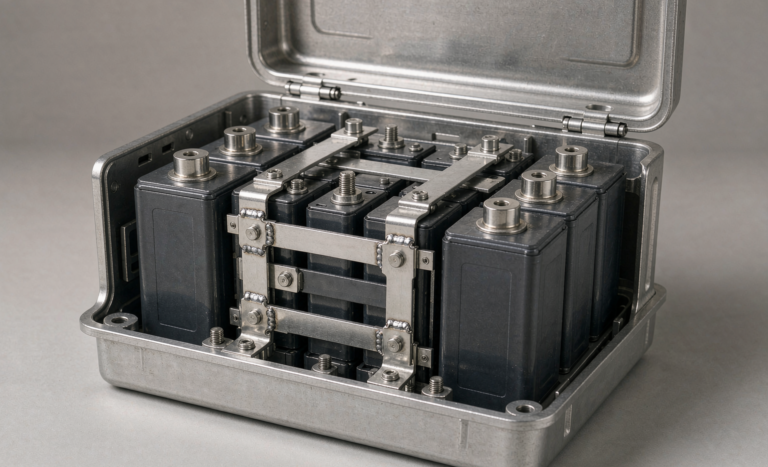
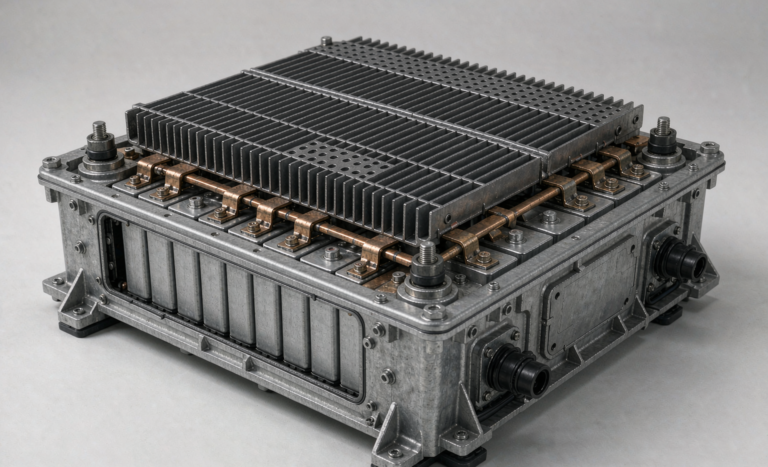
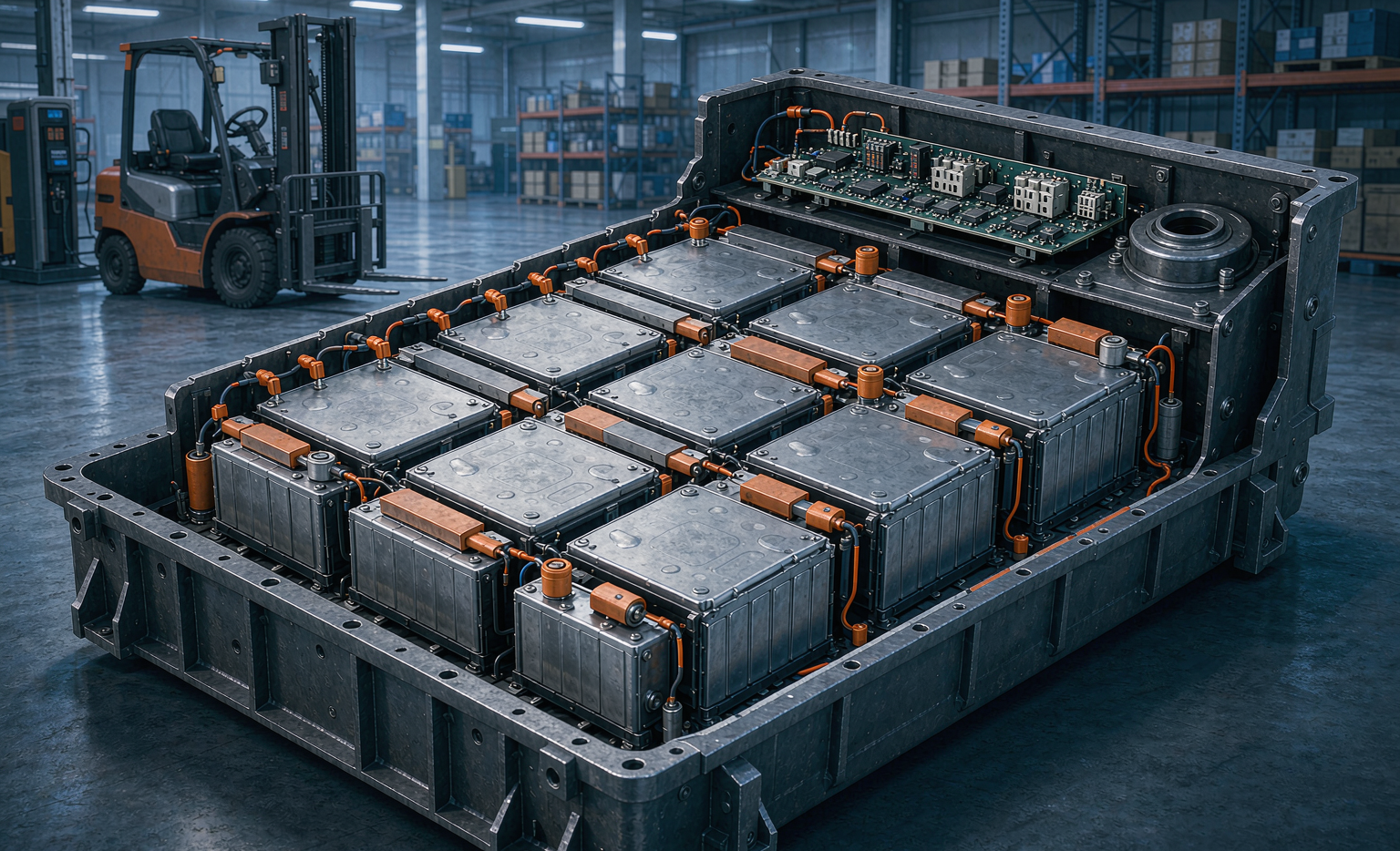
Mechanical layer. A 4 mm to 6 mm welded steel tray sized to the truck’s SAE or DIN compartment, with cells clamped in steel frames at a defined pre-load, typically 300 kPa to 500 kPa on the prismatic face. Pre-load control is not cosmetic: it manages cell swelling over life and prevents the busbar fatigue that causes high-resistance joints and localized heating years later.
Thermal layer. Mica or aerogel barriers between cells, typically 1 mm to 3 mm depending on the propagation test result, plus a directed vent path that channels cell gas out of a defined port rather than pressurizing the enclosure. We size vent area so internal pressure stays under 15 kPa in the worst single-cell venting case. An enclosure that traps gas is how a vent event becomes an explosion.
Electrical layer. Cell-group fusing, a main fuse coordinated to the truck controller’s fault current, a manual service disconnect, dual contactors with pre-charge, and a shunt current sensor on the negative leg. Busbars are laser-welded rather than bolted where geometry allows, because bolted joints are where vibration failures start. All joints get torque marking so a technician can spot a loosened fastener during inspection.
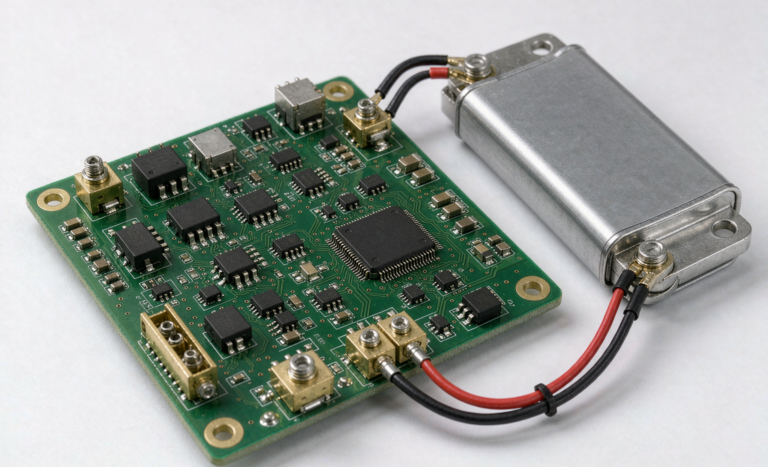
Serviceability layer. If a technician cannot read cell voltages without disassembling the tray, the inspection will not happen — so every custom battery solution we quote includes test points, a diagnostic connector and a service access review.
BMS and Charging Safety Across Multi-Shift Fleets
The battery management system is the active safety element, and forklift duty is where cheap BMS solutions get exposed. Our specification for a motive sodium-ion battery pack:
- Cell voltage accuracy within plus or minus 5 mV across the full temperature range, because sodium-ion cells have a sloped voltage curve and state-of-charge estimation depends on it.
- Temperature sensing on at least 25% of cells plus every busbar junction and both contactor coils, at plus or minus 1 degree C.
- Two independent protection layers: the primary MCU loop and a hardware-only secondary that opens the contactors on over-voltage, over-current or over-temperature without firmware involvement.
- CAN 2.0B or J1939 communication to the truck controller so lift and travel power derate before the pack hits a protection limit. A pack that simply opens a contactor mid-lift creates a load-drop hazard.
- Charger handshake over CAN — no current until the BMS reports temperature, voltage window and permitted rate. We see more field incidents from charger and pack mismatch than from cell defects.
- Event logging with at least 90 days of history at one-minute resolution, so incident investigation has data instead of speculation.
My standing recommendation for three-shift operations: cap opportunity charging at 1C to 80% state of charge, and allow a full charge only on the shift where the truck will then be used. Sitting at 100% at elevated temperature is the biggest accelerator of calendar ageing, and an aged cell with elevated internal resistance is a hotter cell. Safety and life are the same conversation.
Compliance Map: The Standards That Actually Apply
Buyers often receive a stack of certificates that do not cover the right scope. For a battery-powered industrial truck in a Western market, this is the set I insist on:
- IEC 62619 — safety requirements for secondary lithium cells and batteries in industrial applications, including the thermal propagation test. This is the core pack-level document for motive and industrial use.
- UN 38.3 (UN 3551 / UN 3552 for sodium-ion) — transport qualification for cells and packs.
- IEC 62620 — performance and marking for industrial secondary cells.
- UL 2580 or UL 1973 — North American acceptance, depending on traction versus general motive classification.
- UL 583 and ITSDF B56.1 — the truck-level standards your pack lives inside, governing battery compartment, weight and restraint.
- EN 1175 and ISO 3691-1 — electrical and general safety requirements for industrial trucks in Europe.
- IEC 62133-2 — portable ancillary packs only. It does not cover a motive tray, and a supplier offering it as their headline certificate has told you something important.
Two practical notes: insist the certificate scope names your exact cell model and pack configuration, not a family, and ask for the propagation test video. Ten seconds of footage tells you more about a supplier’s engineering honesty than a hundred pages of paperwork.
Fleet Operations: Handling, Storage and Incident Response
Hardware only carries you so far. The fleets with the best safety records have written procedures, and sodium-ion chemistry lets those procedures be simpler.
- Charging area. Maintain 900 mm clearance around packs and chargers, keep combustibles out of the bay, and provide general ventilation. Sodium-ion packs do not off-gas hydrogen the way lead-acid does, so the forced-ventilation requirement for a lead-acid charging room does not apply — many customers reclaim that floor space.
- Storage state of charge. 30% to 50% for packs held longer than two weeks, at 5 to 30 degrees C. Sodium-ion tolerates deep storage far better than a lithium battery, and 0 V storage is acceptable for long-term spares.
- Damage triage. Any pack involved in a rack strike, drop or water immersion goes to quarantine for 24 hours with thermal monitoring before returning to service, regardless of whether the BMS logged a fault.
- Inspection interval. Quarterly torque check on high-current joints, insulation resistance measurement, connector inspection for arc marks, and a BMS log review for over-temperature and over-current events.
- Incident response. Copious water is the correct suppression medium; the goal is cooling neighbouring cells, not extinguishing flame. Train operators never to lift a venting pack.
One more thing I tell every fleet engineer: match the pack to the truck and the duty cycle, not to a spreadsheet capacity number. An oversized pack sits at high state of charge and ages badly; an undersized pack runs hot at high C-rate. Getting sizing right is the least glamorous and most effective safety intervention available, and it is where a proper battery application solution review pays for itself.
Frequently Asked Questions
Are sodium-ion batteries actually safer than lithium batteries in forklifts?
Safer in measurable ways, but not intrinsically safe. Sodium-ion cells show higher thermal-runaway onset, lower total heat release and full zero-volt tolerance, reducing both the probability and consequence of a thermal event. They still use a flammable organic electrolyte and still require proper fusing, propagation barriers and a competent BMS. Chemistry buys margin; engineering delivers safety.
Can a sodium-ion forklift pack be charged inside a cold store?
Yes, and it is one of the strongest arguments for the chemistry. We validate charging down to minus 15 degrees C at a reduced rate, typically 0.3C, without the lithium-plating risk that forces LFP and NMC packs to block sub-zero charging or add heaters. That means no heater, no heater failure mode and no warm-up waiting period.
What certifications should I demand from a supplier?
IEC 62619 with the thermal propagation test, UN 38.3 under UN 3551 or UN 3552, and either UL 2580 or UL 1973 for North America — with the certificate scope naming your specific cell and pack configuration. Add EN 1175 and ISO 3691-1 for Europe, then ask for the propagation report, the video, and the vibration profile actually used.
Do sodium-ion packs need special dangerous-goods paperwork?
They ship under dedicated UN entries — UN 3551 standalone, UN 3552 in or packed with equipment — and may be transported at 0 V with terminals protected. That is simpler than an equivalent lithium battery shipment, which carries state-of-charge restrictions for air freight. Confirm requirements with your carrier, as regional adoption of the latest UN edition varies.
What should happen if a fork or rack upright punctures a pack enclosure?
Stop the truck, clear the area, and do not move or lift the pack. A properly engineered tray directs vent gas out of a defined port, so visible venting does not mean the enclosure failed. Once thermally stable, quarantine the pack for at least 24 hours with temperature monitoring before inspection. Sodium-ion’s zero-volt tolerance makes a controlled full discharge a legitimate safe-handling step, which is not true for a lithium pack.
How long does a sodium-ion forklift battery last in three-shift service?
Our cells are rated above 4,000 cycles to 80% capacity at 25 degrees C and 1C; in three-shift service we design for a seven to ten year horizon. The dominant variables are idle-period state of charge and pack temperature during charging, not raw cycle count.
Where This Leaves Fleet Engineers
The live question in forklift electrification is no longer whether to leave lead-acid behind, but which chemistry and pack architecture survives twenty thousand hours of warehouse abuse without becoming a liability. Sodium-ion is the most under-used answer in motive power: the energy-density penalty is irrelevant in a counterweighted truck, cold-temperature behaviour eliminates a whole class of heater-related failure modes, and zero-volt tolerance transforms shipping, storage and incident handling. None of that excuses sloppy pack engineering. Ask for the raw test data, ask how the vent path is routed, and ask who sized the pack against your actual duty cycle.