Sodium-Ion Battery Deployment for Street Lights
I have spent the last two years putting sodium-ion cells into places where lithium has always made my life difficult, and the simplest of those places turned out to be the solar street light. That sounds like a downgrade. It is not. A pole-mounted luminaire is the one energy storage application where the two things sodium-ion gives up — volumetric energy density and round-trip efficiency — cost almost nothing, and the two things it gives you — cold-temperature charge acceptance and tolerance of being fully discharged — are exactly what kills lead-acid and lithium packs in the field.
Two failures pushed me here. The first was a municipal project in a continental climate where the average January low is -14 °C. The lithium iron phosphate packs were fine electrochemically; the heater pads that let them accept charge were not. We were burning more energy keeping the battery warm enough to charge than some of the luminaires were using to light the road. The second was a rural deployment where a nine-day fog event flattened packs below the low-voltage disconnect and, by the time a truck reached them, the cells had sat under 1.5 V for two weeks. That is a dead lithium pack. It would have been a tired sodium pack.
What follows is the deployment method I have settled on after roughly forty sites: how to size the pack with arithmetic you can defend, why the system voltage matters more than the chemistry, where the cold-climate advantage actually comes from, and the commissioning checks that catch the failures before they become truck rolls.
Why a Street Light Is the Easiest Place to Deploy a sodium-ion battery
Every battery chemistry is a compromise between energy per kilogram, power, cycle life, safety, temperature behaviour and cost. Street lighting removes two of those axes from the decision entirely. Nobody is carrying the pack, so a sodium-ion battery at 100–160 Wh/kg versus LFP at 120–180 Wh/kg is a rounding error. Nobody is space-constrained either — a pole base compartment or a buried vault has tens of litres available, so volumetric density at 200–300 Wh/L is irrelevant. What remains is temperature, cycle life at partial state of charge, safety inside a public asset, and total cost over a fifteen-year service interval.
On those axes sodium scores well. Commercial prismatic cells in the iron-phosphate-pyrophosphate (NFPP) and iron-manganese layered-oxide families are shipping today with 2,000–4,000 full-equivalent cycles to 80 % of beginning-of-life capacity, with the better suppliers publishing 6,000-cycle roadmaps. Calendar life projections of 10–15 years at moderate depths of discharge are now standard in supplier data, which is what matters for a luminaire that only ever does one shallow cycle per night.
The round-trip efficiency gap is real but small in this application. Sodium-ion sits around 88–92 % versus roughly 95 % for a good lithium battery in LFP chemistry. On a 40 W luminaire consuming about 320 Wh per night, that five-to-seven-point penalty costs you about 5 W of extra panel. Five watts is cheap. The 30 W heater pad it lets you remove is not.
Sizing the Pack: The Arithmetic I Use Before Any Quote Goes Out
Most street light battery failures I get called about are sizing failures, not chemistry failures. The pack was specified by rule of thumb — “two days of autonomy” — without ever writing down the nightly load, the worst-month solar resource, or the cold derate. Here is the sequence I use.
Step 1 — Write down the real nightly load, including the dimming profile
A modern luminaire is not a constant load. A typical municipal profile runs 100 % output from dusk to midnight, then 60 % from midnight to dawn. For a 40 W luminaire on a ten-hour night that is:
- 40 W × 5 h = 200 Wh
- 24 W × 5 h = 120 Wh
- Nightly load at the driver input: 320 Wh
Step 2 — Apply the system losses before you apply autonomy
Multiply by driver efficiency (typically 88–92 %) and wiring plus controller losses (about 5 %). At 90 % and 95 % the combined factor is 0.855, so the load seen by the battery is 320 ÷ 0.855 ≈ 374 Wh. Skipping this step is the most common error I find in competitor quotes.
Step 3 — Autonomy, then depth of discharge
Three nights of autonomy is my default for a lit road; five for a critical intersection or a pedestrian crossing with a safety case. Three nights gives 374 × 3 = 1,122 Wh of usable energy. At 80 % depth of discharge that is a 1,403 Wh nameplate pack.
Step 4 — Cold derate, honestly
Every cell loses available capacity as it gets cold, and the number you should design with is the capacity at the cell temperature you will actually see at 4 a.m. in the worst month — not the 25 °C datasheet figure. For sodium-ion I use a 15 % derate at -10 °C and 25 % at -20 °C, measured, not guessed. At -10 °C our example becomes 1,403 ÷ 0.85 ≈ 1.65 kWh. Round to a 1.7 kWh pack.
Step 5 — Size the panel against the worst month, not the annual average
Take the winter peak sun hours (PSH) for the site and divide. At 3.0 PSH in the worst month, with 20 % of combined soiling, mismatch, temperature-coefficient and charge-efficiency losses, the panel must deliver 374 ÷ 0.8 = 468 Wh per sun-hour day, so 468 ÷ 3.0 ≈ 156 Wp. Specify 160–180 Wp. If you size against annual average PSH you will build a light that works beautifully in July and goes dark in December.
Voltage, Cut-Offs, and the Controller Problem Nobody Warns You About
This is where most sodium deployments go wrong, and it has nothing to do with sodium. It has to do with the fact that the entire 12 V solar-lighting ecosystem — drivers, charge controllers, low-voltage disconnects — was designed around the LFP voltage window and has hard-coded limits inside it.
An LFP pack in 4S gives 12.8 V nominal, 10.0 V empty, 14.6 V full. A sodium-ion battery pack in 4S gives about 12.0 V nominal, but the cell window is much wider: roughly 2.0 V to 3.9 V per cell, so 8.0 V to 15.6 V. Two problems appear immediately.
- The top is higher than an LFP controller expects. Most LFP profiles stop absorbing at 14.4–14.6 V and will chronically undercharge a sodium pack, leaving 10–15 % of its capacity permanently unused.
- The bottom is lower than the driver and controller will tolerate. Twelve-volt LED drivers typically brown out around 10–10.5 V and solar controllers set their low-voltage disconnect at 11.0–11.5 V. That throws away roughly a quarter of the pack’s nameplate.
Going to 5S does not fix it — 15 V nominal with a 19.5 V full-charge top breaks the 16 V input ceiling of nearly every “12 V” luminaire driver on the market. The fix is architectural, not chemical: stop buying nominal-voltage systems.
My specification now requires two things. First, a constant-power LED driver with a genuinely wide DC input window — 9 V to 32 V covers 4S sodium end to end. Second, a charge controller with fully user-settable absorption, float, and load-disconnect setpoints, so I can program the real cell window rather than an LFP preset. Both are commodity parts; the cost delta against a fixed-profile system is a few dollars, and it is the difference between using 95 % of the pack and using 70 %.
The one place sodium is easier than LFP
State-of-charge estimation. LFP’s open-circuit voltage curve is famously flat — most of its energy is delivered between about 3.2 V and 3.3 V — which makes voltage-based SOC nearly useless and forces you to rely on coulomb counting that drifts over months. Sodium-ion has a much steeper OCV slope across its usable window, giving roughly 0.6–0.8 V of usable signal. That makes voltage-based SOC meaningfully accurate and, just as useful, makes cell divergence visible as voltage spread early. Passive balancing works better on a sloped curve too, because a weak cell announces itself in millivolts rather than hiding on a plateau.
Cold Climate: Where Sodium-Ion Earns Its Keep
The rule for LFP is simple and expensive: do not charge below 0 °C. Below that, lithium plates onto the anode instead of intercalating, and the plated metal is permanent capacity loss and, eventually, an internal short. Every cold-climate lithium street light therefore carries a heater, a thermostat, and the wiring to run them.
What the heater actually costs
Take a 30 W pad on a thermostat that closes at 5 °C. On a continental or Nordic site the pack is cold enough to trigger it on most nights from November through March — call it 900 heater-hours a year. That is 27 kWh per year spent warming a battery. Our 40 W luminaire consumes about 117 kWh a year. The heater is roughly 23 % of the energy the light itself uses. You pay for it twice: once in the panel and battery capacity needed to harvest it, and once in the parasitic load during exactly the months when there is least sun.
Commercial sodium-ion cells accept charge down to about -20 °C at reduced C-rate, and discharge usefully at -40 °C. On the sites where I have switched, the heater has gone from mandatory to optional — I keep a small pad on the most extreme locations as insurance, but it rarely fires. For a municipal buyer, that is the single most persuasive number in the whole business case.
Zero-volt tolerance and long dark seasons
The second cold-related advantage is structural rather than kinetic. Sodium does not alloy with aluminium, so cell makers use aluminium foil for the anode current collector. Because there is no copper on the anode side, discharging a cell to zero volts does not dissolve the current collector and does not create the metallic bridges that make an over-discharged lithium cell unsafe to recharge. A sodium cell can be taken to 0 V, stored at 0 V, and shipped at 0 V.
Practically, this changes three things. A pack that a long fog event or polar night drives flat can be recovered rather than scrapped. Seasonal or islanded installations can be shut down and left for months with no maintenance charge and no solar input needed. And logistics get simpler — I will come back to that in the compliance section.
Enclosure, Thermal Reality, and Where to Put the Pack
The most under-modelled thermal environment in this industry is the inside of a pole base in summer. I have logged 68 °C inside a dark metal base compartment in a temperate climate on a 34 °C afternoon. No chemistry enjoys that, and it is the dominant driver of calendar degradation. Location matters more than the cell choice.
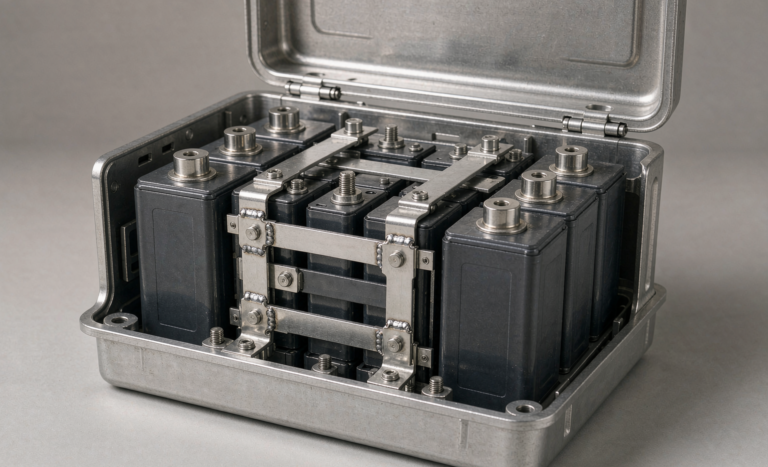
- Buried vault: the best thermal environment by a wide margin. Soil at 600 mm depth sits near the annual mean air temperature — 10–15 °C in most populated latitudes — and barely moves. It is a free, passive thermal battery. The costs are excavation, drainage, and a proper IP68 cable entry.
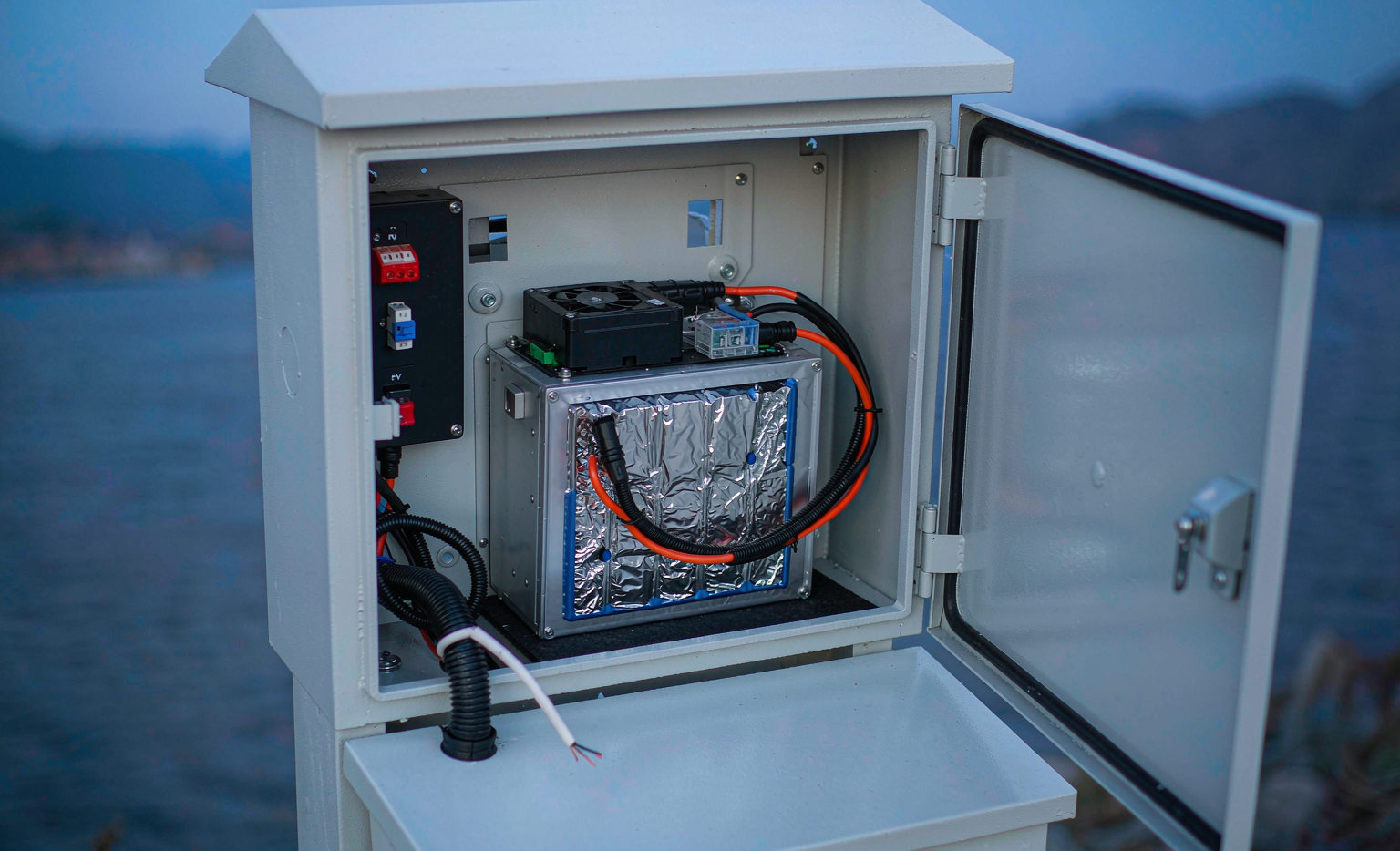
- Pole base compartment: cheapest and easiest to retrofit, worst thermally. Specify a vented, shaded, light-coloured door and derate the calendar-life expectation. Never mount the pack against the sun-facing wall of the pole.
- Pole-top integrated head: compact and theft-resistant, but it puts the battery in the hottest, most vibration-exposed position and makes replacement a boom-truck job. I only specify it where vandalism history justifies it.
Regardless of location, I require IP65 minimum on the enclosure — IP67 where the base can flood — IK08 or better on the door, and marine-grade cable glands. On coastal sites I add a salt-spray test to IEC 60068-2-52 and specify 316 stainless hardware; the number of enclosures I have seen fail from corroded fasteners rather than from electrochemistry is embarrassing.
Theft deserves a mention because it is the leading cause of street light battery loss in most markets. Battery theft is driven by resale value, and today a sodium pack has essentially no secondary market. Combined with tamper-proof fasteners, a door switch wired to the controller, and potting the pack into the base, that is a meaningful security argument — and it is one procurement teams respond to.
Standards, Compliance, and What I Put in the Data Pack
A dedicated international cell standard for sodium-ion has not landed yet; it is in progress under IEC. Until it does, my practice is to certify to the stationary lithium framework and document the chemistry-specific deltas rather than to claim equivalence by silence.
- IEC 62619 — safety requirements for secondary cells and batteries for industrial (stationary) applications. This is the core battery safety reference.
- IEC 62620 — performance and endurance testing for the same industrial cell class.
- IEC 61427-1 — secondary cells and batteries for photovoltaic energy systems, general requirements and methods of test. This is the off-grid renewable storage document that actually matches a solar street light; IEC 61427-2 covers on-grid and does not apply here.
- UL 1973 — required for North American stationary and light electric power applications.
- IEC 62133-2 — for cells, where the cell maker certifies to it.
- Environmental: IEC 60068-2-1 (cold), -2-30 (damp heat), -2-14 (thermal cycling), -2-52 (salt mist), plus IEC 60529 for the IP rating and IEC 62262 for IK.
- Luminaire: IEC 60598-1 and IEC 60598-2-3 for road lighting.
On transport: sodium-ion cells now have their own entries in the UN Model Regulations — UN3551 for the cells and batteries themselves, and UN3552 for batteries contained in or packed with equipment — separate from the lithium UN3480/3481 series. Confirm the current edition of the IATA DGR and the IMDG Code before you book freight, because the transitional dates have moved more than once and a 0 V shipment still has to be type-tested under the applicable packing instruction. The practical advantage stands: being able to ship and store at 0 V removes the state-of-charge limit that makes lithium air freight awkward.
Every project also gets a documented data pack: cell datasheet with the actual test conditions, the UN38.3 test summary for the cell, the pack-level IEC 62619 report, the controller setpoint sheet with the values I programmed, the enclosure ingress and impact ratings, and a torque specification for every terminal in the assembly.
Commissioning and the First-Year O&M Schedule
Commissioning is where a good design either proves itself or quietly fails. My standard sequence takes about twenty minutes per pole:
- Torque audit and paint mark. Every DC terminal torque-checked to specification and marked. Loose DC connections are the number one cause of thermal damage in this equipment, and the paint line makes the next inspection a five-second visual check.
- Insulation and polarity check. Megger the pack-to-enclosure and pack-to-pole, and confirm polarity before the controller is energised. Reversed MC4 connectors still happen.
- Controller setpoint verification. Read the values back out of the controller and compare to the setpoint sheet. I have found factory-default LFP profiles left in place on sodium jobs more times than I would like to admit; the symptom is a pack that never charges above roughly 85 %.
- One full simulated night. Run the luminaire on battery alone from full to the low-voltage disconnect, and log amp-hours out. Compare to the design figure. If the measured capacity is within 3 % of the model, the pack and the model agree. If it reads better than the model, be suspicious — that usually means the coulomb counter is drifting, not that the cells are magic.
- Thermal baseline. Log enclosure and cell temperature over the first clear week. That histogram is the single most valuable artefact from commissioning, because the Arrhenius relationship means every 10 K of operating temperature roughly doubles the degradation rate. The hottest 200 hours of a pack’s life cost more than the coolest 2,000.
Then, annually: repeat the capacity check, repeat the torque audit, and pull a midday terminal thermography scan during peak charge current. Track one fleet-level metric — battery-related unplanned outages per thousand device-hours — and require it to be below 0.5 and falling. A flat trend means you have a systemic problem, not a batch problem.
When Sodium-Ion Is the Wrong Answer
I am a battery engineer at a manufacturer that sells both chemistries, and I talk customers out of sodium regularly. Do not specify a sodium-ion battery when:
- Volume is genuinely constrained. A pole-top integrated head with no base compartment, or a retrofit into an existing enclosure sized for LFP, will not fit a sodium pack of equal energy. This is the one place volumetric density still bites.
- The site has reliable warmth and excellent sun. If the pack never sees freezing and the worst-month PSH is above 5, LFP’s higher efficiency and lower upfront cost win on pure economics. Sodium’s advantage is a cold-climate and logistics advantage.
- Your procurement requires a mature, costed recycling pathway today. Sodium cells avoid cobalt and, in the NFPP family, nickel, and they use aluminium current collectors on both electrodes, so there is no copper to recover. The flowsheets are genuinely simpler. But the collection infrastructure is five years behind lithium’s, and if your tender demands a contracted take-back, read the small print.
- You cannot change the controller. A fixed-profile LFP controller will silently undercharge a sodium pack. If the spec locks you into one, use LFP.
Frequently Asked Questions
Can I drop a sodium-ion pack into an existing LFP street light?
Usually not without changing the driver and controller. A sodium pack needs a charge voltage around 15.6 V in a 4S arrangement, which most LFP controllers will not reach, and it can safely go down to 8.0 V, which most LFP drivers and low-voltage disconnects will not permit. If you can specify a 9–32 V input driver and a controller with user-settable setpoints, the swap is straightforward. If you cannot, the pack will work but you will use roughly 70 % of what you paid for.
How cold is too cold for a sodium-ion street light battery?
Charging below about -20 °C should be inhibited, and I set that limit into the controller rather than relying on the cell. Between -20 °C and 0 °C, charge at a reduced rate — typically 0.2C or less — and expect longer absorption time. Discharge is usable down to -40 °C with a capacity derate. Compare that to LFP, where the hard rule is no charging below 0 °C at all, and you can see why the heater argument is decisive in cold climates.
Does the lower round-trip efficiency mean I need a much bigger solar panel?
No. On a 320 Wh-per-night luminaire, moving from 95 % to 90 % round-trip efficiency adds about 5 Wp of panel requirement. It is a rounding error next to the 25–40 W of parasitic heater load that cold-climate LFP systems carry through the winter.
What cycle life should I expect, and how do I verify it?
Plan for 2,000–4,000 full-equivalent cycles to 80 % of beginning-of-life capacity with current commercial cells, which at one shallow cycle per night is comfortably 8–12 years. Do not take the datasheet number on faith: require the endurance test report to IEC 62620 with the test temperature, depth of discharge and end-of-life criterion stated, and then verify in the field with an annual capacity check.
Is a sodium pack safer inside a public asset?
It is safer in the ways that matter for a pole on a public street. There is no thermal runaway propagation risk of the kind that drives large lithium ESS codes, the cells tolerate being driven to 0 V without becoming unsafe to recharge, and they ship and store at 0 V. It still needs a fused disconnect, a properly rated enclosure, and a BMS with cell-level over-voltage, under-voltage, over-current and temperature protection. “Safer” never means “unprotected.”
What happens if the pack sits flat through a long fog event?
This is the scenario where sodium genuinely differs. A lithium pack held below about 1.5 V for weeks is normally scrap, because copper dissolves off the anode current collector and redeposits as metallic bridges on the next charge. A sodium cell uses aluminium on the anode side and does not have that failure mode. It comes back. I would still log the event and re-verify capacity afterwards, but the truck roll ends with a recharge rather than a replacement.
How much does a custom battery solution add versus a catalogue pack?
For street lighting, usually less than people expect, because the customisation is mostly in the mechanical envelope and the controller setpoints rather than in the cells. If you need a pack to fit a specific base compartment, a specific connector orientation, a communications interface into a fleet monitoring system, or a maintenance interval that lets a technician reach the service disconnect without dismantling the luminaire, that is a modest engineering charge on a standard cell platform. What you should negotiate hard on is not the unit price but the support window: get module and firmware availability in years, and a last-time-buy notification period, written into the contract.
What five documents should I demand before signing?
The cell datasheet with stated test conditions; the UN38.3 test summary for the cell; the pack-level safety report to IEC 62619 (and UL 1973 if you are in North America); the endurance test report to IEC 62620 showing the cycle-life basis; and the environmental test set for your specific climate — cold, damp heat and salt mist if you are coastal. If a supplier can produce all five quickly, that tells you almost as much as the contents do.
Should I use the same chemistry for the fleet’s depot charging and site storage?
Not necessarily. The fixed buffer at a depot charging room, or a stationary store behind a solar array, is a good candidate for sodium in its own right, and stationary residential storage is a natural second-life destination for fleet packs retired at 75–80 % of original capacity. But the mobile platform itself — a drone battery or a vehicle traction pack — is the wrong place for it. Energy density, which is free in a fixed installation, is expensive on anything that has to lift itself.
What I Tell Procurement
Sodium-ion is not a replacement for lithium in every battery product, and any supplier who tells you otherwise is selling rather than engineering. It is the right choice for a solar street light under three conditions: the site sees real cold, the enclosure is not space-constrained, and you are willing to specify drivers and controllers with programmable setpoints instead of nominal-voltage catalogue parts.
Meet those three and the numbers are hard to argue with: a smaller heater bill, a pack that survives being flattened, roughly a decade of service at one shallow cycle per night, and a battery with no resale value sitting in a pole that nobody wants to break into. That is a genuinely good fit for a chemistry whose weaknesses are weight and volume, in an application that has neither constraint.
If you are specifying a sodium-ion deployment and want the sizing arithmetic checked against your site’s solar resource and temperature profile, that is the conversation I have most often — send the luminaire load profile, the worst-month peak sun hours, and the January design temperature, and the rest is arithmetic.