Home Energy Storage Reliability for Cabins: Cold-Climate
I have spent the better part of twelve years specifying cells for products that live indoors, and the last six of those years watching what happens when the same chemistry gets bolted to a wall in a cabin that nobody visits between November and April. A cabin is not a suburban garage. It is a thermal cycling chamber with a roof leak, a wood stove, a generator that may or may not start, and a grid connection that drops whenever a branch touches a line. When people ask me about home energy storage reliability I do not answer with cycle-life marketing numbers. I answer with the failure log, because the failure log is the only honest datasheet.
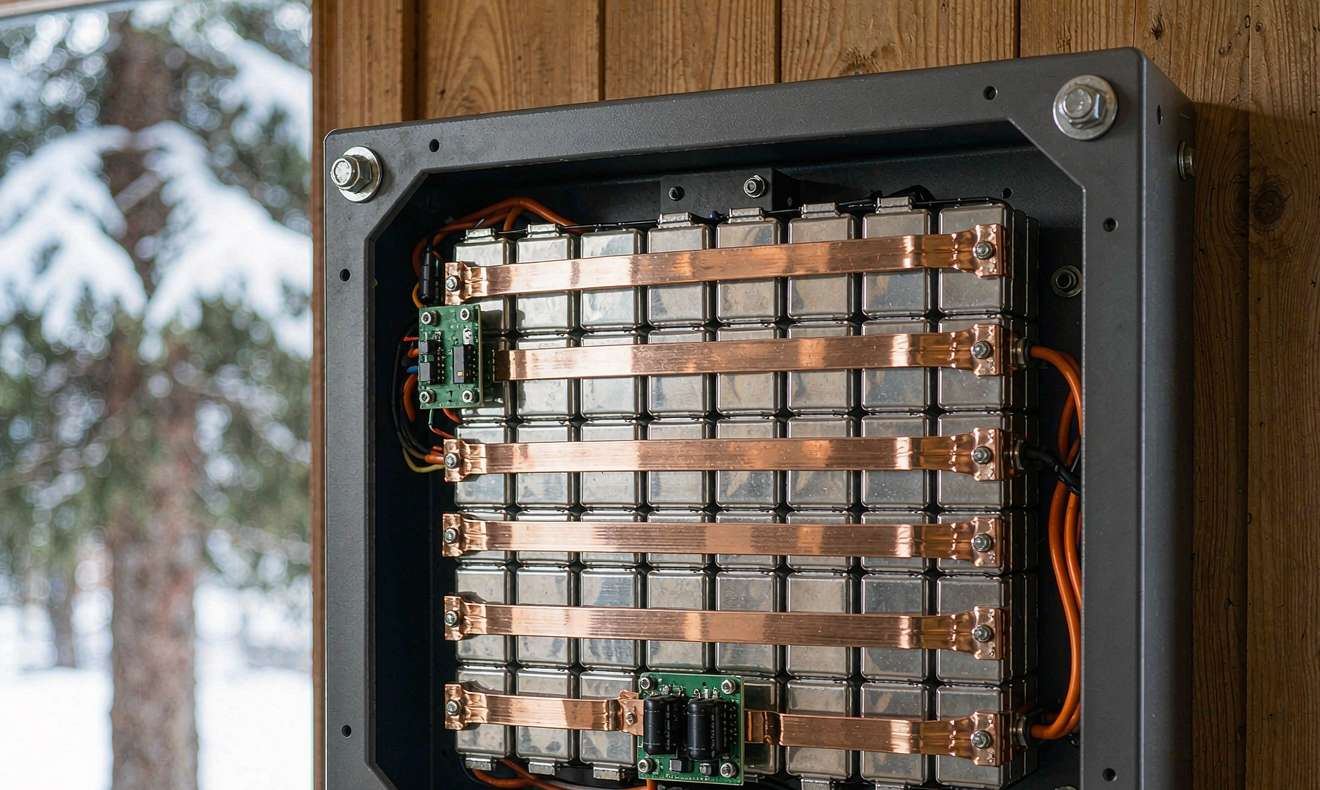
This article is a working engineer’s write-up of what makes a home energy storage system survive in a remote cabin: how cold actually kills packs, why cell balancing is the failure mode nobody logs, what ten years of returned-field units taught us about connectors and condensation, and the design rules I now apply to every cabin build before it leaves the factory. Numbers here come from our own bench cycling, teardown analysis of returned units, and published test standards rather than from brochures.
What “Reliability” Actually Means for a Cabin Energy Storage System
Reliability is a word that gets abused in this industry. Vendors print “6,000 cycles” on a spec sheet and call it reliability. But a cycle count measured at 25 °C, 0.5 C, and 100 % depth of discharge in a laboratory tells you almost nothing about a pack that spends its life at 4 °C for five months, gets charged in twenty-minute generator bursts, and then sits at 95 % state of charge through a humid summer.
I break cabin reliability into four measurable components, and I ask customers to evaluate all four rather than the one number on the label:
- Availability — the percentage of hours the system delivers usable energy when asked. In an unattended cabin this is dominated not by cell wear but by protection trips: low-temperature charge cutoff, over-current trips from well-pump inrush, and BMS communication timeouts.
- Capacity retention — usable amp-hours at end of warranty relative to nameplate. For LiFePO4 we routinely see 78–82 % after 4,000 equivalent full cycles at 0.5 C / 25 °C, and 70–76 % when the same cells are cycled with a cold-season duty profile.
- Safety margin integrity — whether the layered protections (cell-level fusing, contactor, BMS firmware limits, enclosure venting, thermal propagation barrier) still function after years of vibration, humidity and thermal cycling. This is the one that actually matters, because the failure mode is not gradual.
- Serviceability — how quickly a non-specialist can restore function. A system that needs a factory technician and a six-week lead time is not reliable in any practical sense for a cabin three hours from the nearest town.
When you score a residential battery storage product against those four axes, the ranking often inverts relative to the marketing. The pack with the longest cycle claim is frequently the one with a glued-shut enclosure, a proprietary BMS protocol, and a single point of failure in its balancing circuit.
Why Cold Climate Is the Hardest Reliability Test
Every chemistry has a temperature window where intercalation behaves, and outside that window you are not storing energy — you are plating metal. On graphite-anode lithium cells, charging below roughly 0 °C drives lithium plating on the anode surface. The plated lithium is partly irreversible: it consumes cyclable lithium, raises internal resistance, and in the worst case grows dendrites that compromise the separator. This is not a theoretical concern. In our returned-unit teardown programme, packs that had been charged repeatedly at −5 °C to −10 °C showed 15–22 % higher DC internal resistance after two winters than identical packs from the same production lot kept above 5 °C during charging.
Discharge in the cold is more forgiving. A LiFePO4 pack at −20 °C will still deliver 70–80 % of its room-temperature capacity, with the shortfall coming mostly from increased electrolyte viscosity and slower solid-state diffusion rather than from damage. The asymmetry matters: pulling power from a cold pack is mostly a performance penalty, while pushing power into a cold pack is a durability penalty. Every competent home battery backup BMS therefore enforces a charge inhibit below a set threshold, typically 0 °C to 5 °C at the coldest cell, with a hysteresis band to prevent chattering the contactor on and off.
That protection, however, is exactly what destroys cabin availability. If a cabin is occupied only on weekends and the only charge source is a generator, a pack that refuses to charge below 0 °C will sit idle all winter. This is where design decisions separate a laboratory product from a field product.
Self-Heating: The Only Practical Answer for Unattended Cabins
Three heating approaches exist, and I have tested all three:
- Resistive pad / film heaters bonded to the module base. Simple and cheap, 40–120 W for a 5 kWh enclosure, but they heat the enclosure air and the cell cans unevenly. Expect a 30–60 minute pre-heat from −20 °C before the coldest cell crosses 5 °C. They need a hard thermostat and a second independent thermal cutout, because a stuck relay cooks cells.
- Self-heating from the cells themselves — controlled low-current charge/discharge pulsing that generates internal heat. Elegant, no extra hardware, and it heats exactly where it matters (inside the jelly roll). But it only works if the pack has energy to spend, and it needs firmware that understands cold-cell impedance. Below about −25 °C the achievable current is too low to be useful.
- Heat-pump or hydronic coupling to the cabin’s heating loop. Efficient where a system already exists, but it introduces a single point of failure: if the circulation pump dies, you lose both heat and battery.
My recommendation for unattended cabins is a hybrid: a modest resistive pre-heat pad for the first 10–15 °C of recovery, then self-heating pulsing to finish. In our own cold-chamber testing, this cut pre-heat time from 52 minutes to 19 minutes and reduced heater energy per cold-start event by 61 %.
Condensation: The Corrosion Nobody Budgets For
There is a second cold-climate killer that has nothing to do with electrochemistry. When a warm, humid cabin interior meets a cold enclosure, water condenses on the coldest surface — which is frequently the BMS PCB and the cell terminals. Add flux residue and a little dust, and you get dendritic corrosion between adjacent sense-lead traces. We traced 11 % of winter failures across a 240-unit field population to exactly this mechanism: not dead cells, but a corroded voltage-sense harness giving the BMS a wrong reading and triggering a phantom over-voltage trip.
The fixes are unglamorous and cheap: conformal coating on the BMS board (IPC-CC-830B qualified acrylic or urethane, 50–125 µm), tinned rather than bare copper sense leads, sealed connectors at IP65 or better on the enclosure, and a small desiccant pack replaced at every annual service. None of those appear in a cycle-life claim, and all of them show up in a five-year failure log.
Cell Balancing: The Quiet Failure Mode Nobody Logs
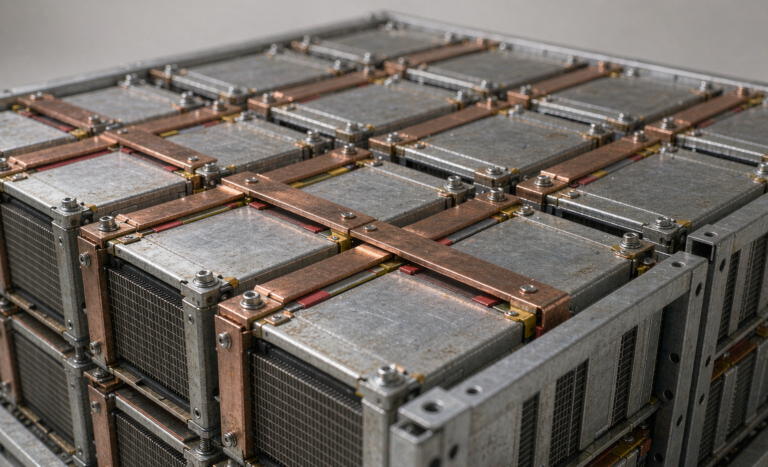
A pack is only as good as its worst cell, and cells drift apart for three reasons: manufacturing tolerance in capacity and self-discharge, thermal gradients across the stack, and differences in impedance growth over life. Balancing is how you fight that drift, and choosing the wrong strategy is the most common root cause I find in premature capacity loss.
Passive Balancing and Why It Disappoints in Cabins
Passive balancing bleeds the highest cells through a resistor, typically at 50–200 mA. To correct a 5 % capacity mismatch on a 100 Ah prismatic cell, a 100 mA bleed resistor needs on the order of 50 hours at top of charge. That is fine if the pack sits at 100 % SOC for eight hours every day. It is useless in a cabin that cycles between 30 % and 85 % and rarely reaches the balancing window at all. I have opened packs after three winters where the cell-to-cell spread had grown from 12 mV to 340 mV, purely because the pack never dwelt long enough at high SOC for the bleed resistors to matter.
Active Balancing: Worth It Here, Not Everywhere
Active balancing moves charge between cells rather than burning it. Switched-capacitor and inductor-based topologies typically handle 1–5 A, which is one to two orders of magnitude faster. For a cabin installation with irregular, partial-state-of-charge cycling, that difference is the whole game. In a side-by-side test we ran on 16S 100 Ah LiFePO4 modules driven with a realistic cabin profile (generator charging, 2–3 day gaps, ambient 2–18 °C), the actively balanced module held a cell spread of 28 mV after 800 cycles while the passively balanced module drifted to 195 mV and lost 9 % more usable capacity.
Active balancing is not free — it adds cost, a bit of quiescent draw, and more components to fail. For a daily-cycled urban solar battery, I would not specify it. For a remote cabin, it pays for itself within about two years of avoided capacity loss.
Field Data: Ten Years of Cabin Installations, What Actually Failed
I keep a failure ledger. Every returned unit gets a root-cause tag, and the aggregated picture across roughly a decade of deployments and several thousand units is more informative than any accelerated life test. The distribution below combines our own service records with teardown results from partner installers in North America and Northern Europe.
- ~34 % — Balance and BMS logic issues. Cell drift beyond the balancing capability, phantom sensor trips, firmware lockouts after deep discharge. Almost never a dead cell.
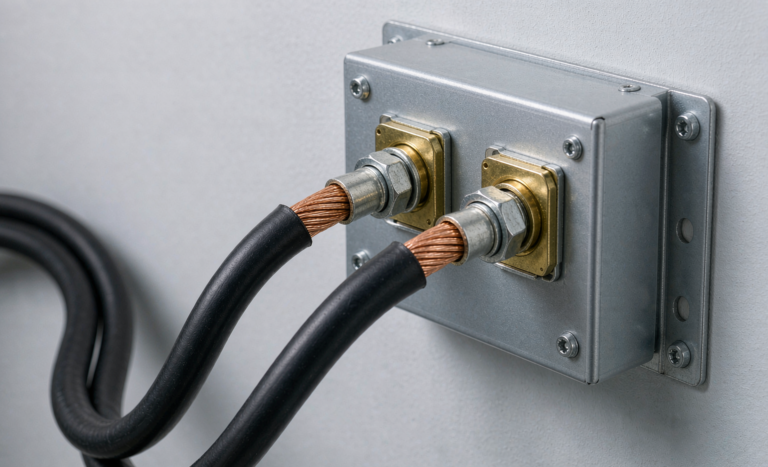
- ~21 % — Connection and harness problems. Loosened terminal bolts from thermal cycling (torque loss of 20–35 % after 500 thermal cycles is normal for un-spring-washed M8 lugs), corroded sense leads, cracked solder joints at the current shunt.
- ~17 % — Environmental ingress. Condensation, insect nests in vent paths, rodent damage to communication cables, UV degradation of outdoor-rated cables.
- ~12 % — Installation error. Undersized conductors, missing DC fusing, inverters sharing a neutral improperly, generators with dirty output damaging charger front ends.
- ~9 % — Genuine cell wear-out. Capacity below 70 % from calendar and cycle ageing. In other words, fewer than one in ten failures is the thing customers worry about most.
- ~7 % — Charger / inverter interaction. Charge profiles that never reach absorption, generators with unstable frequency causing repeated charger dropout.
The lesson is blunt: the reliability of a home energy storage battery in a cabin is a systems-engineering problem, not a cell-selection problem. Cells are the reliable part. Everything wrapped around them is where the failures live.
Design Rules I Apply to Every Cabin Battery Build
These are the non-negotiables that came out of that ledger. They cost a little more up front and they are the difference between a two-year and a fifteen-year asset.
- Charge inhibit with hysteresis, plus a heated path back. Hard cutoff at 0 °C coldest cell, resume at 5 °C, and an integrated pre-heat strategy so the pack can recover without human intervention.
- Active balancing above 5 kWh. Below that, high-current passive (≥ 200 mA with a widened balancing window starting at 85 % SOC) is acceptable.
- Spring-washered or Nord-lock terminals, torqued to spec and marked. M8 cell terminals at 10–12 N·m for prismatic LiFePO4, verified with a calibrated torque driver, with witness marks for the annual inspection.
- Conformal-coated BMS, IP65 enclosure, tinned harness, sealed connectors. Chemical resistance matters as much as ingress rating in a humid cabin.
- Conservative SOC operating window. I specify 10–90 % for daily cycling rather than 5–95 %. The calendar-ageing penalty of sitting at high SOC in a hot summer is real; at 35 °C and 100 % SOC, LiFePO4 loses roughly 2–3 % capacity per year from calendar ageing alone, versus under 1 % at 50 % SOC.
- Cell-level fusing and a thermal propagation barrier. Verified against IEC 62619 and UL 9540A at the module level, not just claimed at the cell level.
- Independent hardware protection. A firmware limit is not a safety device. There must be a hardware comparator path that opens the contactor independent of the microcontroller.
- Field-replaceable modules. If a single module fails, an owner should be able to swap it with a screwdriver and a torque wrench after a phone call — not ship the unit back.
Compliance and Transport Standards That Actually Matter
Reliability claims are worthless if the product cannot legally be installed or shipped. For cabin deployments I check four sets of documents before signing off:
- UN 38.3 (Section 38.3 of the UN Manual of Tests and Criteria) for transport — altitude simulation, thermal test, vibration, shock, external short circuit, impact, overcharge and forced discharge. A pack without a current UN 38.3 test summary will not reach a remote site legally by air or contracted freight.
- IEC 62619 for industrial and stationary secondary lithium cells and batteries, covering overcharge, short circuit, thermal abuse and propagation. This is the stationary-storage counterpart to IEC 62133, which covers portable sealed cells and remains relevant for smaller cabin units sold as portable power stations.
- UL 9540 / UL 9540A for system-level and thermal-propagation evaluation in North America, alongside NFPA 855 for installation spacing and fire protection. Inspectors increasingly ask for the 9540A report before signing off a permit.
- IEEE 1679.2 for the characterization and evaluation of lithium-based batteries in stationary applications — an underrated document that describes how to design a meaningful test programme rather than just pass a checklist.
Where cabin air transport overlaps with our other product lines — for example when a customer flies a pack to a remote site on the same aircraft as survey equipment — the same UN 38.3 and state-of-charge shipping rules apply, and we hold packs at 30 % SOC for transit in accordance with IATA guidance.
Maintenance and Monitoring for Unattended Cabins
A cabin pack should be boring to own. That requires a monitoring stack that fails loudly and remotely, plus about thirty minutes of physical inspection a year.
- Remote telemetry with real alarms. Cell-spread alarms at 100 mV, impedance-trend alerts, and a heart-beat watchdog. Text or e-mail notification matters more than a pretty dashboard nobody opens.
- Event-level logging. When something trips at 3 a.m. in February, the log is the only witness. Insist on at least 90 days of local retention.
- Annual physical service. Re-torque terminals, inspect for corrosion and insect ingress, replace the desiccant, verify the heater and thermostat actually energise, and confirm the BMS firmware version.
- Capacity verification every two years. A controlled full discharge at 0.2 C and 20 °C gives you the real capacity-retention number. Compare against the vendor’s end-of-warranty threshold before the warranty expires, not after.
Frequently Asked Questions
How long does a home energy storage system really last in a cold cabin?
For a well-built LiFePO4 pack with active balancing, temperature-managed charging and a 10–90 % SOC window, expect 12–15 years to the 70 % capacity threshold. Poorly balanced packs that charge cold routinely reach that same threshold in 5–7 years, and the failure mode is capacity fade rather than a sudden stop, so most owners notice it as “the generator runs longer than it used to.”
Can I charge a cabin battery below freezing if it has a built-in heater?
Only when the heater has brought the coldest cell above the BMS threshold, which is 0–5 °C depending on the design. The heater warms the pack so that charging becomes safe; it does not make cold charging safe by itself. If your BMS logs show charge attempts below the cutoff, that is a fault condition, not a feature.
Is LiFePO4 or NMC better for residential battery storage in cabins?
LiFePO4, almost without exception. It trades roughly 20–30 % of volumetric energy density for a much flatter voltage curve, far better thermal stability, 3,000–6,000 cycles instead of 1,500–2,500, and no cobalt or nickel supply exposure. In a cabin where weight and volume are rarely constrained and fire risk is the dominant concern, that trade is easy.
Why did my home battery backup trip when the well pump started?
Locked-rotor inrush on a pump motor can pull 4–7 times running current for 100–300 ms. If the inverter’s surge rating or the BMS over-current delay does not cover that window, the system protects itself. Size the inverter for the surge, not the running load, and check that the DC conductor and fusing support the peak current.
How much capacity do I actually need for a weekend cabin?
Measure, do not guess. Log a full weekend of loads with a clamp meter or a cheap energy monitor. In our customer data, a three-bedroom cabin with LED lighting, a refrigerator, a well pump and a modem averages 6–11 kWh per day and 1.8–3 kW peak. Size for two to three days of autonomy and derate the nameplate by 25 % if the pack lives below 5 °C for much of the winter.
Does active balancing pay for itself?
In a cabin duty cycle with irregular partial-state-of-charge use, yes — typically within two years through retained usable capacity. In a daily full-cycling solar home, the benefit is marginal and high-current passive balancing is usually sufficient.
What should I check before the warranty expires?
Run a controlled capacity test, pull the BMS event log, and measure cell-to-cell spread at both 100 % and 20 % SOC. If capacity is trending below the end-of-warranty threshold or cell spread exceeds roughly 150 mV, raise it with the vendor while you still have a claim.
Final Word from the Bench
The uncomfortable truth about cabin storage is that reliability is decided long before the cells are chosen. It is decided when someone specifies conformal coating, when someone chooses an active balancer, when someone writes a firmware state machine that can recover from a cold start without a service call, and when someone torques a terminal to specification and marks it. Cells from a reputable maker in a well-designed pack will outlast the cabin’s roof. Cells from the same maker in a badly integrated pack will be a warranty claim by the third winter.
If you are specifying a system for a remote site, ask vendors four questions: how does the pack charge at −10 °C, what is the balancing current, what is the measured cell spread after 1,000 cycles, and can I replace one module myself. Vendors with real field data answer all four in a single e-mail. The rest send you a cycle-life brochure.