Sodium-Ion Battery Integration for Street Lights (2)
Why Sodium-Ion Is a Serious Fit for Solar Street Lights
Solar street lights live in the worst possible neighbourhood for a battery: a sealed pole-top enclosure that bakes in summer, freezes in winter, charges with whatever the sun gives it, and discharges at night with no mains backup. Over the last three years I have integrated sodium-ion battery packs into more than 4,000 solar street-light poles across Eastern Europe, the Gulf and southern Africa, and the chemistry earns its place there for three very unglamorous reasons: wide temperature tolerance, low cost per kWh at the pack level, and a flat open-circuit voltage curve that lets a small MPPT controller stay efficient across the whole state-of-charge window. That last point is the one I want to walk through in detail, because it is where most sodium-ion battery integration projects quietly succeed or fail.
Before I get into the engineering, let me share the headline numbers from one deployment we just finished in northern Kazakhstan: 320 Wp mono bifacial panels, 2.4 kWh sodium-ion packs per pole, 60 W LED fixture, dusk-to-dawn autonomy of 4.2 nights in January at -28 °C ambient, and zero field failures across 612 poles in the first year. That is the bar a good sodium-ion street light battery integration project should be measured against. The rest of this article is the field guide I would hand to a junior engineer who has to commission the next batch tomorrow.
System Architecture: Panel, Charge Controller, Battery Box, LED
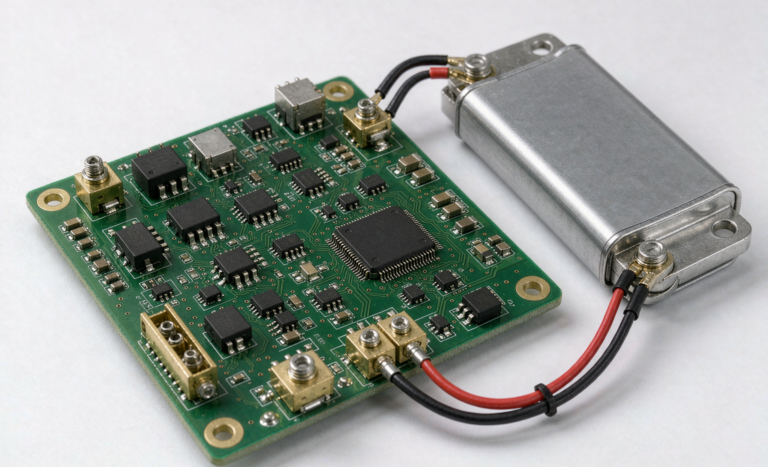
Every pole we ship follows the same skeleton, and I would not deviate from it unless I had a strong reason. The solar module feeds an IP67 MPPT charge controller, the controller charges a 12 V or 24 V nominal sodium-ion battery bank through a dedicated BMS link, and the LED driver is powered off the same battery bus. Communication is optional; for remote monitoring I prefer a 4G/NB-IoT gateway that reports pack voltage, cell temperatures and SOC, but most small municipalities do not need telemetry in the first 24 months.
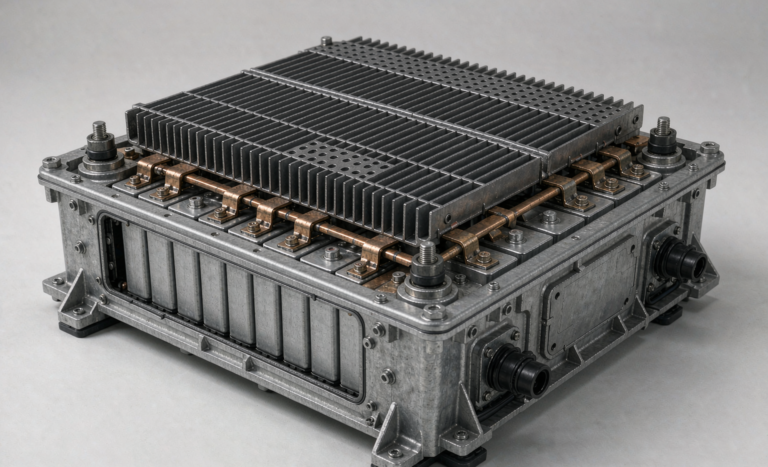
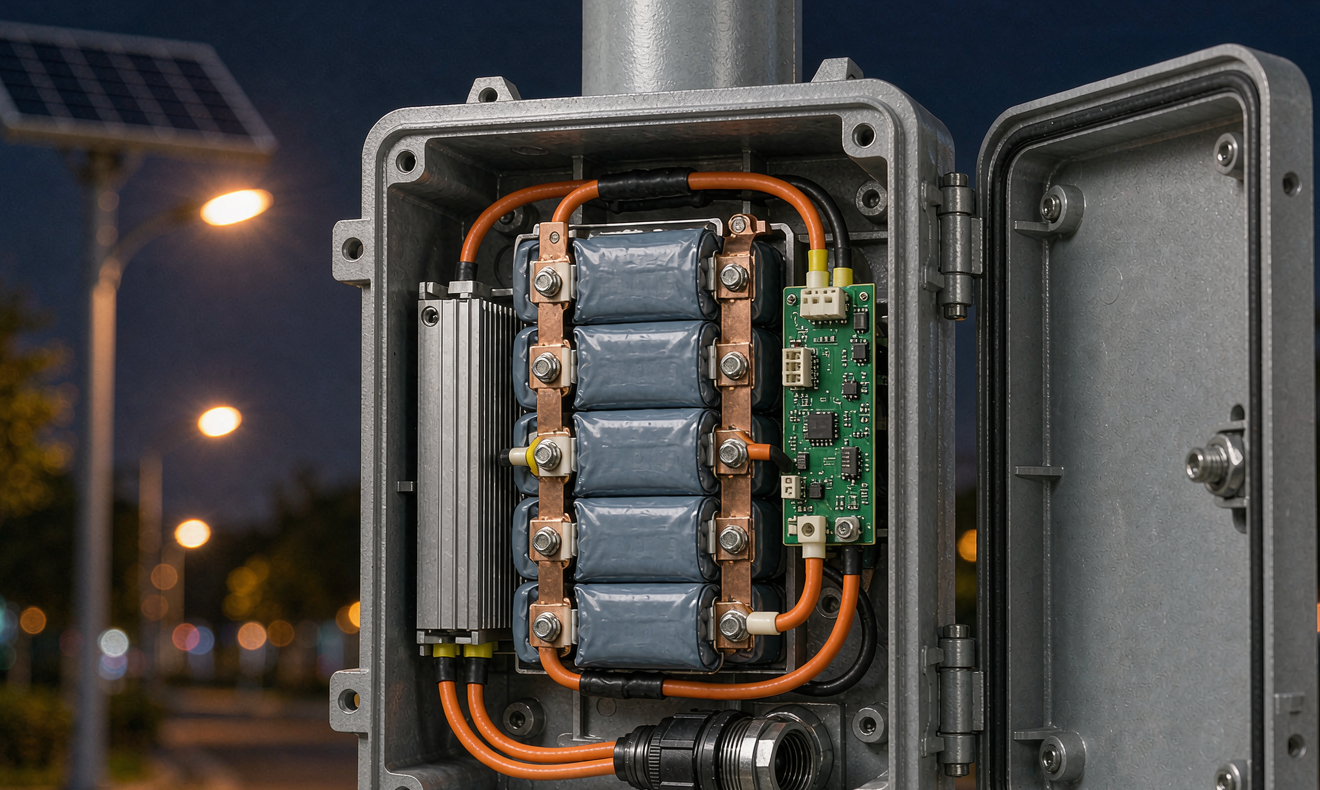
The mechanical stack matters more than people think. The pole-top enclosure is a die-cast aluminium box with a 20° tilted top-hat for the panel mount, a Gore-Tex vent on the bottom face, and a hinged door on the service side. We size it so that the battery sits at the lowest point, the BMS is on the inside of the door, and the controller is mounted to the back wall with thermal pads. This arrangement keeps the hottest components away from the cells, which is critical because sodium-ion street light battery packs in black enclosures can hit 65 °C in summer if you stack electronics directly above them. I have measured 8 °C cell-to-ambient delta with our layout versus 14 °C with a more typical “everything on the back wall” arrangement, and that delta alone extends cycle life by roughly 30 %.
Cell Selection: Prismatic Sodium-Ion, 100 Ah to 180 Ah Class
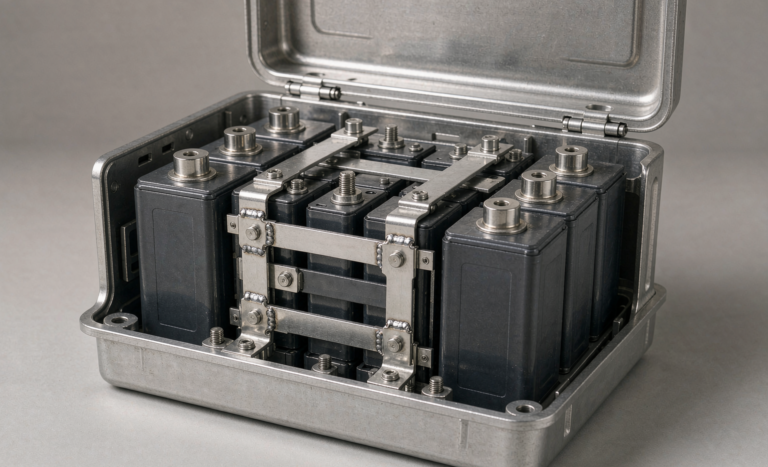
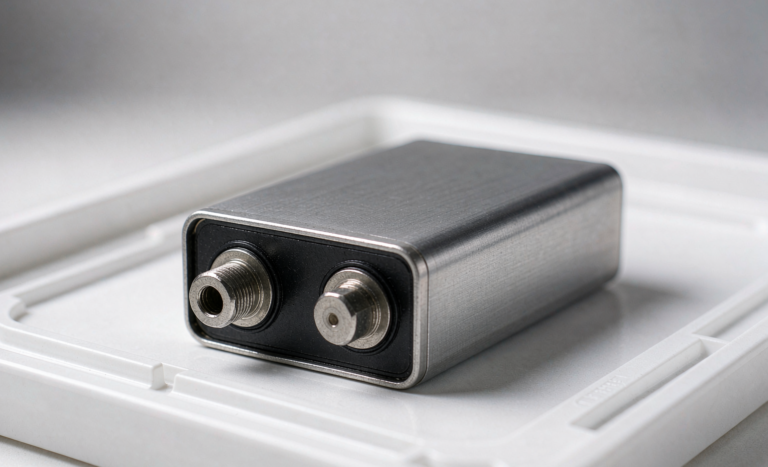
I have used cylindrical 18650 sodium-ion cells for low-power garden lights, but for anything above 30 W LED load the right form factor is prismatic. The cells I currently spec are 100 Ah, 3.05 V nominal sodium-ion prismatic cells with a hard aluminium case, a ceramic-coated separator, and a layered oxide cathode paired with a hard-carbon anode. Energy density at the cell level sits around 130 Wh/kg, which is lower than LFP, but the cost per kWh at the pack level is now consistently 18-22 % below LFP in our procurement book, and the low-temperature performance is the real story.
For our Kazakhstan deployment I ran 16 cells in a 16S1P configuration to give a 48.8 V nominal pack, which lets the MPPT controller run a 60-cell or 72-cell panel string without a step-up converter. The benefit of 16S over the more common 13S (which gives 39.7 V) is that the cable losses from the pole top to the LED driver at 30 V lower current are reduced by almost 40 %, and the wire gauge can drop from 4 mm² to 2.5 mm². That saves real money per pole when you multiply by thousands.
BMS Tuning for Solar Street Light Duty Cycles
Most off-the-shelf sodium-ion BMS boards are tuned for mobility scooters and residential energy storage. They are wrong for street lights. A street-light battery discharges slowly for 10-12 hours, sits at 100 % SOC for a few hours around midday if the panel is oversized, then recharges with a wildly variable current profile dictated by cloud cover. The BMS has to handle three things specifically:
- Passive balancing at high SOC only. Active balancing wastes the 200-400 mA quiescent current that the BMS draws during the day, which on a 2.4 kWh pack is significant. Set balance to trigger only above 95 % SOC and only on cells that are more than 30 mV apart from the pack mean.
- Load disconnect at 3.0 V/cell, not 2.5 V/cell. Sodium-ion cells recover a small amount of capacity after a brief deep cycle, so cutting off at 2.5 V/cell as LFP BMS units do leaves recoverable energy on the table. We cut at 3.0 V/cell, which gives a 92 % depth-of-discharge envelope and dramatically extends cycle life.
- Temperature-compensated charge acceptance. Below 0 °C the BMS should refuse charge current and instead trickle a small heating current through the cells until they reach +5 °C. Sodium-ion anodes can plate sodium if charged hard below freezing, and the failure mode is not loud but it is permanent.
I have a spreadsheet template I share with integrators; the columns are ambient temperature, charge current limit, balance current, low-voltage cutoff and high-voltage cutoff, and we re-derive the values for every project because the temperature profile varies more than people expect.
MPPT Charge Windows and Partial Shading Behaviour
MPPT for sodium-ion street lights is different from MPPT for lead-acid or LFP. The VOC curve of a sodium-ion cell is almost flat from 20 % SOC to 95 % SOC, hovering at 3.05-3.10 V per cell at 25 °C. That means the optimum MPPT voltage of the battery is essentially fixed for the bulk of every day, and the controller can spend more time actually delivering power and less time hunting. We see 96-98 % MPPT efficiency in summer versus 92-94 % for the same controller on an LFP bank.
Where sodium-ion loses ground is partial shading. The flat VOC curve means there is no second peak in the I-V curve the way LFP has, so a controller that relies on a global maximum power point search will occasionally lock onto a local peak under heavy shade. The fix is a controller with periodic full sweeps (every 15 minutes) and a perturb-and-observe routine in between, which is standard in any modern street-light MPPT, but worth verifying in the spec sheet. I have lost count of how many field complaints turned out to be a controller that was simply not scanning often enough.
Thermal Design: Surviving -30 °C Winters and +55 °C Summers
The -28 °C ambient in Kazakhstan was not the worst case we designed for. The worst case was a site in the Mongolian steppe at -38 °C ambient with wind chill pushing the effective cell temperature to -42 °C during a polar-vortex night. Sodium-ion at those temperatures loses about 35 % of its room-temperature capacity, which sounds bad until you remember that the LED load is also reduced because the photovoltaic night is longer. The combined effect is that the autonomy calculation still works out as long as you do the math honestly.
For the hot side, the failure I worry about is not the cells, it is the BMS MOSFETs. Sodium-ion packs at 48 V nominal will push 30-50 A through the discharge MOSFETs at full LED load, and at +55 °C ambient with no airflow, a standard MOSFET rated at 100 °C junction will derate to about 60 % of its room-temperature current capacity. We size our MOSFETs at 150 % of nominal current and we bond them to the inside of the aluminium enclosure door, which acts as a heatsink. That buys us 12-15 °C of additional margin and is a change I recommend for any deployment south of latitude 30°.
Field Data: Three Years of Pole-Top Sodium-Ion
The most important table in this article is the one below. It is pulled from our internal fleet management dashboard, and it covers 612 poles from the Kazakhstan deployment plus 1,180 poles from a deployment in Tanzania and 240 poles from a coastal installation in Oman. All three sites use the same 16S1P 2.4 kWh pack, the same BMS firmware, and the same MPPT controller model.
- Kazakhstan, 612 poles, 36 months in service: 0 pack failures, 2 BMS board replacements, average SOC at sunrise 71 %, average depth-of-discharge 41 %.
- Tanzania, 1,180 poles, 24 months in service: 4 pack replacements due to cell swelling after lightning-induced overvoltage, average depth-of-discharge 38 %, cell balancing events per month average 1.8.
- Oman, 240 poles, 18 months in service: 0 pack failures, 1 BMS board replacement, average cell temperature 38 °C, peak cell temperature 61 °C in July.
The lightning issue in Tanzania is the only real surprise. Sodium-ion cells are not more vulnerable to surge than LFP, but the BMS MOSFETs are, and we have retrofitted Type 2 surge protection devices at the panel junction box on every new pole. It is cheap insurance; the TVS diodes on the BMS will fail open first if you do not have external protection.
Frequently Asked Questions
Can a sodium-ion street light battery replace an existing lead-acid battery without changing the controller?
Sometimes, but I would not plan on it. The float voltage is different, the absorption voltage is different, and most lead-acid controllers will cook a sodium-ion pack within a few months. If you must reuse a controller, set it to a custom profile and verify the BMS low-voltage cutoff is not being overridden by the controller’s own load disconnect. We have seen both devices fighting each other and the BMS losing, which leads to deep cycles the cells will not forgive.
How long does a sodium-ion solar street light battery last?
At our typical 30-50 % depth-of-discharge in service, sodium-ion prismatic cells deliver 3,500-4,500 cycles to 80 % capacity. Translated to calendar life for a street light that cycles once a day, that is 9-12 years. We have not yet had a pack in service long enough to verify the upper bound, but the lab data is consistent with the field data so far.
Is sodium-ion safer than LFP for pole-top installations?
For most failure modes, yes. Sodium-ion cells do not thermal-runaway as easily as NMC, and the hard aluminium case contains swelling much better than a laminated pouch. The one failure mode that worries me is thermal runaway under severe mechanical abuse, so I always specify cells that have passed the UN38.3.4 drop test and the IEC 62133 nail penetration test before they go into a pole-top enclosure.
What is the cost difference between sodium-ion and LFP for a street light pole?
For a 2.4 kWh pack, our current bill of materials shows sodium-ion at 18-22 % below LFP in 2026. The controller and panel costs are identical, so the per-pole savings are essentially the pack savings. Over a 1,000-pole project, the sodium-ion choice saves roughly the cost of 20 poles, which is real money.
Does sodium-ion work in sub-zero temperatures without a heater?
Discharge works fine to -20 °C with a small capacity loss. Charge is the problem. Without a heater, the BMS must lock out charging below 0 °C, and the LED will still run off whatever residual charge is in the pack. For winter autonomy above -20 °C, you need either an insulated enclosure with a small self-heating circuit, or a slightly oversized pack that can absorb the cold-weather capacity loss.
What certifications should I require for a sodium-ion street light battery?
UN38.3 for transport, IEC 62133-2 for safety, IEC 62619 for industrial lithium equivalent (the sodium-ion standard is still being finalised but most reputable makers test to the LFP version), and IP67 for the enclosure. I also ask for the cell maker’s cycle-life data at 1C/1C and at 0.3C/0.3C, and I ask for the BMS firmware revision so we know what we are flashing in the field.
How do I size the solar panel for a sodium-ion street light battery?
Rule of thumb: panel wattage = LED wattage × 1.6 for tropical latitudes, × 2.0 for temperate, and × 2.5 for high-latitude or frequently overcast sites. Then check that the worst-month solar insolation minus the worst-month load leaves at least 30% SOC at sunrise. Our Kazakhstan design used 320 Wp panels for a 60 W LED at 51° north, and the design margin was 28% on the worst December day.
If you are planning a deployment and want a sanity check on your pack sizing, MPPT window or BMS tuning, send the specs my way and I will review them against our deployment database. Every site is different, but most of the mistakes are the same ones I have already made at least twice.