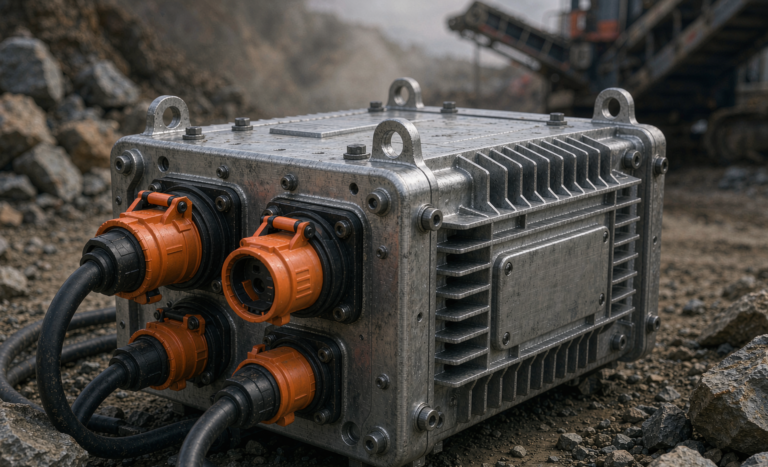
Battery Solution for Trams and Trolleybuses
Overhead line voltage sags on a hot afternoon and the timetable slips by two minutes before anyone explains why. I have spent eleven years specifying lithium battery packs for railway rolling stock, and the trams and trolleybuses that come through our bay are among the harshest customers I service. A tram cannot run on its battery alone, but it will not run cleanly without one. This guide walks through how a battery solution for trams and trolleybuses is sized, built, certified and kept in service, with the numbers I use on real projects.
Why trams and trolleybuses need onboard storage
The overhead line on a tram network is a shared bus, not a battery. Regenerative braking from one vehicle can only return energy to the contact line when another vehicle is accelerating at the same moment. On a busy corridor that matters; on a quiet branch line after midnight it simply disappears into the substation resistors. On the networks I have measured, between 15 and 30 percent of braking energy is lost this way.
Onboard storage fixes three separate problems. It captures braking energy locally, it shaves the peak current the substation has to deliver, and it lets a trolleybus keep moving when it loses contact with its wires. That third point sounds minor and is not. A trolleybus unable to steer around an obstacle under its poles must stop, drop its poles and wait, which on a congested street costs more time than the extra battery weighs.
The pack is small relative to the vehicle. A city tram of the type running in Lyon, Hong Kong or Rotterdam carries roughly 40 to 120 kWh of usable lithium capacity, against a daily consumption of 400 to 900 kWh. A trolleybus typically carries 40 to 90 kWh against 1.5 to 2.5 kWh per kilometre. The pack is not there to replace the wire. It is there to absorb the stop-start rhythm of surface transport.
Sizing from the duty cycle, not from the range
My first sizing mistake on a tram project was copying an electric bus spreadsheet. Bus duty is long, flat, high-speed, and the pack is sized for range on a fixed route. Tram duty is the opposite: hundreds of short events per day. A tram on a dense city corridor stops every 250 to 400 metres, which works out at 250 to 400 braking events in a working day, each one producing a 250 to 400 kW burst lasting 8 to 15 seconds.
Here peak power dominates over energy. I size the pack by taking the worst acceleration profile on the worst gradient in the timetable, adding the auxiliary load of the air conditioning compressor and the traction motors fans, and confirming the pack can deliver that peak for 30 consecutive seconds without dropping below the traction inverter minimum voltage. Then I check energy over a full day, and that number is usually only a third of what people expect.
One detail catches every new engineer: the pack must hold useful capacity at the bottom of its range. Trolleybuses that manoeuvre off the wire run at low state of charge, so I keep the usable window between 15 and 95 percent rather than the full 0 to 100. Cutting 15 percent off the top is easy since cells never like full charge anyway, but cutting 15 percent off the bottom saves real weight.
Field data from the trams I commission: a 6 percent state of charge swing per stop, a pack internal temperature rise of 6 to 12 degrees Celsius over a summer day, and a peak cell delta of 8 millivolts between the hottest and coldest module in the rack. Those three numbers are the ones I watch for a fortnight after handover.
Lithium iron phosphate, nickel chemistry, and the capacitor hybrid
Trams and trolleybuses are a lithium iron phosphate application almost by default. Rail operators want a 12 to 20 year service life against a vehicle refurbishment cycle, and LFP gives 6000 to 10000 cycles to 80 percent capacity at 25 degrees Celsius with a flat voltage plateau that makes state of charge estimation boring in the good sense. NMC packs with 20 to 30 percent higher gravimetric energy density look attractive on the first quote and then lose the argument on cycle count, which lands somewhere between 1500 and 2500 for the same duty.
Weight matters less than most assume. Underfloor space is bounded, but a tram has a lot of it, and the pack sits low, which actually helps the centre of gravity. I have never had an operator reject an LFP pack on weight once the thermal enclosure and the fire wall are accounted for.
The interesting case is the hybrid. A supercapacitor in parallel with the pack absorbs the two second braking spike and handles the acceleration transient, which cuts the lithium cell current by 30 to 50 percent. Supercapacitors take hundreds of thousands of cycles and will outlast the vehicle, but at 5 to 8 Wh per kilogram and a self-discharge of 20 to 30 percent of charge per month when idle, they cannot carry a trolleybus over a lunchtime layover. My usual recommendation is a supercapacitor only where the substation connection is weak and the peak shaving payback is measured in months.
Pack engineering: vibration, thermal path and fire separation
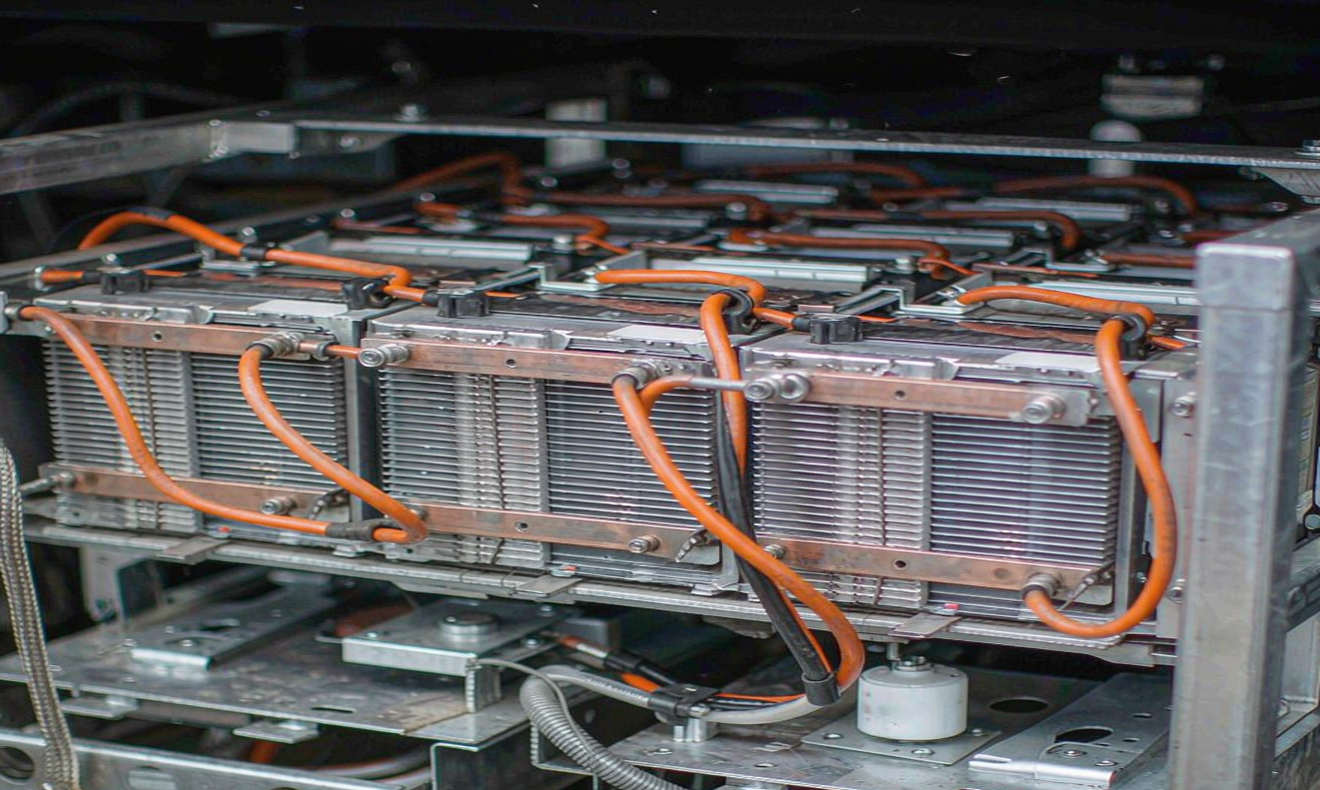
Rolling stock is a vibration environment. A pack rated only for static industrial duty will work for six months and then start loosening busbars. I design the rack with welded stainless brackets, spring washers at every cell terminal, and a busbar stack of 0.15 to 0.2 millimetre nickel plate that survives the thermal cycling without work hardening. After commissioning, the depot tightens every Mechanical joint at six months and then annually, and we have never seen a thermal event that traced back to a re-torqued joint done properly.
The thermal path is easier than in an automobile because there is no tight packaging, but the ambient is worse. Underfloor bays reach 45 to 55 degrees Celsius in a summer city, and the winter start in northern China or Canada can be minus 25 degrees Celsius. That means conduction cooling through a cold plate fed from the vehicle loop at 30 to 40 degrees Celsius, plus a resistive heater bundle that brings the cells above 0 degrees Celsius before the traction contactor closes. The heater itself is trivial; the control logic that decides when it runs is where the bugs live.
Fire hardware is where rail differs from every other application I work on. The pack bay is separated from the passenger saloon by a steel partition, the vent duct routes gases to the roof outside the cab, gas sensors trigger depot alarm as well as local exit lighting, and a fixed water mist loop gives the fire brigade something predictable to aim at. Enclosures carry at least IP54 and we specify IP65 for any bay that road washers can spray. On the documentation side, EN 45545-2 hazard level HL3 restricts smoke and toxicity of every organic material in the bay, which rules out a lot of cheap potting compounds.
Supply voltages, isolation and integration
Trams and trolleybuses run from a 600 to 800 volt direct current contact system, most commonly a nominal 750 V overhead line or a 750 V third rail, with trolleybuses at 600 to 750 V. The battery pack itself is therefore an intermediate voltage architecture: a 600 V class assembly of roughly 150 to 200 lithium iron phosphate cells in series, with a charge accept range set by the chopper or the on-board charger.
Isolation monitoring is what I see missing most often on second-hand equipment. A 600 V class pack needs insulation resistance discipline along the lines of 500 ohm per volt, so roughly 300 kilohms minimum measured after a cold soak, and the depot needs the tracking trend rather than a single pass or fail. Continuous insulation monitoring with an alarm at half the trip level costs very little and has saved two of my projects from a fleet wide outage.
On the control side, the pack talks to the traction equipment over CANopen or a railway fieldbus, and reports to the depot over the vehicle Ethernet or mobile link. The depot consumes something boring: cell min and max volts, pack volts, current, four temperatures, insulation resistance, fault history and cumulative ampere hours. If the pack cannot export that, you replace packs blind.
Acceptance, maintenance and end of life
Acceptance testing for rail packs is more paperwork than cell testing. We do a full ramp discharge at 0.5C to confirm delivered capacity, a 30 minute high-rate discharge to prove the power claim, a vibration bench pass to the rolling stock profile, and a thermal soak at both extremes. Then a two week on-vehicle observation before the pack is signed off, because no test rig reproduces a city centre with ten stops an hour at 35 degrees Celsius.
In service, I recommend a capacity check every six months, a full ramp once a year, and a replacement trigger at 70 to 80 percent of nameplate capacity. Balancing drift above 30 millivolts between cells in the same module is the early warning I act on. Most packs I retire are at 78 percent on the first retirement date and simply get moved to depot shunting or lighting duty rather than scrapped.
What we quote as a custom battery solution for these vehicles is therefore not a catalogue item. It is a rack with a defined thermal path, a fire wall, a communication profile the depot can read, and a service interval the operator can plan a budget against. Get those four right and the pack outlasts the traction motors.
How large is a tram battery in practice?
Most city trams carry 40 to 120 kWh of usable capacity against a daily consumption of 400 to 900 kWh, because the pack absorbs braking energy and peaks rather than driving range. A trolleybus usually runs 40 to 90 kWh because its consumption is only 1.5 to 2.5 kWh per kilometre.
Can a trolleybus run without its overhead wires?
Yes, but only briefly and slowly. Well designed trolleybus packs move the vehicle 100 to 300 metres at 8 to 15 kilometres per hour when the poles are down, enough to steer around traffic or reach the next wire. They are not designed for free running.
Why choose lithium iron phosphate instead of NMC for rail?
Because rail duty rewards cycle life. LFP delivers 6000 to 10000 cycles to 80 percent capacity, against 1500 to 2500 for the same duty in NMC, and a tram or trolleybus expects 12 to 20 years of service. The energy density penalty is marginal once the enclosure and fire wall are counted.
How long does a tram battery pack last?
Eight to twelve years of daily service before capacity falls to the 70 to 80 percent replacement trigger, with calendar ageing often dominating cycle ageing because each braking event only swings state of charge by 5 to 8 percent. Depots that trend internal resistance and balance voltage reliably push that out a year or two.
Which standards apply to railway battery packs?
EN 50155 covers the environmental and vibration classes for onboard equipment, EN 50121 covers electromagnetic compatibility for rolling stock, EN 45545-2 sets the fire, smoke and toxicity hazard levels for materials, and IEC 61991 covers railway battery power supplies. Transport of the cells themselves still follows UN38.3 and, for the packed battery, UN3481 by road or rail.
Can a supercapacitor replace the lithium pack?
No. A supercapacitor handles the two second braking spike brilliantly and takes hundreds of thousands of cycles, but at 5 to 8 Wh per kilogram and 20 to 30 percent self-discharge per month it cannot carry a vehicle through a layover. The useful design is a small capacitor bank in parallel with the pack to cut lithium current.
Further Reading
References