Home Energy Storage Design for Cabins
As a senior lithium battery engineer at Horizon Power, I have spent the last decade designing battery systems that have to work when there is no grid to fall back on. A cabin is one of the harshest environments you can put a battery into: temperature swings of 40 °C between a summer noon and a winter night, humidity from the surrounding forest, intermittent occupancy, and a homeowner who expects the lights to come on the moment they arrive after three months away. A generic residential battery storage unit rarely survives that duty profile. This guide walks through how we approach home energy storage design cabins — from load profiling to the safety standards that actually matter in the field.
Why a Cabin Needs a Purpose-Built Home Energy Storage System
Most cabins are either fully off-grid or connected to an unreliable radial line that drops out for days during storms. In both cases the battery is not a convenience — it is the primary source. A purpose-built home energy storage system for a cabin differs from a city installation in three ways. First, the depth of discharge (DoD) must be deeper and the cycle life longer, because the battery sees full daily cycles rather than occasional peak shaving. Second, the enclosure has to resist condensation, rodents, and UV. Third, the system needs to ride through long idle periods without the cells drifting into an unsafe voltage window. In our projects we typically specify LiFePO4 (LFP) chemistry because its flat voltage curve and thermal stability make it forgiving in exactly these conditions.
The mistake we see most often is a cabin owner buying a standard residential unit rated for a mild garage and expecting it to survive a mountain winter. It will not. Below 0 °C, charging a lithium cell without heating triggers lithium plating, which permanently loses capacity and can create dendrites. Above 45 °C, calendar aging accelerates. A cabin system therefore needs thermal control as a first-class design input, not an afterthought bolted on once the first winter kills the pack.
Sizing the Battery — Load Profiling for Off-Grid Cabins
Before we select a single cell, we build a 14-day load profile. For a typical two-bedroom cabin this includes a 12 V DC fridge (about 1.2 kWh/day), LED lighting (0.3 kWh/day), a water pump (0.4 kWh/day), a laptop and a Starlink-style router (0.5 kWh/day), and weekend-use cooking or heating spikes. Summed, that is roughly 3–5 kWh/day. We then apply a winter autonomy factor: cabins in snowy regions may see two or three consecutive cloudy days, so we design for at least two days of autonomy plus a 20% margin. A home energy storage battery of 10–14 kWh usable capacity (at 90% DoD) comfortably covers this. The rule of thumb we use is: usable capacity (kWh) = daily load × days of autonomy × 1.2.
To make that concrete, consider a cabin with a 4 kWh/day load and a worst-case three-day winter stretch. Usable capacity = 4 × 3 × 1.2 = 14.4 kWh. Because LFP is safe to 90% DoD, the nameplate pack is about 16 kWh. We then size the solar array to replace that in roughly one good day of sun — typically 5–7 kWp of panels — so the battery never enters a sustained deficit. Getting this balance right is the single biggest factor in whether the owner enjoys ten quiet years or three frustrating ones.
Chemistry and Cell Selection
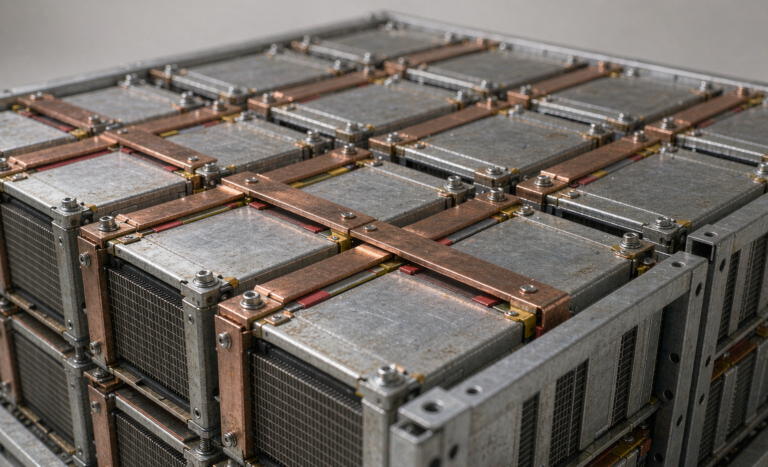
LFP is our default for cabins. Compared with NMC, LFP offers roughly 2,000–4,000 cycles at 80% state of health, operates safely up to 60 °C, and does not release oxygen at the cathode during thermal abuse. For cabins where a fire would be catastrophic and far from help, that margin matters. We grade cells by DC internal resistance (DCIR) within ±10% and capacity binning within ±3% to keep pack imbalance below 20 mV at the end of a cycle. Every module we ship carries a UN38.3 test summary and is built to IEC 62133 for transport and stationary safety — the same standards we apply to our drone battery packs, because the failure modes are identical even if the enclosure is not.
For cabins that also run a workshop or an EV charger, we sometimes step up to a higher-energy cell, but we resist NMC for stationary cabin use because its thermal runaway onset is tens of degrees lower. The small energy-density advantage is not worth a weaker safety envelope when the nearest fire crew is thirty minutes away. Where weight is irrelevant — and in a wall-mounted cabin bank it always is — LFP wins on every axis that counts.
Inverter Architecture and the BMS
The inverter decides whether your home battery backup actually keeps the lights on. We recommend a 48 V nominal bus with a hybrid inverter that supports solar MPPT, grid or generator pass-through, and seamless transfer (under 20 ms). The battery management system (BMS) is the real safety device: it must monitor per-cell voltage, pack current, and temperature, and it must open the contactor on over-voltage (3.65 V/cell for LFP), under-voltage (2.5 V/cell), or a ΔT fault. We log BMS data over Modbus/CAN so the owner can see state of charge (SoC) and state of health (SoH) from a phone app. This telemetry is what lets a remotely located cabin flag a weak cell before it becomes a roadside call.
Installation, Thermal Management, and Home Battery Backup
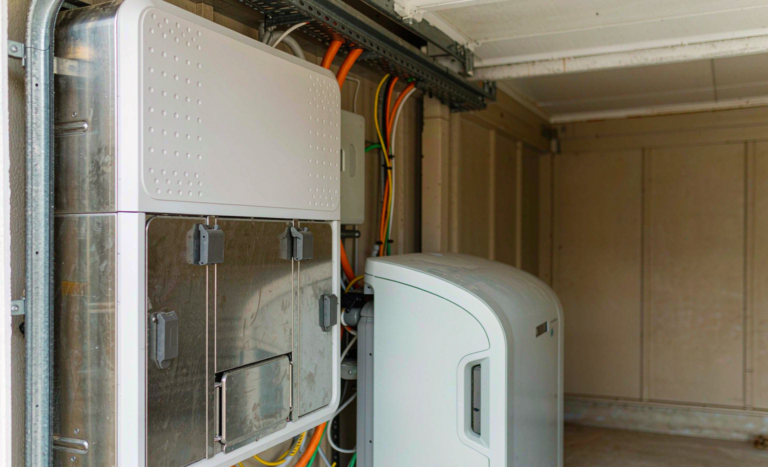
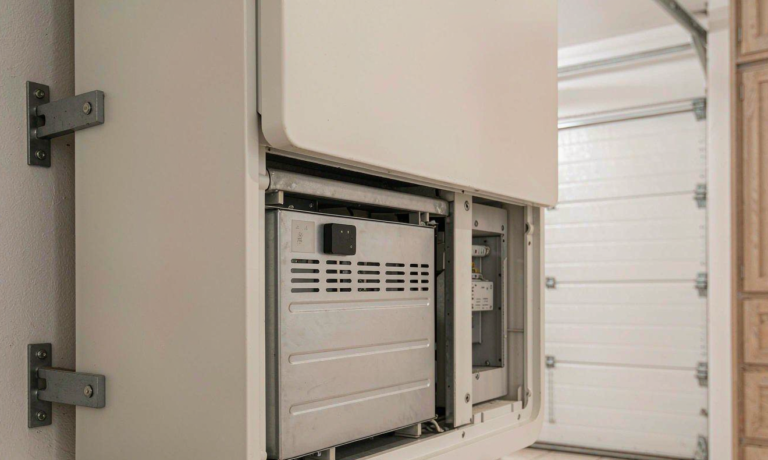
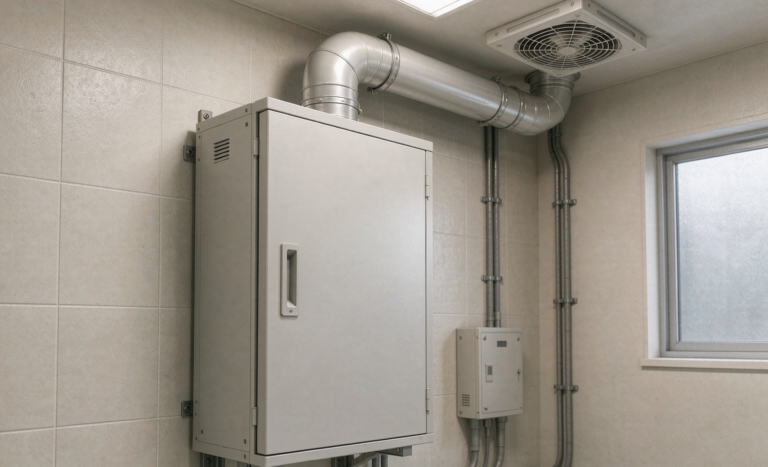
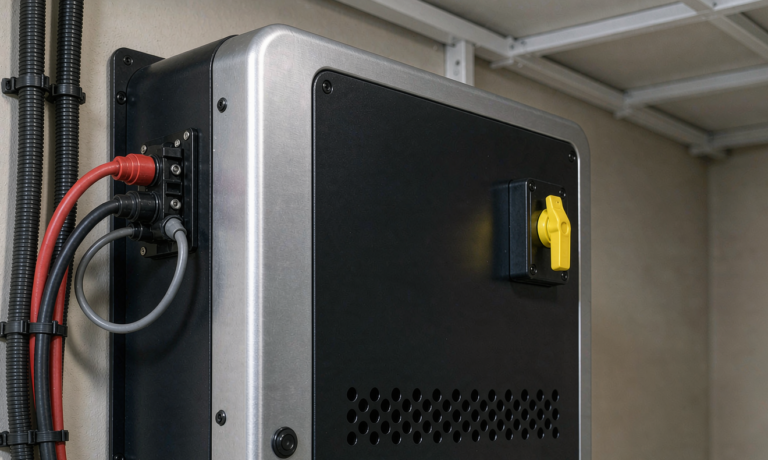
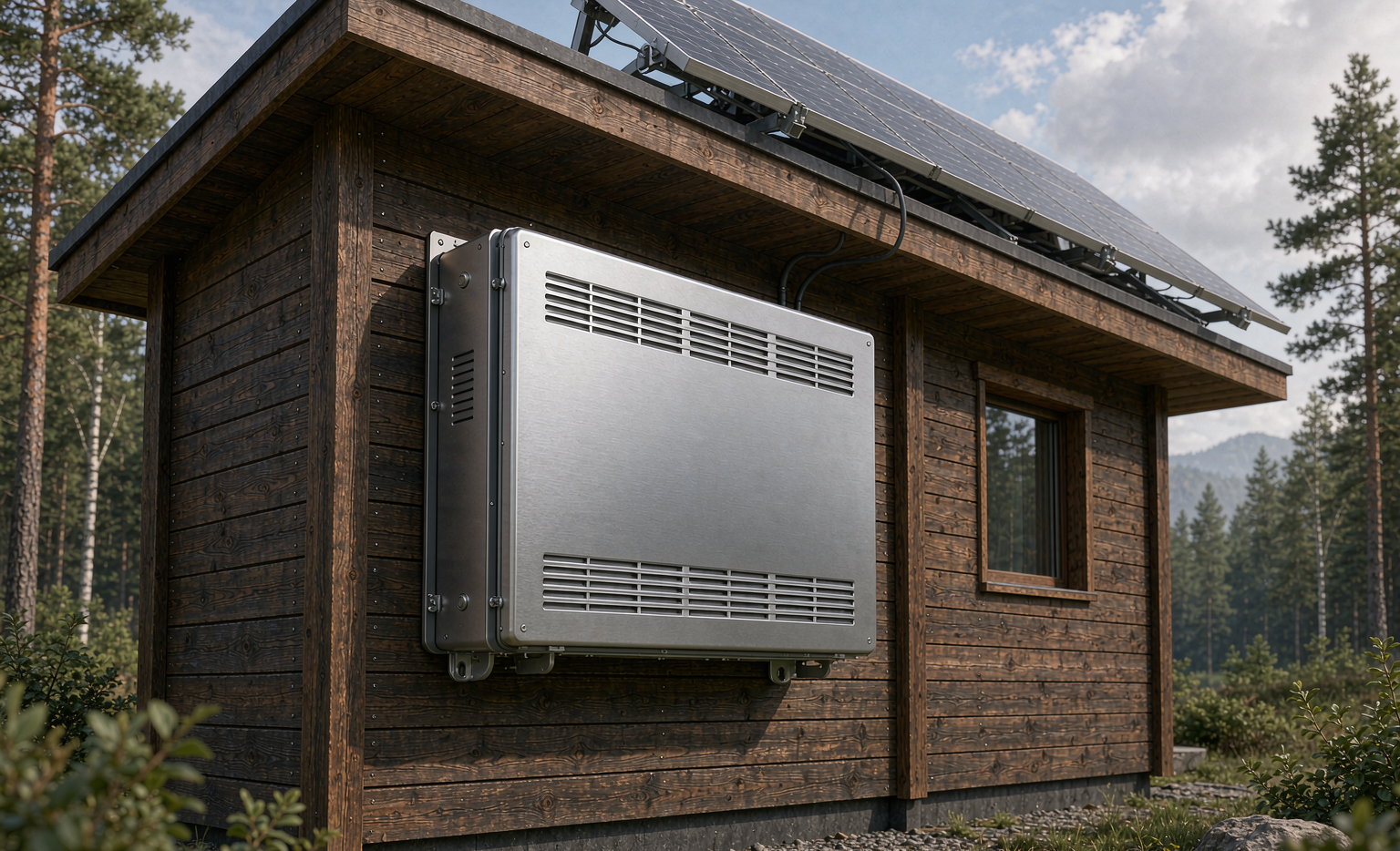
Cabins swing in temperature more than any suburban garage. We mount the enclosure on a shaded north wall (in the northern hemisphere) with at least 10 cm of air gap, and we add a low-wattage thermostatic pad for sub-zero starts. For home battery backup during outages, we size the inverter’s surge rating to the largest motor load — usually the well pump — at 3× running watts. Ventilation is passive but deliberate: the enclosure breathes through a condensate-protected louvre, and we never install a residential battery storage bank inside the living space. Where the cabin is also a workshop, we keep the battery on its own branch with an accessible DC disconnect.
One detail newcomers miss is surge protection. Remote cabins sit on long, exposed lines and catch lightning that a suburban home rarely sees. We fit a Type 1+2 surge arrester on both the AC and the PV inputs and bond the enclosure to a proper earth electrode. A home battery backup is only as reliable as the transient protection in front of it, and a single un-arrested spike can take out the inverter and the BMS in the same strike.
Monitoring, Maintenance, and Longevity
A cabin battery is often unattended for months. We set the BMS to a storage SoC of 50–60% and a float trickle from a small solar maintainer if the site is abandoned through winter. Annual maintenance is light: torque-check terminals, verify the BMS firmware, and run a capacity check every 12 months. With proper home energy storage design cabins can expect 10+ years of service before SoH drops below 80%. The economics are straightforward — a well-specified system pays back inside its warranty window, and the peace of mind of arriving to a warm, lit cabin is harder to quantify but rarely regretted.
Commissioning and Your First Winter Checklist
Commissioning is where good designs fail or shine. On first energization we balance every cell to within 10 mV at the top of charge, verify the inverter transfer time under a live load, and confirm the BMS opens the contactor on a forced fault test — never skip this, because a BMS that has never been fault-tested is an unknown. Before the owner leaves for the season we walk a short checklist: storage SoC set, remote monitoring credentials handed over, DC disconnect labeled, and a paper card in the panel stating the chemistries and the emergency shutdown path. A home energy storage system that is documented and testable is one the owner will trust for a decade.
FAQ
What size home energy storage system do I need for a weekend cabin?
For a typical two-bedroom weekend cabin using 3–5 kWh/day, plan on 10–14 kWh of usable LFP capacity to cover two cloudy days plus margin. If you run electric heating or a well pump with a large motor, add the surge and autonomy headroom before sizing.
Is LiFePO4 safe to install in a wooden cabin?
Yes. LFP is the safest mainstream lithium chemistry: it is thermally stable, does not vent oxygen under abuse, and we build every enclosure to IEC 62133 with a BMS that interrupts faults in milliseconds. Install it outside the living space on a non-combustible backing with a DC disconnect.
Can I expand the battery later?
Design the 48 V bus and inverter headroom for expansion from day one. We parallel additional LFP modules of the same grade (matched DCIR and capacity binning) and let the BMS re-balance. Avoid mixing old and new chemistries on the same string.
How do I keep the battery healthy during long vacant periods?
Set storage SoC to 50–60%, enable a small solar maintainer, and have the BMS report SoC/SoH remotely. A healthy storage window prevents the deep self-discharge drift that damages cells left unattended for months.
Which standards should my cabin battery meet?
At minimum, UN38.3 for transport, IEC 62133 for cell and pack safety, and a BMS certified for the stationary application. For aviation-adjacent or remote deployments we reference FAA/EASA guidance on lithium battery containment as an added design checkpoint.