Home Energy Storage Performance for Cabins
When most people picture a home energy storage system, they imagine a suburban garage: a 10 kWh wall unit quietly shaving a few dollars off the evening utility bill. A cabin is the opposite problem. After fifteen years engineering battery packs for harsh, intermittent-duty applications, I can tell you that a cabin is one of the most demanding performance cases in the entire residential battery storage market. The building sits empty for days or weeks, then a family arrives, flips on the heat, the refrigerator, the lights, the well pump, and a laptop charger at the same instant. The pack goes from near-idle to a brutal multi-kilowatt step load in under a second.
This article is a performance engineer’s view of what actually matters when you spec, build, or buy a home energy storage system for a cabin — not the marketing sheet, but the C-rates, the cold-weather derating, the inverter surge headroom, and the partial-state-of-charge cycling that decides whether the lights stay on on night three of a long weekend.
Why Cabin Loads Are a Different Performance Problem
The defining feature of a cabin battery system is the mismatch between its two operating states. For 90% of the calendar, the pack is parked at partial state of charge, slowly drifting on a tiny self-discharge and a trickle of solar. Then occupancy arrives and the load profile snaps to something that looks like a small construction site. This is exactly the kind of bursty, non-continuous duty I have spent years designing around in other fields.
In a typical suburban energy storage system, the inverter rarely sees more than 0.2C of continuous load. In a cabin, the peak-to-average ratio is often 8:1 or higher. A 1,200 W well pump can draw 3,500 W for 200 ms at start-up. An electric water heater element is a flat 4,500 W. A heat-pump startup surge can hit 6–8 kW. If the pack and inverter cannot deliver that step without the bus voltage collapsing, the inverter trips and the whole system goes dark — the single most common “failure” cabin owners report, and almost always a performance-specification error rather than a battery defect.
Sizing for Peak Power, Not Just Stored Energy
The first mistake I see is specifying a home energy storage system by energy (kWh) alone. Energy decides how long you run; power decides whether you run at all. For a cabin, I recommend sizing the inverter to the sum of the three largest simultaneous loads plus 25% headroom, then sizing the battery to the desired autonomy at the expected average draw.
The battery itself must support the inverter’s C-rate. A 10 kWh pack asked to deliver 6 kW is running at 0.6C — comfortable for lithium battery chemistry. But a 5 kWh pack delivering the same 6 kW is at 1.2C, and the internal resistance penalty grows non-linearly. Voltage sag = I × R_internal. At 1.2C with a 6 mΩ pack resistance, you lose 0.43 V per cell-string segment; across a 16S (51.2 V) LFP pack that is roughly 7 V of sag before the BMS sees it. Keep sustained cabin loads at or below 0.5C and reserve the upper C-rate band for the sub-second motor and compressor surges.
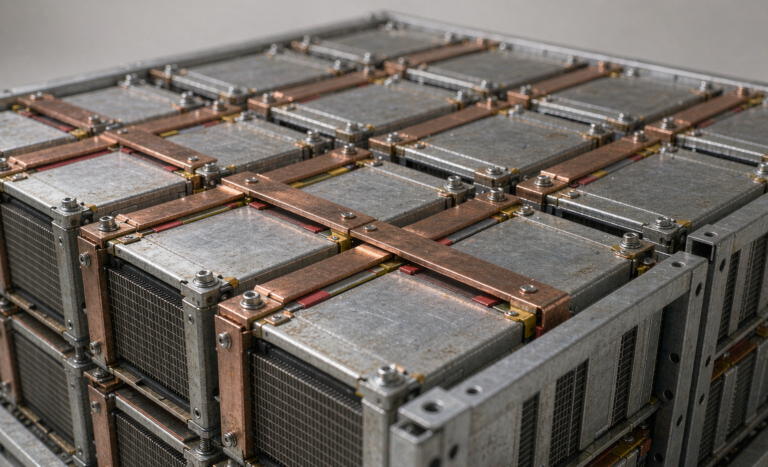
When a client needs a pack that comfortably rides these surges, we deliver it as a custom battery solution: matched-cell modules with a low-DCIR busbar layout and a BMS tuned for 3× rated surge for 500 ms, exactly the envelope a well pump or compressor demands.
Cold-Climate Performance: How LFP Behaves Below Freezing
Most cabins are unheated when empty. The pack can sit at −10 °C to −20 °C for weeks. This is where chemistry choice becomes a performance decision, not just a cost one. Lithium iron phosphate (LFP) is my default for cabins because of its flat voltage curve and long cycle life, but it has a hard rule: do not charge below 0 °C without current limiting, or you plate metallic lithium onto the anode and permanently lose capacity.
The performance fix is a temperature-compensated charge profile. Below 10 °C we derate charge current to roughly 0.1–0.2C and lower the termination voltage slightly; between 10–45 °C we run full rate. Discharge, by contrast, stays strong in the cold — an LFP cell still delivers 85–92% of its 25 °C capacity at −10 °C. So the real cold-weather performance risk is the charge event after a sunny winter day, not the evening load. A good home energy storage controller threads this automatically; a cheap one either blocks winter charging entirely (wasted solar) or silently damages the cells.
For cabins that must charge in deep cold, we add a small self-heating film or thermally couple the pack to the inverter’s waste heat — a detail that separates a usable mountain cabin battery from a decorative one.
Round-Trip Efficiency and the Partial-SoC Cabin Duty Cycle
Efficiency is where small percentages become real money. A cabin runs on intermittent, partial cycles: solar trickles in, a load event pulls a few kWh, the pack sits again. Every conversion leg costs you. A quality LFP residential battery storage system with a high-frequency hybrid inverter delivers 90–95% round-trip efficiency at the 0.2–0.5C cabin duty band. A worn lead-acid bank or a poorly matched inverter can bleed that to 70–80%, meaning 20–30% of your hard-won solar never reaches the toaster.
The cabin duty cycle also lives in the partial-state-of-charge (partial-SoC) regime far more than a daily-cycling home. Modern LFP tolerates partial-SoC indefinitely without the memory effect that crippled older chemistries, but it does demand periodic balancing. I spec a full balance charge (every cell within 30 mV) at least once every 10–15 cycles, or the pack’s usable capacity quietly shrinks as the weakest cell caps the string.
AC-Coupling vs DC-Coupling and Inverter Loading
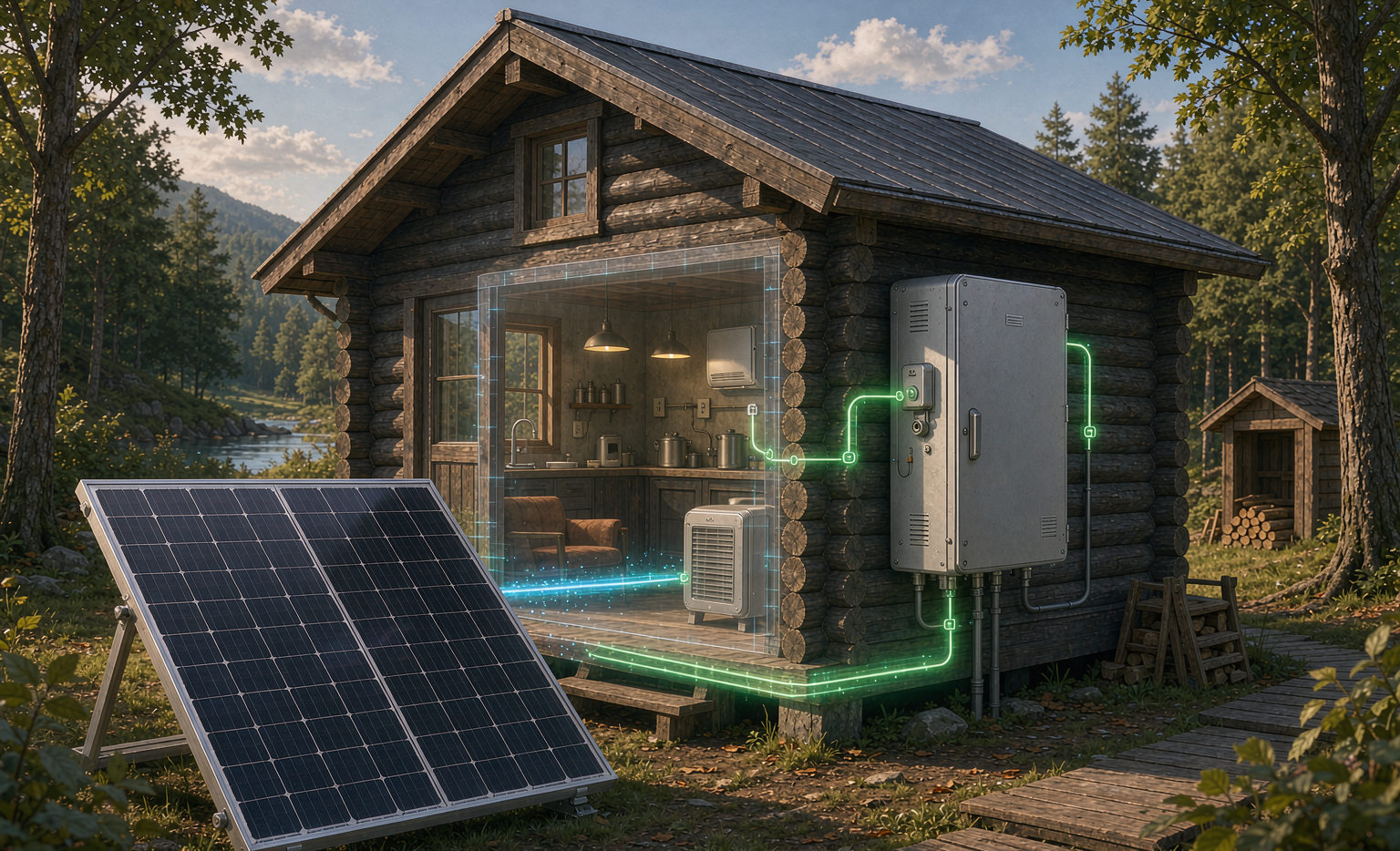
There are two ways to wire solar into a cabin energy storage system. DC-coupling runs the panels through a charge controller straight into the battery bus, then inverts once. AC-coupling runs the panels through their own grid-tie inverter into the AC bus, where the battery inverter synchronizes and stores excess. For a retrofit cabin with an existing solar inverter, AC-coupling is cheaper and faster. For a ground-up build, DC-coupling usually wins on efficiency — one conversion instead of two — and gives tighter BMS control.
Whichever you choose, watch the inverter’s continuous and surge ratings like a hawk. The surge rating (typically 2–3× continuous for 5–20 seconds) is the number that decides whether your pump starts. I have seen 5 kW inverters that would not start a 1.1 kW well pump because the locked-rotor surge exceeded their 10 kW ceiling for the required duration. Match the surge window, not just the wattage.
Load Prioritization and the Autonomy Trade-Off
Cabin performance is ultimately about autonomy: how many days can you stay before the pack hits its reserve floor? The lever most owners ignore is load prioritization. A simple contactor-and-relay scheme can shed the water heater and space heater at 20% state of charge, keeping the refrigerator, lights, and internet alive for two extra days. That is a far cheaper way to extend autonomy than adding another 5 kWh of cells.
When I design a custom battery solution for a remote cabin, I almost always include a programmable load-shed relay and a critical-loads sub-panel. The performance win is not just more hours of runtime — it is graceful degradation instead of a hard system collapse.
For owners who also run field equipment, the same battery discipline applies: I have advised drone operators on-site to keep a dedicated drone battery charger on the critical-loads panel so survey missions are never stranded by a dead cabin bank.
The Engineering Standards Floor
None of this performance is safe without a compliance baseline. Every cabin home energy storage system I ship is built to a stack I consider non-negotiable: UN38.3 (T.1–T.8 transport simulation), IEC 62133-2 (cell-level safety), IEC 62619 (industrial stationary cells), UL 1973 (stationary battery systems), UL 9540 / UL 9540A (system and fire-containment), IEEE 1547 (grid interconnection), and NFPA 855 (installation fire code). For the lithium battery cells themselves, transport and handling follow IATA Section II at ≤30% state of charge. This is the floor, not the ceiling — but a cabin pack that skips it is a liability, not a convenience.
FAQ
How big should a cabin battery system be?
For a typical weekend cabin with a refrigerator, lights, and phone charging, start at 10–15 kWh of usable LFP capacity with a 5 kW continuous / 10 kW surge inverter. Add 5 kWh per major electric appliance you cannot live without (well pump, heat pump, electric water heater). Size the inverter for peak power first; size the battery for autonomy second.
Can a home energy storage system run a cabin heater or AC?
Resistive electric heat and AC are the two largest cabin loads and the two I most often recommend shedding or replacing with propane. A heat pump is far more battery-friendly (3–4× efficiency) but still demands a healthy surge margin. If you must run electric heat off the pack, budget it as a dedicated load and confirm the inverter surge window covers the compressor start every time.
Does cold weather kill cabin battery performance?
Cold hurts charging, not discharging. An LFP pack still delivers 85–92% of rated capacity at −10 °C. The danger is charging a cold pack, which plates lithium. Use a temperature-compensated charge profile that limits current below 10 °C, or add pack heating for deep-winter cabins. Properly managed, a cabin home energy storage system performs reliably year-round.
How long will a cabin battery last between visits?
With self-discharge under 3% per month and a solar trickle, an LFP residential battery storage bank stays healthy for months unattended. The practical limit is usually the appliances’ own standby draw, not the battery. For seasonal cabins, I set a “maintenance floor” of 40% state of charge and a monthly solar top-up so the pack never sits deeply discharged through a freeze.