Semi-Solid State Battery for 12V Start-Stop and Mild Hybrid
In fifteen years building lithium battery packs for automotive and industrial customers, the hardest request has never been the biggest one. It is the small one: a 12 V pack that cranks an engine on a winter morning, then soaks up regeneration pulses twenty times before lunch. That duty profile is where a flooded lead-acid battery goes first and where a well-built lithium battery has to earn its price. Below is how we specify a pack for stop-start and mild-hybrid platforms, where the semi-solid state battery fits, and which tests actually reject a design. This is the reasoning behind every custom battery solution we quote.
Why Start-Stop Duty Cycles Break Lead-Acid
Stop-start control shuts the engine at junctions and restarts it the moment the driver releases the brake. The battery never gets a rest, only a burst of a few hundred amps lasting two to four seconds followed by a partial recharge, then the same again minutes later. Repeated deep partial cycles are precisely what a lead-acid plate cannot survive; the active material sheds and the plate stratifies even without a full deep discharge.
A flooded cranking battery usually delivers 400 to 600 deep cycles before capacity falls below what the control unit accepts. AGM versions push toward 900 to 1000 cycles, at roughly three times the price. The failure mode is rarely a sudden dead cell. It is progressive capacity loss and rising internal resistance, and it first shows up as slower crank speed on cold mornings. In fleet data we reviewed, replacement clustered at 30 to 45 months of city duty, short against the eight to twelve year life those vehicles expect from the starter motor.
What a 12V Lithium Start-Stop Pack Has to Do
Cranking and crank-plus-load pulses
A 12 V lithium starting pack is normally a 12.8 V nominal assembly built from four cells in series, sized between 40 and 60 amp hours, which places it at roughly 0.5 to 0.8 kWh. That sounds tiny next to a traction pack, but the power requirement is brutal: 300 to 500 A for three to five seconds while the starter motor turns an engine over at cranking speed, and this has to hold at minus 25 degrees Celsius. The pack also has to absorb the alternator reclaim and, on mild-hybrid platforms, repeated regenerative braking charges that arrive as fast current pulses rather than a slow trickle.
EN 50498 defines the test and general requirements for battery monitoring systems in road vehicles, and it sets the expectation that the battery state estimate stays inside a tight band across the whole state of charge range. That is the specification most integrators underestimate. The pack is not only a power source; it is a measured device that the engine control loop reads every few milliseconds.
Depth of discharge and the thermal budget
Each stop-start event removes maybe 8 to 12 percent of pack capacity. On a 50 amp hour pack at 12.8 V that is a 60 to 80 watt hour bite, twenty times a day, which is a genuine daily throughput of 1 to 1.6 kWh. Charge acceptance at low state of charge is the limit, not the discharge. A lithium cell that cannot take the alternator current back at 70 percent state of charge will sit the pack permanently in a shallow cycle and lose the service life benefit entirely.
The other budget item is heat. A 450 amp pulse across a 30 milliohm path puts roughly 6 watts into the busbars and cells per event. Alone that is nothing; twenty events a day with incomplete cooling piles up. That is why we bond a cell temperature sensor to the widest cell face and use it to derate both the crank window and the regen acceptance.
Cell Selection: LFP, NMC and Lithium-Titanate for Cranking
For a 12 V cranking duty I stay with lithium iron phosphate. Its 3.2 V nominal platform, thermal runaway onset well above 250 degrees Celsius, and 3000 to 5000 cycle life at 50 percent depth of discharge are exactly what a start-stop loop wants. NMC carries 160 to 220 watt hours per kilogram against 120 to 160 for LFP, but for a 0.7 kWh under-hood pack that density is irrelevant. What matters is the safe envelope and the flat, predictable behaviour.
Lithium-titanate oxide cells are the other serious candidate, accepting 4C to 6C charge and delivering 3000 to 7000 cycles, which suits duty cycles with a very short recharge window. Their energy density is low, around 60 to 90 watt hours per kilogram, so the pack gets physically larger for the same crank amps. We use them where the recharge window is shorter than a traffic light, and not where under-hood space is fixed.
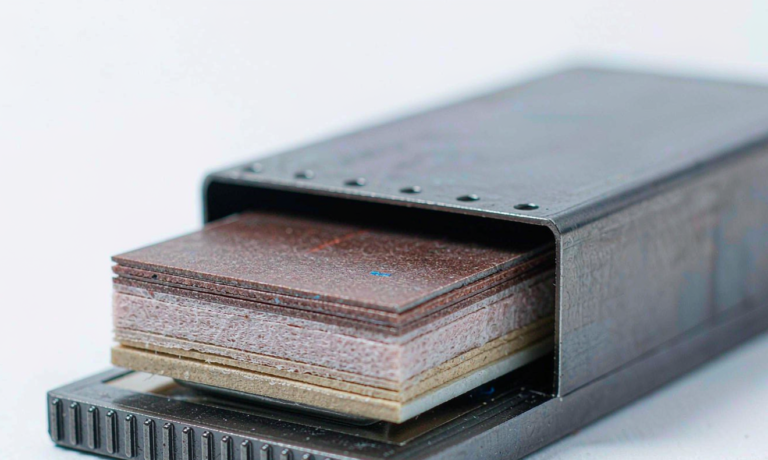
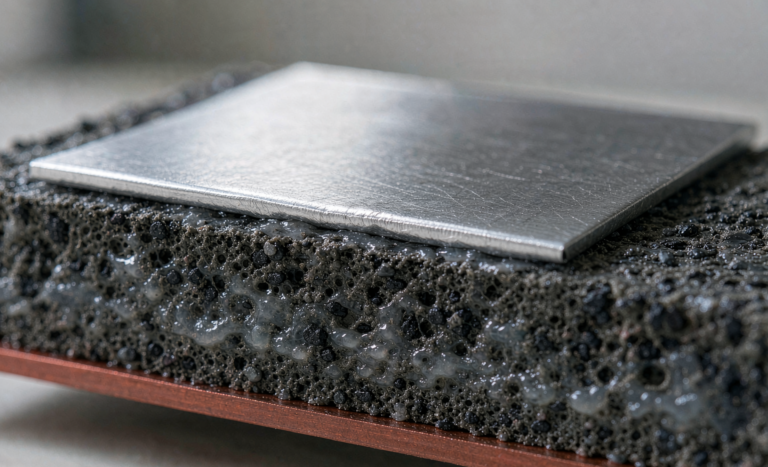
The semi-solid state battery now deserves a look in this segment. A partially solid electrolyte flattens interfacial resistance during high-rate pulses, which is a real cranking advantage, and cells on our pilot line show lower impedance growth over the first few hundred cycles than comparable liquid-electrolyte cells. My honest advice to customers is that the benefit is genuine but the cost per kilowatt hour is still high, and a 12 V start-stop pack should be judged on cycle life and crank power at minus 25 degrees Celsius, not on headline energy density. Ask for tested numbers, not a roadmap.
Pack Architecture: Busbars, Cases and the Thermal Path
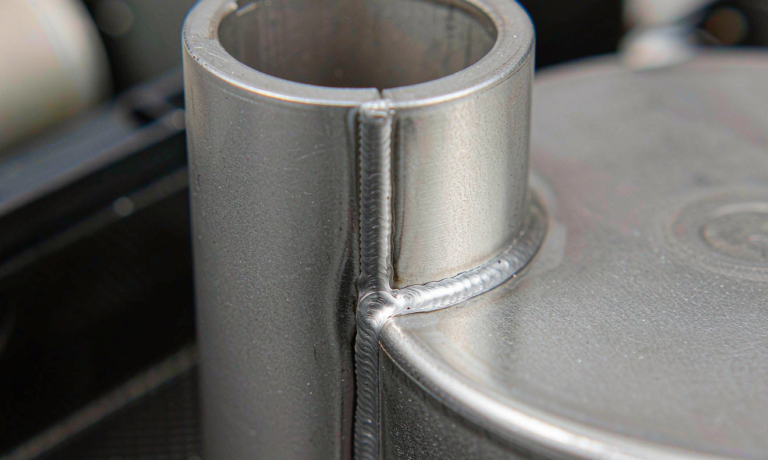
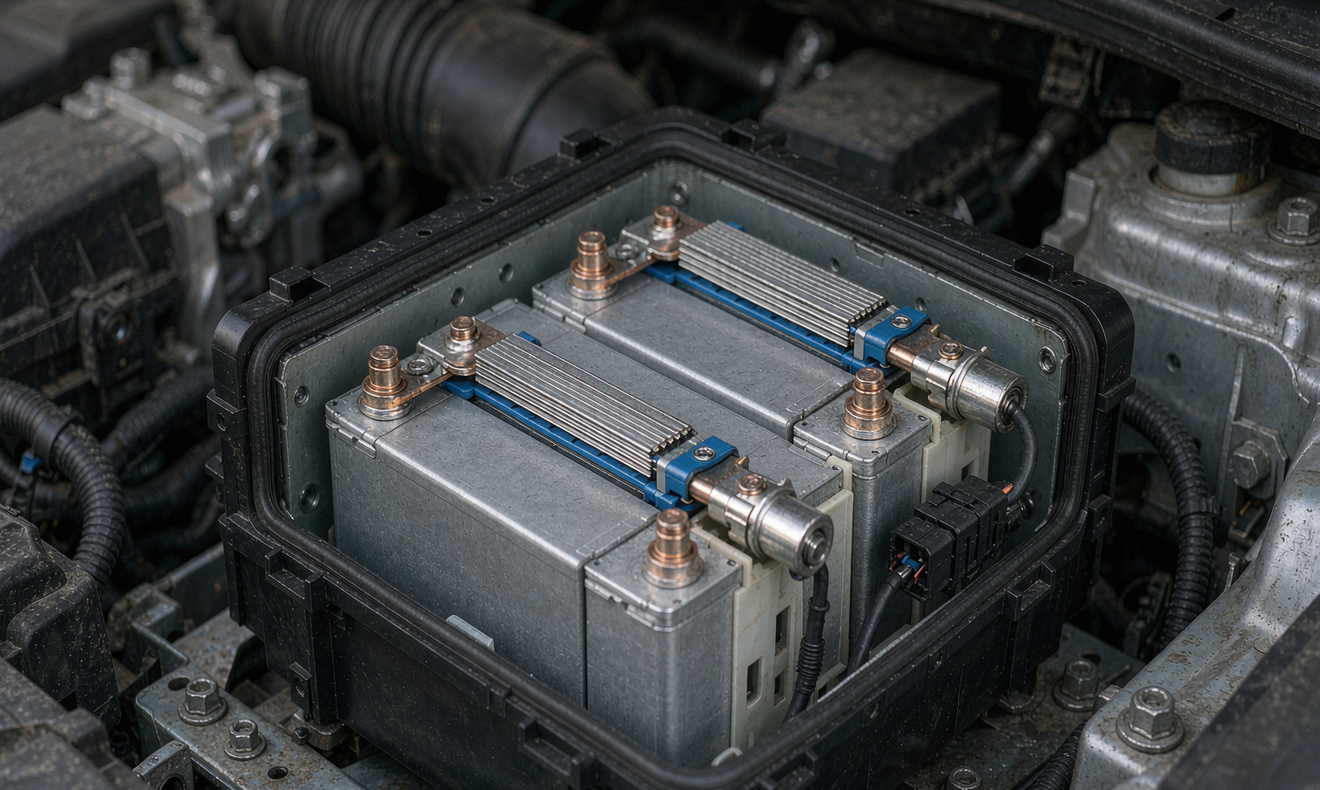
The electrical path is where most cheap packs fail. Four cells in series gives 12.8 V nominally and roughly 10 V to 11 V at the end of a cranking event, so busbar resistance directly eats crank torque. We use laser welded nickel-plated copper tab stacks and keep the DC path below 30 milliohms end to end. A pack measuring 80 milliohms will pass a bench crank test and then fail a real engine at minus 20 degrees Celsius, because cold cell voltage sags faster than the design assumed.
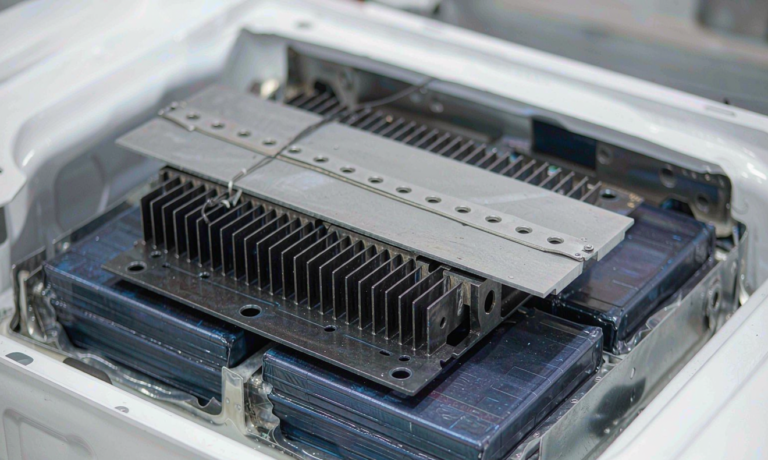
The enclosure has to survive under-hood air: an IP6K-rated housing, a pressure relief path routed away from the electronics, a lid mating to a gasket rather than a screw flange, and cell restraint that holds prismatic cells against vibration without crushing the soft-pack edges. ISO 16750-3 covers the mechanical loads for road vehicles, including random vibration in the 5 Hz to 2000 Hz band and mechanical shock, and we qualify to the severe profile because engines mount their electronics just as badly.
State of Charge Accuracy on a Flat Discharge Curve
This is the subtle engineering problem. LFP sits on a plateau around 3.2 to 3.3 V, so a 2 percent state of charge error moves terminal voltage by only about 60 mill volts. Lead-acid has a sloping open-circuit curve and can be read by voltage alone. Pure coulomb counting drifts 1 to 3 percent per hundred cycles through temperature and self-discharge error, and on a flat cell that drift is invisible in the voltage signal.
What we ship combines coulomb counting with a model-based estimator that tracks internal resistance and capacity, then corrects against terminal voltage whenever the pack settles. The acceptance target is under 5 percent error across the operating window, verified over a hundred-cycle soak. On mild-hybrid platforms this is not academic: the control unit clips regeneration once the pack crosses a state of charge ceiling, and a drifting estimate either wastes free regen energy or drops the pack below the floor that guarantees crank capability.
Qualification and Standards for Start-Stop Packs
Transport and basic cell safety are the floor. UN38.3 governs the lithium cell and battery tests required for air and road freight, and every cell we ship carries a test summary naming the cell model and manufacturer. IEC 62133-2 covers safety requirements for portable lithium cells; an under-hood pack is automotive rather than portable, but its abuse test philosophy shapes our separator and vent design.
Automotive qualification is where designs actually get separated. ISO 16750-4 sets the climatic load cases, including storage at 85 degrees Celsius and minus 40 degrees Celsius, which is what an under-hood pack sees on a summer heat soak and a Nordic winter. EN 50498 governs the battery monitoring interface. ISO 26262 governs functional safety, and depending on the OEM the battery management function is assigned ASIL B or ASIL C, which forces redundant voltage sensing and a defined fail-safe state rather than a single monitoring chip.
When we hand a start-stop pack to a customer, the report carries crank voltage traces at minus 25, minus 40 and 45 degrees Celsius, regen acceptance at 30 percent state of charge, the vibration and thermal shock logs, and a cycle life projection backed by our own test cells rather than a vendor datasheet.
Can a lithium battery replace a 12V lead-acid start-stop battery directly?
In most cases yes, but the charging interface matters. A drop-in pack with the same footprint, terminals and monitoring signalling will usually work, and the vehicle sees a healthier battery. If the platform uses a battery monitoring system with a specific data bus, you either replicate that bus or accept that the information goes missing.
How long does a lithium start-stop battery last in daily city driving?
A correctly charged lithium iron phosphate pack in stop-start duty should run 1500 to 3000 start cycles a month for six to ten years. The realistic limit is rarely the cell. It is winter charge acceptance, vibration damage to the busbar joint, and a state of charge estimator that drifts until the pack sits permanently clipped at a low floor.
Does a lithium start-stop pack need a special alternator?
Usually not, but buck-type alternators with reduced output at low charge voltage need a pack that accepts current at 13.8 V without gassing concerns. A strong equalisation pulse meant for lead-antimony plates is simply ignored by a lithium pack, which is fine. What you should not do is fit lithium without checking the charging voltage envelope.
Will a lithium start-stop battery survive cold winter cranking?
Yes, and this is one of its strongest advantages. Lithium iron phosphate loses available capacity in the cold but keeps a usable crank power window down to minus 30 degrees Celsius, and self-heating from each pulse partially compensates. The detail that matters is busbar resistance: a low resistance path holds terminal voltage above the starter threshold when the cells are cold.
Is a semi-solid state battery better than conventional LFP for start-stop?
For cranking, the interesting property is lower impedance growth under high-rate pulses, which keeps crank voltage healthy as the pack ages. Energy density advantages do not matter in a small under-hood pack. If the supplier cannot show cranking data at minus 25 degrees Celsius plus a cycle projection measured on their own cells, treat the claim as premature.
What warranty should I expect from a lithium start-stop pack?
A genuine automotive-grade pack carries three to five years against capacity loss below 70 percent of nameplate, plus a stated cranking amp guarantee. Claims in this segment are almost always charging interface problems rather than cell defects, so confirm the alternator profile and the state of charge algorithm before you buy, not after.
Further Reading
References