Sodium-Ion Battery Telecom Tower Backbone: An Engineer’s Field Guide to Off-Grid Power
As a senior lithium battery engineer, I have spent the better part of fifteen years standing in the mud next to telecom towers, listening to diesel generators cough their way through another cold night. The “backbone” of any telecom site is not the antenna on top — it is the battery bank that keeps the radios alive when the grid drops. For years that backbone meant lead-acid, and more recently lithium iron phosphate (LFP). In 2026 a quieter shift is underway: the sodium-ion battery telecom tower backbone is moving from pilot to mainstream at remote and off-grid sites. I want to walk you through why, what the real trade-offs are, and how we actually spec these systems in the field.
Why the Telecom Tower Backbone Needs a Better Battery
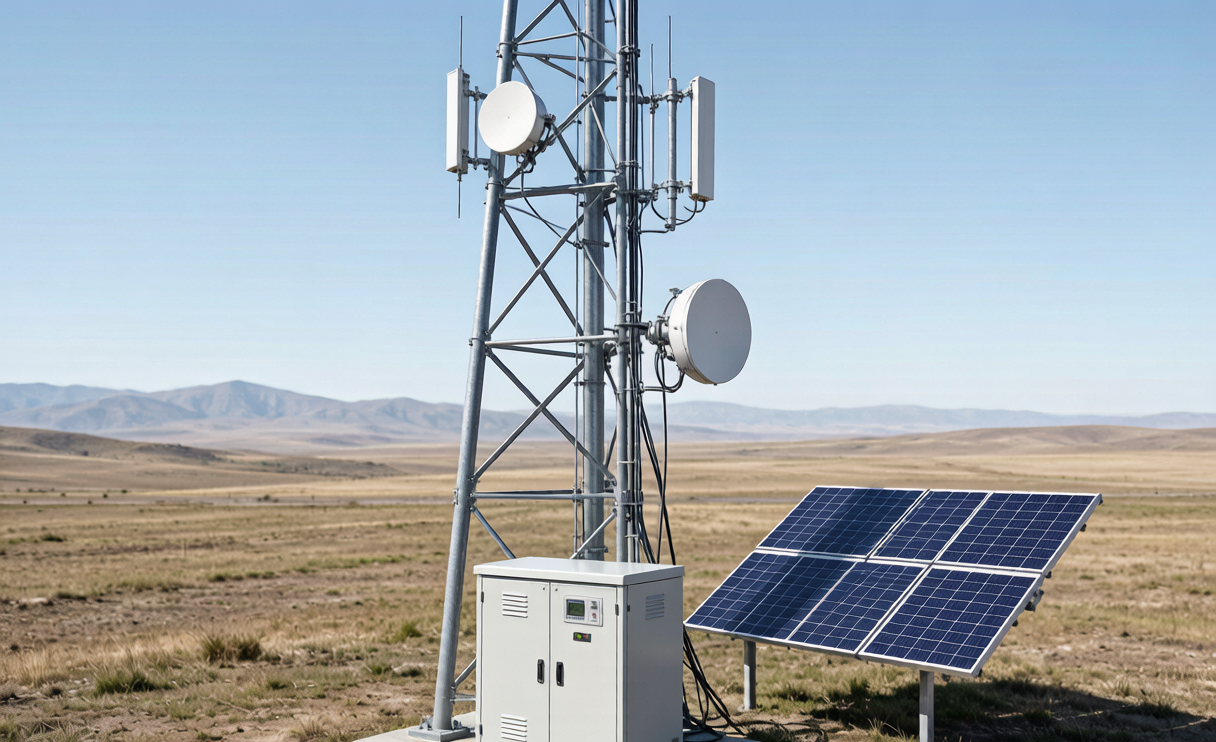
Most people picture a telecom tower as a steel mast with a blinking light. The part that keeps your call connected is the power system at the base. At a typical rural site the grid is either absent or unreliable, and the local utility may drop for hours at a time. The battery bank is the only thing standing between a dropped call and a regional outage.
- Diesel generators have been the traditional backbone. They work, but they burn fuel, need monthly refueling, invite fuel theft, and push a steady stream of CO2 and maintenance tickets onto the ops team.
- Lead-acid batteries are cheap upfront but short-lived, hate heat, and lose most of their capacity in the cold — exactly the conditions you find at remote towers.
- Lithium batteries (mostly LFP) fixed the cycle life and weight problems, yet material cost volatility and thermal-management requirements still make operators nervous at scale.
The backbone we want delivers long autonomy, survives -30°C to +50°C, needs almost no maintenance, and never becomes a fire risk. That is the bar a sodium ion battery has to clear.
What Makes Sodium-Ion a Strong Backbone Candidate
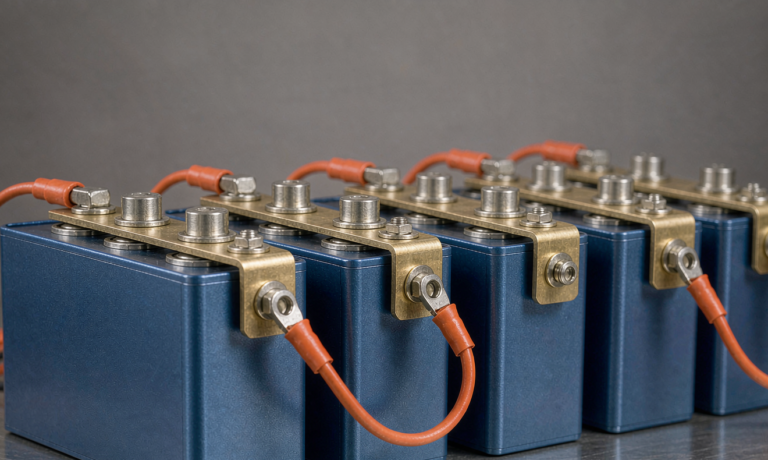
Sodium-ion chemistry moves sodium ions between a hard-carbon anode and a layered-oxide or Prussian-blue-type cathode. No lithium, no cobalt, no nickel. That single fact changes the economics and the geography of the supply chain. Here is what we measure in the lab and confirm in the field:
- Wide operating temperature. Cells stay healthy from roughly -40°C to +80°C. At -20°C a good cell still delivers around 90% of its room-temperature capacity, against the 60-70% an LFP cell manages without a heater.
- Inherent safety. Sodium chemistry is harder to push into thermal runaway. There is no plating dendrite issue like metallic lithium, and the cell tolerates over-charge abuse far better. For an unattended cabinet in the middle of nowhere, that margin matters more than a few percent of energy density.
- Material abundance. Sodium comes from salt. The cathode avoids critical minerals entirely, so the bill of materials does not swing with lithium or cobalt spot prices.
- Cycle life. We routinely see 3,000 to 6,000 cycles at 80% depth of discharge in stationary telecom duty.
- Energy density trade-off. Expect 120-160 Wh/kg versus 160-200 Wh/kg for LFP. The footprint is bigger, but a telecom cabinet is stationary — floor space is rarely the binding constraint.
For a sodium-ion battery telecom tower backbone, those properties line up almost perfectly with what the site actually demands.
Sodium-Ion vs LFP: The Trade-offs Engineers Actually Weigh
I am not here to tell you sodium-ion beats lithium everywhere. It does not. The honest comparison looks like this:
- Sodium-ion wins on low-temperature performance, intrinsic safety, supply-chain stability, and long-term cost predictability. It also avoids the heating pads that LFP cabinets need in cold climates — pads that quietly eat 200-400 W around the clock.
- LFP wins on gravimetric and volumetric energy density, product maturity, and a decade of field track record. If you are space-constrained or weight-limited, LFP still has the edge.
For a stationary telecom backbone the tie-breakers are usually cold performance, safety margin, and total cost of ownership over ten years — all places where the lithium battery incumbent starts to look expensive to keep warm and insured. We increasingly treat sodium-ion as the default where ambient lows drop below -10°C.
Certifications and Standards You Cannot Skip
A battery is only as good as the paperwork that lets it ship and get installed. Before any sodium-ion battery telecom tower backbone leaves our building, it carries:
- UN38.3 (Tests T.1-T.8) for safe transport of lithium- and sodium-based cells.
- IEC 62133-2 for the safety of secondary cells and batteries containing alkaline or non-acid electrolytes.
- IEC 62619 for the safety requirements of industrial stationary batteries.
- UL 1973 for batteries used in stationary and motive auxiliary power applications.
- IEC 62477-1 for the safety of power electronic converter systems that sit between the pack and the load.
- IEC 60529 ingress-protection rating on the cabinet itself — we specify IP55 as a floor and IP65 for coastal or dusty sites.
- Telecom-site specifics: lightning protection to IEC 62305, EMC to EN 301 489, and proper site grounding so a strike does not travel through the BMS.
Do not let a vendor ship without these. A missing UN38.3 document will stop a container at the port; a missing IEC 62619 will stop an insurer from signing off.
Designing a Sodium-Ion Backbone System: From Cabinet to BMS
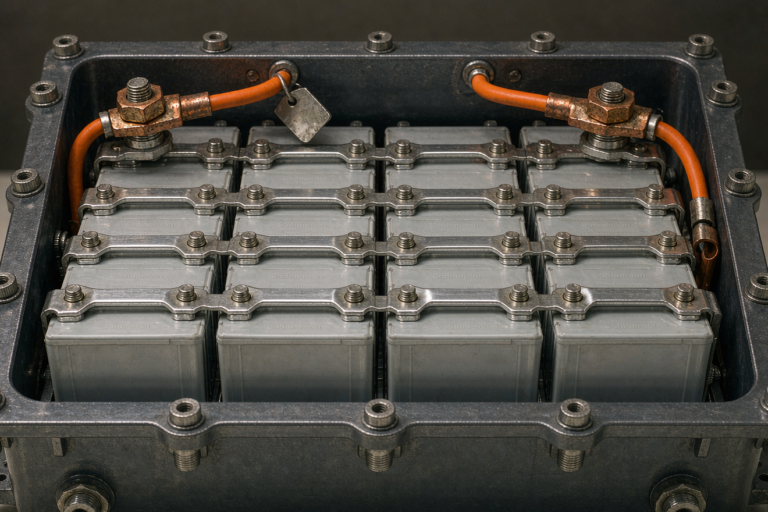
A practical build starts from the site load profile, not a catalogue number. A typical off-grid tower pulls 1.5-3 kW. For eight hours of autonomy you need roughly 16-24 kWh of usable storage. We stack 48 V nominal modules — commonly 48 V 100 Ah, about 5 kWh each — into a string of three or four to hit that target.
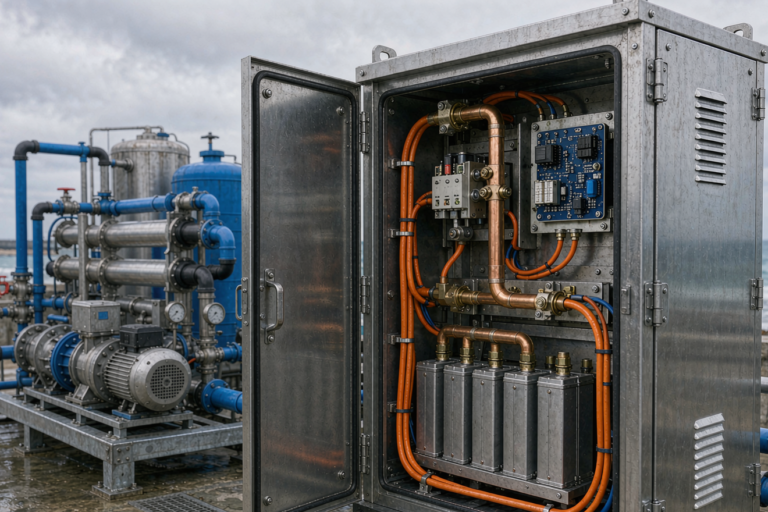
- Cabinet: IP55 steel enclosure with passive thermal insulation. Because sodium-ion tolerates temperature swings, we usually skip active cooling entirely and save the energy.
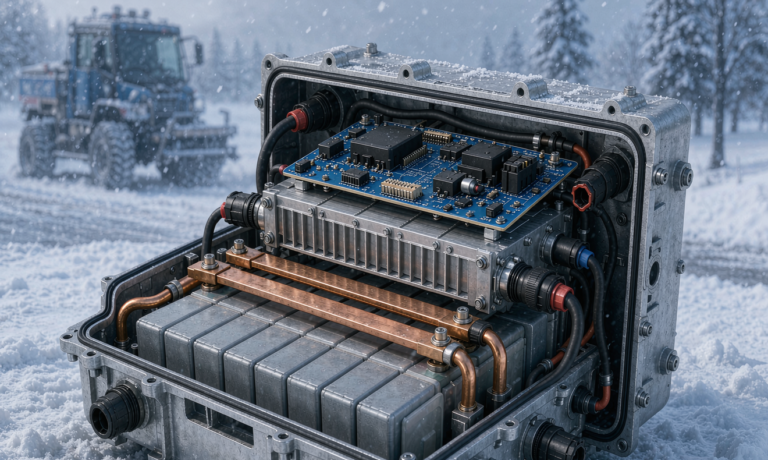
- BMS: per-cell voltage monitoring, passive or active balancing, at least two temperature sensors per module, and RS485 or CAN bus reporting into the tower controller so the NOC sees state-of-charge in real time.
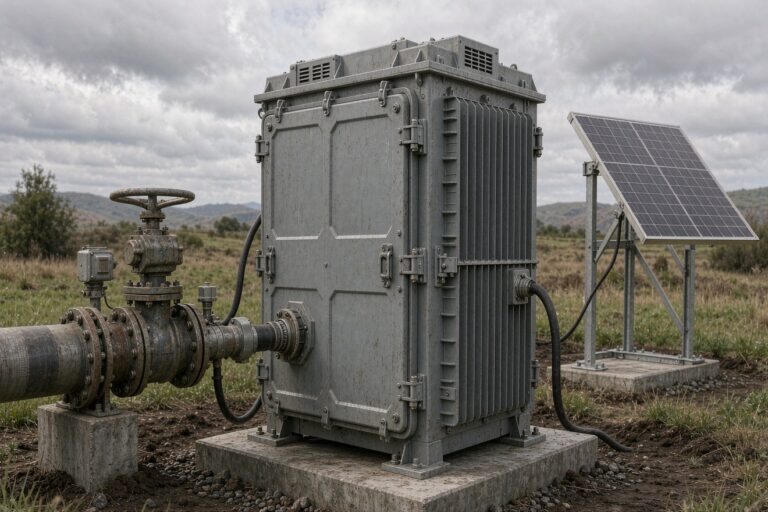
- Hybrid solar: a small PV array tops the pack during the day and cuts generator runtime toward zero. This is where a custom battery solution pays off — we size the PV, pack, and controller as one system against the actual duty cycle.
Get the BMS communications right and the site becomes nearly invisible to operations: a quarterly visual check replaces a monthly fuel run.
Real-World Deployment: What We Learned in the Field
One deployment I personally supervised sat at 1,400 m elevation where winter lows hit -30°C. The LFP units we had paired with it needed 300 W heater mats just to stay above their comfort zone, which ate a meaningful slice of the solar budget. The sodium-ion bank next to it ran unheated, held capacity, and needed no thermal load. Over a full heating season the sodium-ion site logged roughly 40% fewer maintenance hours.
The lessons were mundane but important: size the BMS communications bus before you bury the conduit, leave real ventilation gaps in the cabinet even when cooling is passive, and train the local technician on state-of-charge reading instead of fuel-level guessing. None of that is chemistry-specific, but it is where backbone projects actually succeed or fail.
On total cost of ownership across a ten-year horizon, the sodium-ion backbone beat both diesel and our heated-LFP reference by a clear margin, driven almost entirely by eliminated fuel, eliminated heaters, and reduced truck rolls.
Round-Trip Efficiency and the Quiet Cost of Self-Discharge
Two numbers decide whether a backbone silently bleeds money. First is round-trip efficiency: a well-designed sodium-ion system lands around 90-92%, which is a hair below premium LFP but more than enough when the alternative is a diesel set running at 30% efficiency. Second is self-discharge. Sodium-ion cells lose roughly 2-5% per month at room temperature, far better than lead-acid and comparable to LFP. For a site that may sit idle for weeks between grid events, that low standby loss means the pack is actually full when the outage finally arrives — not mysteriously half-empty from calendar drift.
I have walked onto too many lead-acid sites where the batteries read “charged” on the gauge but could only deliver minutes because of sulfation and self-discharge. Sodium-ion removes that failure mode almost entirely, which is a bigger reliability win than the spec sheet suggests.
Sustainability: The Backbone That Is Easy to Recycle
Operators are increasingly asked to report Scope 3 emissions and end-of-life plans, and this is where a sodium ion battery is genuinely friendlier. There is no cobalt or nickel to recover, no lithium to re-refine, and the cathode materials are far less hazardous to process. The recycling flow is simpler and cheaper, which lowers the true cradle-to-grave cost and keeps the environmental story honest. For a national carrier rolling out thousands of towers, that simplicity at end-of-life is a procurement argument in its own right.
Frequently Asked Questions
How long does a sodium-ion telecom battery last?
In stationary telecom duty we design for 3,000 to 6,000 full-equivalent cycles at 80% depth of discharge, which translates to roughly 8-12 years of service before capacity falls to 80% of nameplate. Real lifespan depends mostly on temperature and how deeply you cycle the pack.
Is sodium-ion safe in extreme heat and cold at remote sites?
Yes. The chemistry is more thermally stable than lithium variants and tolerates a wide operating window, typically -40°C to +80°C, without the dendrite and thermal-runaway risks that worry operators with LFP or NMC packs in unattended cabinets.
How does the cost compare with diesel generators or LFP?
Upfront cell cost in 2026 is approaching or below LFP at the pack level, and it is far more stable because it avoids lithium and cobalt. Against diesel, the sodium-ion backbone wins on total cost of ownership once you account for fuel, maintenance, and generator replacement over a decade.
Can a sodium-ion battery replace the diesel generator entirely?
In most off-grid telecom scenarios, yes — paired with a modest solar array and sized for the site load profile, a sodium-ion backbone can eliminate the generator. We keep a small generator only at sites with multi-day cloudy periods and very high loads, and even there it runs a fraction of the hours it used to.
If you are planning a sodium-ion battery telecom tower backbone and want the pack, BMS, and solar sized as one engineered system, that is exactly the kind of custom battery solution we build. The chemistry is ready; the engineering is what makes it reliable.