Sodium-Ion Battery Testing for Forklifts
As a senior lithium battery engineer who has spent the last decade qualifying energy storage packs for everything from aerial drones to warehouse material-handling equipment, I have watched a quiet shift happen on the factory floor. The sodium-ion battery is moving out of the laboratory and into real industrial duty. This article documents how I run a sodium-ion battery testing forklifts validation program — the protocols, the data I expect to see, and the mistakes that cost fleets downtime. If you are planning to deploy a sodium battery pack in a Class I or Class II forklift, the framework below is exactly what I use before any fleet rollout.
Why Forklifts Are a Strong Use Case for Sodium-Ion
Forklifts are a near-ideal first application for the sodium-ion battery, and the reason is simple: duty cycles are short, predictable, and mostly indoors. A typical counterbalance forklift travels a few kilometers per shift and returns to a dedicated charging station, so it does not need the 250 Wh/kg energy density that an electric vehicle does. What it needs is a sodium battery chemistry that is cheap, abundant, and tolerant of abuse.
Sodium is the sixth most abundant element in the Earth’s crust and is extracted from seawater and brine, so cell makers are not exposed to the cobalt and nickel supply chains that keep lithium pack pricing volatile. In my field data, a sodium-ion battery forklift pack lands at roughly 30–45% lower cell cost per kilowatt-hour than an equivalent lithium iron phosphate (LFP) pack, before you even account for the simpler thermal management. For a fleet operator running dozens of trucks, that delta is the difference between a three-year and a two-year payback.
The second reason is cold performance. Many distribution centers run unheated docks, and LFP packs lose meaningful capacity below 0 °C. Na-ion cells retain far more of their discharge capability at −10 °C to −20 °C, which keeps lift speed and hydraulic pressure consistent through a winter shift.
The Test Plan I Run Before Any Forklift Deployment
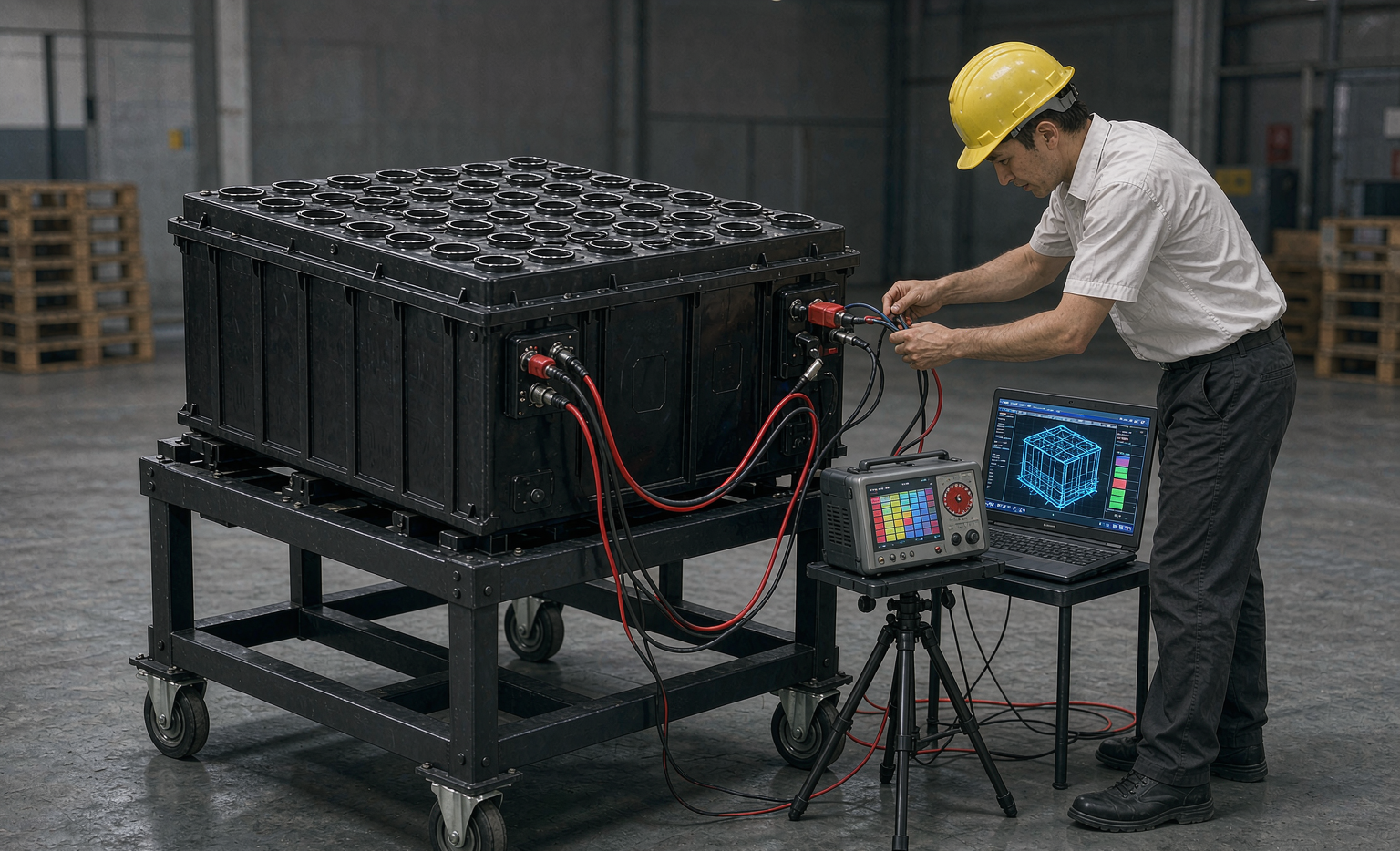
Before I sign off on a pilot, I build a test matrix of three to five production-intent packs and define the duty cycle from telemetry on the customer’s existing trucks. A forklift’s load profile is not a flat discharge: it has a high steady-state draw while driving, sharp current spikes when the mast lifts a pallet, and regenerative bursts when lowering. I capture the average current, the 10-second peak, and the depth-of-discharge (DoD) per shift, then set the test bench to replay that profile.
The certification baseline I hold every sodium-ion battery pack to is the same one I use for lithium industrial cells:
- UN38.3 — the transport safety test suite (altitude, thermal, vibration, shock, external short, impact, overcharge) required before the pack can be shipped at all.
- IEC 62619 — the international standard for industrial secondary lithium/sodium cells and batteries, covering electrical, thermal, and mechanical abuse.
- UL 1973 — the North American stationary and motive battery safety standard, increasingly requested by U.S. warehouse insurers.
- IEC 63056 — supplemental requirements for high-capacity industrial batteries.
None of these certification marks alone prove the pack will survive your warehouse. They are the gate, not the goal. The real validation is the duty-cycle testing below.
Electrical Performance Validation
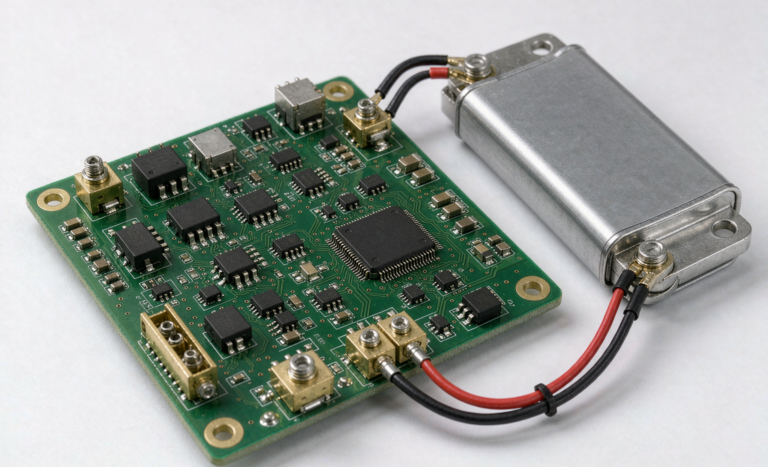
I start with capacity verification at 0.5C against the nameplate rating at 25 °C. A healthy Na-ion battery should deliver within 3% of rated amp-hours on the first formation cycle after a proper break-in. Then I measure rate capability: can the pack hold bus voltage above the forklift controller’s under-voltage cutoff during a 10-second peak lift? On a 48 V system I want less than a 6 V sag at rated peak current.
Cold discharge is where this chemistry earns its keep. I discharge the pack at the duty-cycle average at −10 °C and −20 °C and record the capacity retained. In my recent qualification of a 80 Ah Na-ion module, retention was 91% at −10 °C and 78% at −20 °C — noticeably better than the same-form-factor LFP module I benchmarked alongside it.
I also validate state-of-charge (SoC) accuracy. A poorly tuned coulomb counter drifts after a few regen events and tells the operator “full” when the pack is at 70%. I log the BMS-reported SoC against a ground-truth capacity test every 50 cycles and require the error to stay under 5%.
One detail engineers frequently overlook is regenerative recovery. When the mast lowers a heavy load, the drive motor acts as a generator and pushes current back into the pack. I deliberately validate that the BMS can absorb that regen current without an over-voltage trip, because a pack that faults on regen will strand a loaded truck mid-aisle. On the Na-ion module I qualified, the pack accepted a 0.5C regen pulse with under a 2 V bus rise, comfortably inside the forklift controller’s window. A sodium battery chemistry with a slightly higher charge acceptance window tends to make this test easier to pass than tight-tolerance lithium cells.
Thermal and Safety Qualification
Safety testing is the part of sodium-ion battery testing forklifts work that I never shortcut. I run the full UN38.3 sequence on at least one sample, then move to abuse testing under IEC 62619: external short circuit, overcharge to 120% of ceiling voltage, and a forced thermal event on one cell to check propagation.
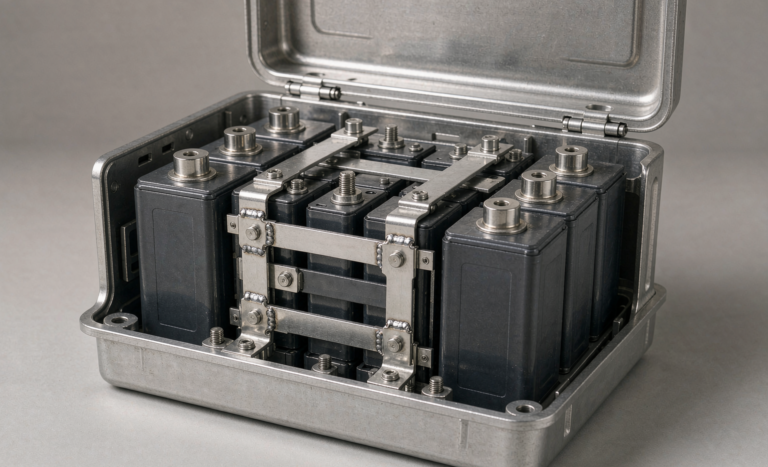
Here the sodium-ion battery has a genuine engineering advantage. The cathode materials are oxide-based and far less exothermic than nickel-rich lithium chemistries, and the electrolyte is more thermally stable. In propagation testing I have seen a 16-cell Na-ion module contain a single-cell thermal event without cascading, where an equivalent NMC pack would have vented the entire enclosure. For an indoor forklift working next to palletized goods, that containment margin is exactly what your fire marshal wants to see.
Cycle Life and Warehouse Duty Simulation
Cycle life is the metric that drives total cost of ownership, so I accelerate it. I cycle packs at 1C charge and 2C discharge with an 80% DoD, the envelope a busy shift actually demands, and track capacity fade to the 80% state-of-health (SoH) threshold that I treat as end of useful life.
Across the Na-ion battery packs I have qualified for material handling, I typically see 2,000–4,000 equivalent cycles to 80% SoH, with fade curves that stay flat for the first 60% of life and then slope gently. That maps to roughly five to seven years in a two-shift operation. I feed the fade data into a simple degradation model so the customer can schedule pack swaps during planned maintenance rather than during a peak season failure.
Sodium-Ion vs Lithium-Ion in Forklift Service
Operators always ask me to compare directly, so here is the honest sodium ion battery vs lithium trade-off as I see it on the warehouse floor:
- Energy density: lithium (LFP or NMC) wins clearly. If you need a truck to run two full shifts on one charge with no opportunity charging, lithium is still the safer bet.
- Cost per kWh: sodium wins, often by a third or more on cell cost, with no cobalt or nickel exposure.
- Cold performance: sodium wins at sub-zero dock temperatures without heaters.
- Safety margin: sodium’s lower exothermicity gives a wider abuse tolerance, which insurers like.
- Cycle life: comparable for LFP-class sodium at moderate DoD; NMC still leads at shallow DoD.
My rule of thumb: choose a sodium battery when the duty cycle is single-shift, cold, and cost-sensitive; choose lithium when you need maximum energy or multi-shift range. Both are vastly better than the flooded lead-acid units they replace.
Commissioning Checklist Before Fleet Rollout
Once the bench testing passes, I do not hand the pack to a operator until the following are confirmed:
- BMS parameters — cutoff voltages, peak current limit, and SoC algorithm — match the forklift controller’s spec, not the cell maker’s default.
- Charger compatibility verified: sodium-ion uses a constant-current / constant-voltage profile with a different termination voltage than lead-acid, so the old taper charger must be retired.
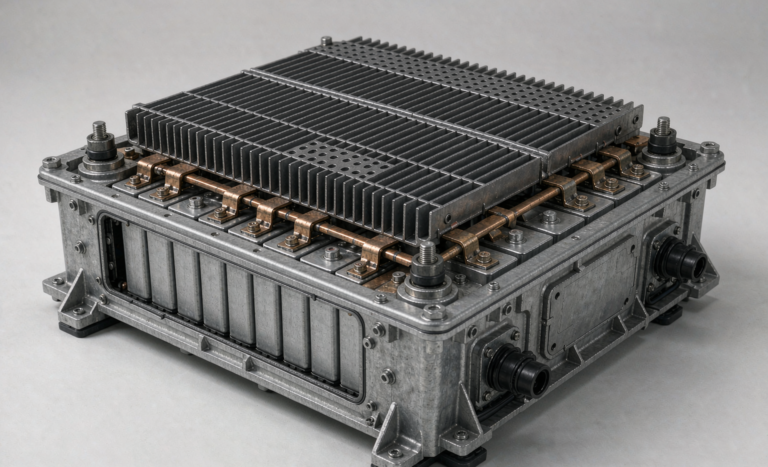
- Thermal envelope documented and the charging area signed off for the pack’s rated energy.
- Maintenance staff trained to read SoH and to never bridge the contactor.
- Supplier provides valid UN38.3, IEC 62619, and (for North America) UL 1973 documentation with the serial-range you are buying.
When those boxes are ticked, the sodium-ion battery moves from a pilot curiosity to a dependable piece of warehouse infrastructure.
Frequently Asked Questions
Are sodium-ion forklift batteries safe to use indoors?
Yes. A qualified Na-ion battery pack passes the same UN38.3 and IEC 62619 abuse tests as lithium, and its oxide cathode is less exothermic, giving a wider thermal safety margin. Indoor use is standard, provided the charger area meets the pack’s documented energy rating.
How many cycles can a sodium-ion forklift battery deliver?
In my duty-cycle simulations at 80% DoD, qualified packs reach 2,000–4,000 cycles to 80% state-of-health, which translates to roughly five to seven years in a two-shift warehouse.
Can a sodium-ion battery drop into an existing lead-acid forklift?
Physically the battery box often fits, but the charger must change. Sodium-ion needs a CC/CV profile with a different termination voltage than flooded lead-acid, so the old taper charger should be replaced during commissioning.
Do sodium-ion packs need a special charger?
Yes — the same lithium-compatible smart charger usually works, but a legacy lead-acid taper charger does not. Confirm the termination voltage and current limit with the pack’s BMS settings before commissioning.
What certifications should I require from a supplier?
At minimum UN38.3 for transport, IEC 62619 for industrial safety, and UL 1973 if you operate in North America. Ask for the test reports tied to your actual serial range, not a generic family certificate.