Home Energy Storage for Well Pumps and Rural Water Supply
When a rural household loses grid power, it loses more than lights. The well pump stops, the pressure tank bleeds down, and within hours there is no running water for drinking, livestock, or sanitation. I have sized backup systems for farmhouses, off-grid cabins, and small water districts, and the well pump is almost always the load that decides how large a home energy storage bank has to be. This guide covers what a well pump actually draws, how to size a battery and inverter around it, and the charging, code, and cold-weather details that keep water flowing when the grid does not.
Why Rural Wells Depend on Battery Backup
A city water utility keeps pressure with gravity towers and pumping stations. A rural home has no such buffer. It has a submersible pump at the bottom of a borehole, a pressure tank of 20 to 80 gallons, and a pressure switch that starts the pump whenever tank pressure falls. That chain has no redundancy, and when the grid fails the tank delivers perhaps 10 to 20 gallons before every tap in the house runs dry.
Rural outages also last longer. A single downed feeder or a storm-damaged transformer can leave a farm without power for two to four days. A rural water supply carries loads a suburban home never sees: livestock watering, irrigation top-up, and, in many regions, fire suppression reserves. Battery backup is therefore not a comfort feature but water security, sized around motor loads rather than lighting and phone chargers.
The Real Load of a Well Pump: Surge Watts and Running Watts
The mistake I see most often is sizing a battery around a pump nameplate. A 1 HP submersible pump is rated 746 watts, but it does not behave like a 746 watt heating element. It behaves like an induction motor, and induction motors draw a large inrush current for a fraction of a second at every start.
A typical 230 V single-phase submersible pump draws its running amps continuously, then pulls three to seven times that current during the first 300 to 800 milliseconds of a start. A 1 HP unit at 230 V might run at about 7 amps and reach 35 to 45 amps locked rotor. On a 240 V inverter that surge translates into 8,000 to 11,000 watts of instantaneous demand, even though the pump settles to roughly 1,000 watts of real running load.
- 0.5 HP pump: about 0.5 kW running, 4 to 6 kW surge
- 1 HP pump: about 1.0 kW running, 8 to 11 kW surge
- 1.5 HP pump: about 1.4 kW running, 11 to 15 kW surge
- 2 HP pump: about 1.8 kW running, 14 to 20 kW surge
Two design rules follow. The inverter continuous rating must cover the pump plus the house loads running at the same time. Its surge rating must cover locked-rotor current for at least one second, because a well pump ramps more slowly than a furnace blower. Ignore those two numbers and an otherwise well built home energy storage system will trip on every start.
Sizing a Home Energy Storage Bank for Water Supply
Energy sizing starts with daily water demand, then converts it into pump run time. A rural household of four with livestock may consume 600 to 1,500 liters per day. If the pump delivers 15 gallons per minute, that demand translates into one to two hours of pump run time, not a full day of continuous draw.
From there the math is straightforward. A 1 HP pump drawing 1 kW for two hours consumes about 2 kWh per day. Add house loads of 3 to 8 kWh and the daily energy budget lands between 5 and 10 kWh. A lithium battery bank built on LFP cells, which tolerate 80 to 90 percent depth of discharge, delivers 4 to 5 kWh from a 5 kWh module without shortening cycle life.
A practical target for a rural well is two to three days of autonomy. If the daily budget is 8 kWh, a 20 kWh LFP bank covers two and a half days and leaves headroom for a cloudy no-sun stretch. Lead-acid is a poor fit here because at 50 percent usable depth it needs roughly double the nameplate capacity for the same autonomy, and its voltage sags harder under a 40 amp motor start.
Battery voltage and capacity combinations
- 48 V, 100 Ah LFP: 5.12 kWh, good for a 0.5 to 1 HP pump with modest house loads
- 48 V, 200 Ah LFP: 10.24 kWh, comfortable for 1 to 1.5 HP pumps
- 48 V, 300 to 400 Ah LFP: 15 to 20 kWh, two to three day autonomy for a working farm
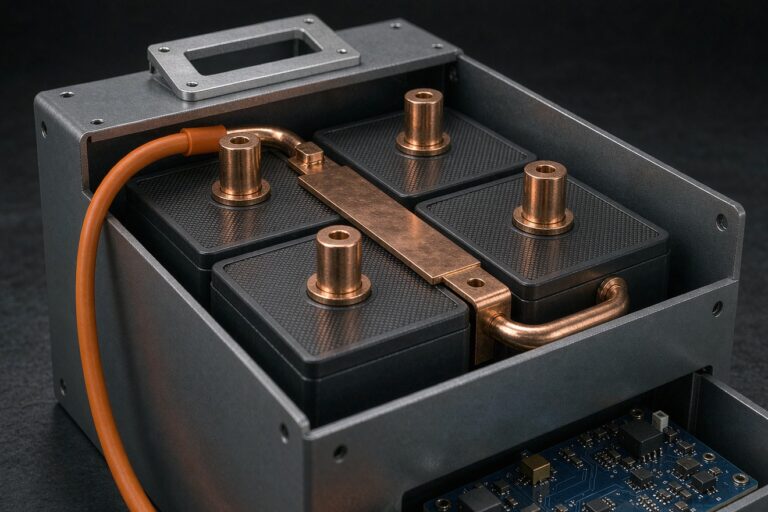
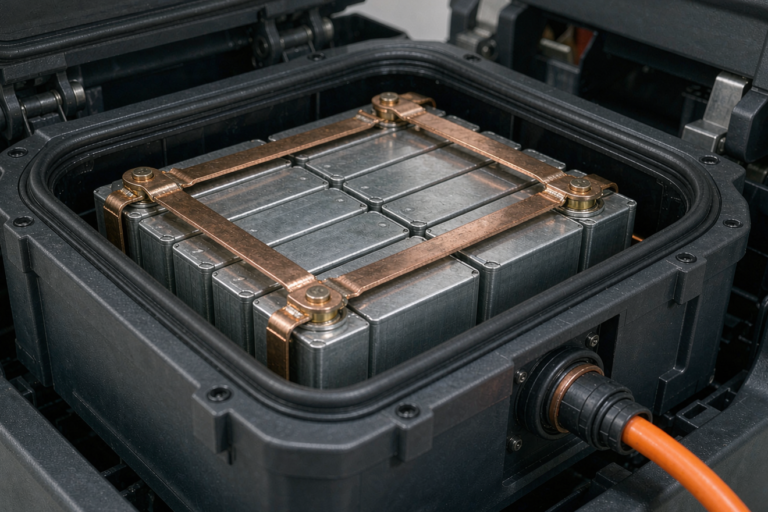
The pack must also deliver surge current without an alarming voltage sag, which is why busbar sizing and connector torque matter as much as amp-hour count.
Inverters, Voltage and Soft-Start for Submersible Pumps
For submersible wells I standardize on 48 V nominal systems. Lower voltage means higher current for the same power, and higher current means thicker cable, more heat, and a bigger voltage drop during the motor start. A 48 V architecture keeps the DC current manageable and lets a single inverter handle both the pump surge and the household panel.
The inverter must produce a pure sine wave. Modified sine wave output overheats induction motors, makes them run hotter and noisier, and shortens pump life. A low-frequency, transformer-based inverter is usually the better choice for well pumps because its surge rating is real and sustained for several seconds, whereas many high-frequency units advertise a large surge number that lasts only a few milliseconds.
Soft starters and variable frequency drives deserve serious consideration. A soft starter ramps voltage up over one to two seconds, cutting inrush by 40 to 60 percent. That drop in starting current lets you specify a smaller inverter and smaller battery cable, and it reduces mechanical shock on the pump, shaft, and drop pipe. On new installations I have found a soft starter pays for itself by allowing a 6 kW inverter to start a pump that would otherwise demand a 10 kW unit.
Charging from Solar, Grid and Generator
A backup bank is only as good as its recharge path. In a rural setting that usually means a blend of solar, grid when available, and a standby generator. The control logic should recharge the battery first, then carry the running load, so the bank returns to full before the next outage.
Solar sizing depends on daily consumption and local sun hours. As a rule of thumb, a PV array should produce about 1.5 times the daily energy budget to account for charge and conversion losses. For an 8 kWh daily budget that points to a 3 to 5 kW array in a mid-latitude area, with an MPPT charge controller that tracks array voltage across a wide input range.
When a generator is part of the system, its job is to run the pump and recharge the bank during extended outages. A generator should never backfeed an inverter output directly. Instead it feeds an automatic transfer switch on the input side, and the inverter charges the battery through its own charger. This keeps the bonding logic in one place and avoids the double-neutral faults that rural installers run into.
For water districts and larger rural systems the same architecture scales. A containerized bank with a lithium battery, a commercial inverter, and a generator input can hold a well field online through a multiday outage, which is exactly the kind of custom battery solution to model before hardware is ordered.
Cold Weather, Code and Maintenance
Cold quietly kills rural battery installations. LFP cells discharge acceptably down to about minus 20 degrees Celsius, but they must not be charged below 0 degrees Celsius without a warm-up, because lithium plating inside the cell permanently reduces capacity. A wellhouse or utility room that drops below freezing overnight needs either a heated battery enclosure or a BMS that blocks charge until the cells warm up.
Code compliance keeps the system legal and insurable. In North America, an optional standby system is governed by NEC Article 702, motor circuits by Article 430, grounding and bonding by Article 250, and interconnection of multiple sources by Article 705. Energy storage hardware should be listed to UL 9540 with the battery module listed to UL 1973, while cells follow IEC 62619 for industrial work. Transport of cells and spare modules falls under UN38.3.
Maintenance is mostly inspection and telemetry. The BMS should log cell voltages, temperature, and state of health so a weak module is caught before it drags the bank down. Lugs and busbars should be checked for torque annually, since a loose connection under cyclic motor loading is a fire risk. Finally, log depth of discharge and cycle count, the evidence any warranty claim is judged against.
Frequently Asked Questions
How big a battery do I need to run a well pump?
Size for autonomy, not for nameplate. Work out the pump energy, add house loads, then multiply by the number of outage days you want to ride through. A 1 HP pump running two hours a day uses about 2 kWh, so with house loads of 5 to 8 kWh a 10 to 20 kWh LFP bank covers one to two days comfortably.
Can a 48V lithium battery start a 1 HP well pump?
Yes, if the inverter surge rating is sized for it. A 48 V LFP bank easily supplies the current, and the limiting factor is the inverter, which must hold locked-rotor current for about one second. A soft starter allows a smaller, cheaper inverter to do the same job.
Will a well pump run during a power outage on solar alone?
It can, provided the battery bank carries the surge and the array can recharge daily consumption. Solar alone works well in sunny regions, but a generator or grid input is worth keeping as a fallback during multi-day cloudy periods.
How long will home energy storage run a well pump?
Runtime depends on bank capacity, pump power, and how often the house draws water. A 10 kWh LFP bank running a 1 HP pump at two hours per day gives about four days of pump energy before house loads are counted, and roughly two days once a typical rural household load is included.
Is a soft starter worth it for a backup well pump system?
Usually yes. Cutting inrush by 40 to 60 percent lets you downsize the inverter and the DC cabling, and it reduces mechanical wear on the pump and drop pipe. The hardware cost is often lower than the cost of the larger inverter it replaces.
What inverter size do I need for a submersible well pump?
Match continuous rating to pump plus simultaneous house loads, and match surge rating to locked-rotor current for at least one second. As a starting point, budget three to five times the pump running watts of surge capacity, or less if a soft starter is fitted.
Further Reading
References