Battery Solution for Electric Marine Dredgers
When a dredging contractor decides to electrify a cutter suction dredger, the first question is never whether a lithium battery can be built. It is whether the pack survives saltwater, wave loading and the hammering torque of a cutting head for a full eight-hour shift. Over the last six years I have specified custom battery solutions for more than a dozen dredging vessels, from a 22 m grab dredger in sheltered harbors to a 46 m trailer suction unit on an exposed river bar. This is the engineering logic I use, and the numbers I hold myself to.
Why dredging is a punishing load for a battery pack
A dredger does not draw a steady current. The cutting head bites into loose sand, then meets consolidated clay or an abandoned concrete block, and the cutter motor load jumps from a few hundred kilowatts to full rated power inside a single second. The average draw sits near 45 percent of installed power, but the peaks arrive as short spikes lasting 5 to 20 seconds.
Those spikes are exactly what a battery does well and a diesel genset does badly. A generator must be sized for the worst spike it will ever see, which means buying iron that sits idle most of the shift. On the vessels I have measured, the generator is oversized by 30 to 45 percent relative to the mean load. Splitting peak demand between a lithium battery and the genset lets the genset be downsized and the fuel burn drop.
Where the battery pack actually belongs on the vessel
Three architectures come up in this market, and picking the wrong one is the most common mistake I see.
Battery for hotel and auxiliary load only
This is the easy retrofit. On a small grab dredger or a maintenance barge, a 40 kWh to 80 kWh lithium battery covers lighting, cabin load, hydraulics pumps and the grab winch between bites, while the diesel still drives the machinery. Capital cost stays modest and the payback arrives in two to three seasons, but the fuel saving is limited.
Hybrid buffer for cutter and pump motors
This is the design I recommend for most contractors moving a mid-size cutter suction dredger. The genset is sized for the mean load plus a margin, and the battery absorbs the cutting spikes. Because the cutter hits hard only part of the time, a 300 kWh to 500 kWh pack will cover the peaks that a 25 percent larger generator would otherwise have to provide.
Fully electric cutter suction dredger
A handful of newbuild river dredgers now run a battery as the prime mover for the cutter and the dredge pump, with a small diesel range extender for transit. It is the cleanest from an emissions standpoint and the hardest to justify on cost, and I only recommend it where a tender specification is writing the rule.
Pack architecture and cell selection
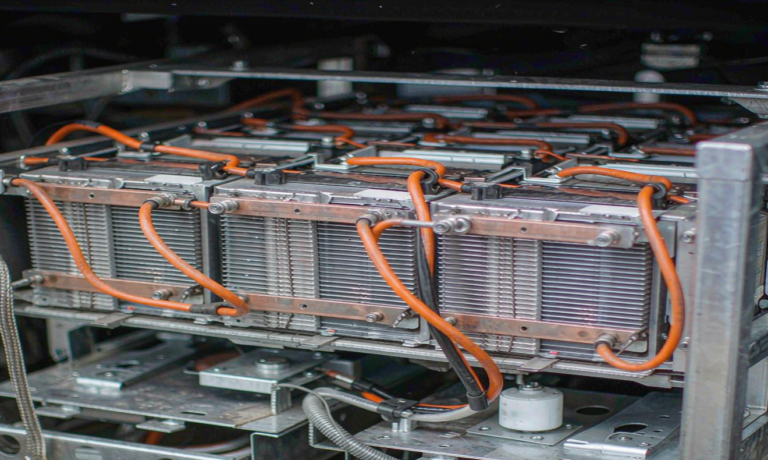
For anything above 100 kW I do not look at cylindrical cells. Prismatic LFP cells in the 100 Ah to 280 Ah range are what a marine pack is built from, because the rigid case stacks into a module without a holder and the flat faces transfer heat to a cold plate evenly. A 3.2 V nominal cell charged to a 3.65 V ceiling gives a usable window of roughly 3.0 V to 3.5 V in practice.
Series count follows the DC bus, not the battery. Marine DC distribution commonly runs at 690 V, and 216 cells in series gives a nominal 691 V with a charged voltage near 789 V. Below roughly 200 kW, a 400 V or 540 V bus with a smaller pack is easier to interface with the variable frequency drives already on the cutter motor.
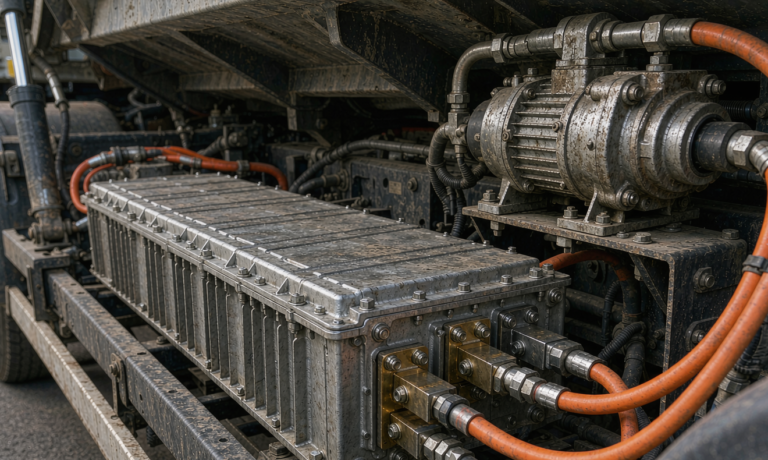
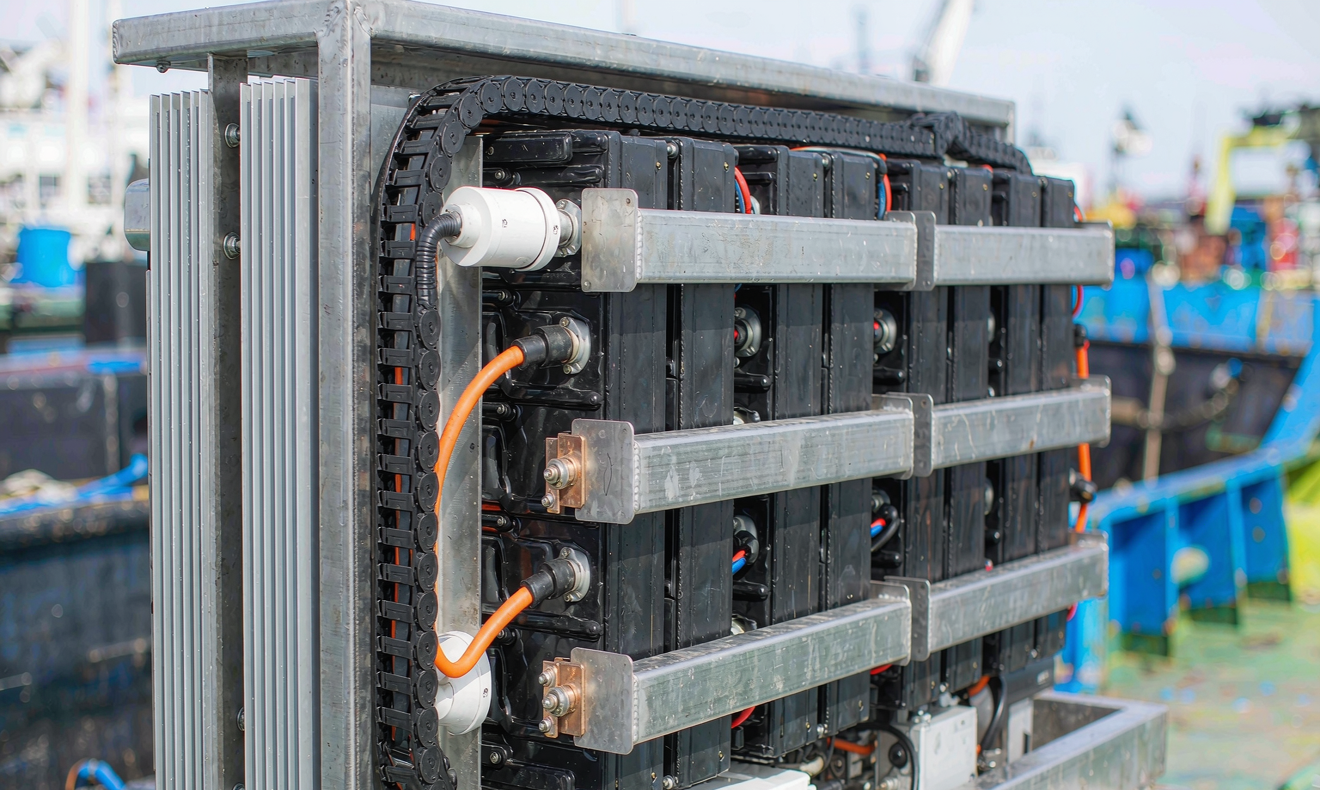
Two mechanical points decide the design life. Restraint, because a vessel in a 4 to 5 metre working swell imposes continuous low-frequency acceleration on the deck and the pack must be bolted through to a welded frame rather than strapped. Venting, because cells are spaced so gas from a single cell exits to an open deck path instead of into the neighbouring module.
Marine qualification and corrosion control
Standard industrial qualification is not enough on a dredger. The enclosure hardware has to survive salt fog, the pack has to survive vibration, and the whole DC installation has to stay safe with saltwater all around it.
- Salt spray to ISO 9227, neutral 5 percent sodium chloride at 35 degrees Celsius, with 500 hours minimum for enclosure hardware and 1,000 hours for external fixings. 316L stainless steel, hot-dip galvanised frames and powder coated aluminium frames are the three finishes I trust.
- Ingress protection. Deck mounted packs need IP56 at least, and packs below the main deck need IP67 or IP68 with a sealed serviceable busbar chamber. Every penetration gets a gland with a documented pull test.
- Vibration and shock to the classification society route, generally the guidance in DNV-ST-B203 for lithium-ion battery systems in marine and offshore applications, tested on three mutually perpendicular axes with the sweep spectrum a vessel actually produces.
- Insulation monitoring. Marine DC systems are fitted as insulated systems with permanent insulation resistance monitoring, because a single earth fault on a 690 V DC bus can start a fire rather than cause a nuisance trip.
- Equipotential bonding and galvanic isolation. The pack frame, the hull and the generator frame are bonded together, and any galvanic separator is sized for the current that saltwater immersion can actually push through it.
A worked sizing example
The numbers below come from a 38 m cutter suction dredger I sized last year, offered as a template rather than a quote. The cutter motor peaks at 320 kW with a 60 percent load factor, the dredge pump runs 260 kW, two spud and anchor winches draw 2 x 55 kW, and the hotel load sits at 25 kW. Installed power is 720 kW, mean draw is 380 kW, and the worst simultaneous spike is 715 kW.
The original installation carried two 400 kW diesel generators burning about 3,400 litres a day. The redesign used one 400 kW genset plus a 400 kWh LFP pack, configured for 1.25C continuous and 2C peak, which is 500 kW sustained and 800 kW for 15 seconds, so it covers the 715 kW spike without touching the genset. At 85 percent depth of discharge the usable energy is 340 kWh.
The pack weighs about 4.1 tonnes, while the lead-acid bank the vessel carried before weighed more than 12 tonnes, so the pontoon sat higher and the freeboard problem on the bar went away. Measured fuel consumption settled 22 percent below baseline over the first season, with payback in the fifth year at 1,800 operating hours a year.
Duty windows, charging and maintenance
On every dredger pack I deliver, the operating window is 20 percent to 90 percent state of charge. Held at 80 percent depth of discharge in that window, LFP will typically deliver 6,000 to 8,000 cycles, or eight seasons of shift work. Running the pack to 100 percent depth of charge every day roughly halves that.
Charging happens at the quay. A shore connection of 200 kW to 300 kW refills the pack in under two hours, and I limit charge current to 1C with a hard cut-out below 0 degrees Celsius and a taper above 45 degrees Celsius cell temperature. On vessels without shore power the genset recharges between cuts, with the BMS talking to the genset controller over CAN or J1939 so the two never fight over the same DC bus.
Maintenance is boring, which is the point. Busbars are torque checked every 250 hours because vibration loosens them, insulation resistance is logged monthly, and the enclosure gets a fresh water wash down after any saltwater ingress. A top balance after each shift keeps the pack inside a 30 millivolt spread, and that is the cheapest thing an owner can do to protect capacity.
Standards, class approval and what buyers ask
Two tracks run in parallel and both have to close before a vessel leaves the dock. The product track is cell and pack safety: UN38.3 for transport, IEC 62133-2 for the cells and modules, and IEC 62619 for industrial systems with a DC output. The marine track is the classification route, where DNV-ST-B203 or the equivalent rules from LR, ABS, NK or BV define the vibration, thermal, ventilation and fire segregation requirements.
Emissions rules do the rest. MARPOL Annex VI and the Tier III NOx limits have already pushed several contractor fleets toward hybrid dredgers, and a port offering berth discounts for low emission vessels is usually the customer who signs first. The practical lesson is that a dredger battery is not sold on capacity alone but on a completed test report, a documented class approval and a maintenance schedule an owner can actually follow.
FAQ
Can a lithium battery pack run a cutter suction dredger directly?
Yes, but the pack has to be built for the load shape, not just the energy. A dredger draws full cutter power in short spikes repeated every few seconds, so the pack needs a 2C peak rating sustained for 15 to 20 seconds, not merely high capacity in kilowatt hours. Sizing only for the mean load produces a pack that survives six months.
Which cell format is better for dredger batteries, prismatic or cylindrical?
For packs above 100 kW I use prismatic LFP almost without exception. The rigid case stacks into a module without a holder, the flat face gives the cold plate a large thermal contact area, and cell-to-cell variation is easier to control in production.
How long will a marine dredger battery last in saltwater?
The battery does not need to survive saltwater so much as its enclosure and hardware do. With an IP56 or better enclosure, 316L fixings and a monthly fresh water wash down, the pack will hold 80 percent capacity for 6,000 to 8,000 cycles, or roughly eight seasons. The usual first failures are a corroded busbar terminal or a weeping cable gland.
How is a dredger battery pack charged while the vessel works?
Almost always at the quay through a shore connection of 200 kW to 300 kW, which restores a 400 kWh pack in under two hours and fits the loading cycle. Vessels without a quay supply recharge from the genset between cuts at a reduced rate, with the BMS and the generator controller sharing the DC bus over CAN or J1939. Charging below 0 degrees Celsius or above 45 degrees Celsius cell temperature is locked out.
What approvals do marine battery packs need before a class survey?
You need type test reports against UN38.3, IEC 62133-2 and IEC 62619 covering the cells, the modules and the complete pack with its BMS, plus a factory audit. The class society then surveys the installation against its battery system rules, typically DNV-ST-B203 or the equivalent, covering ventilation, gas detection, fire segregation and thermal runaway venting. Budget eight to sixteen weeks, and start the submission before fitting out, not after.
Is a hybrid battery pack worth the capital cost on a dredger?
It depends on hours and fuel price rather than on battery price. Payback lands between four and seven years when the vessel runs more than 1,500 hours a year, diesel is above 1 USD per litre, and the genset can be downsized because the pack absorbs the peaks.
Further Reading
References