Battery Solution Performance for Robotics: How We Engineer
When a customer asks me to design a battery solution performance robotics program, the first thing I tell them is that robots do not draw power the way a phone or a laptop does. A robot’s load is a living, breathing mission profile: a warehouse AGV surges when it accelerates, a six-axis arm spikes when it lifts, and an inspection drone pulls hard the instant its rotors spin up. After fourteen years building packs on the factory floor at Horizon Power, I have learned that battery solution performance for robotics is won or lost in the duty cycle, not on the spec sheet. In this article I will walk you through exactly how my engineering team sizes, designs, and validates a custom battery solution that survives real robot life instead of dying in the first 200 cycles.
Robotics Power Demand Is a Mission Profile, Not a Single Curve
The biggest mistake I see in robotics procurement is specifying a pack from a single number. Someone reads “the motor is 200 watts” and orders a 200-watt-hour battery. That ignores the fact that a robot’s current is never flat. A collaborative arm might idle at 0.4 A, lift at 6 A, and rebound at 14 A for 400 milliseconds every few seconds. A delivery robot on a 24 V bus draws 8 to 12 A while driving and near zero while its LIDAR scans a junction.
When we build a battery application solution for robotics, we instrument a prototype robot for at least one full shift and log current at 100 Hz. Only then do we know the real shape of the demand. I have caught “steady-state” loads that were actually 30% pulsed, and that single insight changes cell selection, busbar sizing, and the entire thermal story.
Sizing the Battery Solution for Duty Cycle, Not Peak Current
Capacity is easy to misunderstand. Watt-hours tell you energy; C-rate tells you whether the pack can deliver it without collapsing. For a robotics battery pack design, I size to the worst sustained ten-minute window, not the one-second peak. A 24 V, 20 Ah pack gives 480 Wh. If a robot averages 80 W, that is six hours of runtime on paper. But if the same robot pulls 18 A pulses at 1.5 C every thirty seconds, the effective usable capacity drops because of internal resistance and protection headroom.
My rule of thumb: leave 15% state-of-charge headroom at the top and never discharge below 10% in a robotics deployment. That protects cycle life and gives the BMS solution room to throttle before a hard cutoff. The result is a battery solution that reports the runtime the operator actually experiences, not the number printed on the label.
Battery Pack Design Choices That Decide Robotics Performance
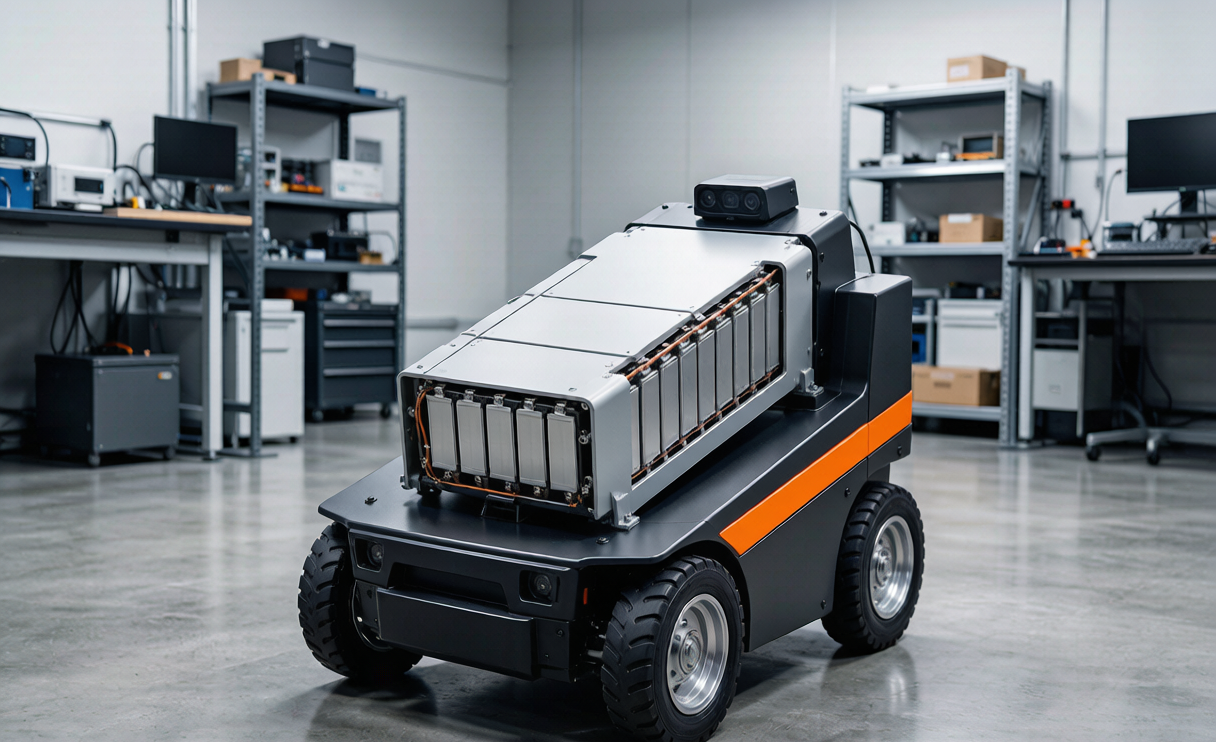
Cell format is the first fork. Cylindrical 21700 cells give excellent mechanical robustness and are easy to weld into a rigid pack, which is why I favor them for mobile robots that get bumped around. Pouch cells win on energy density but need a rigid housing and careful pressure management. For a lithium battery in a robotics chassis, I almost always default to 21700 in a laser-welded nickel strip arrangement.
Voltage architecture matters just as much. Many robots run on 24 V; some arms and heavy AGVs want 36 V or 48 V to keep current low and wiring light. We parallel groups to hit capacity and series them to hit voltage, then balance the pack so every parallel group ages the same way. Ingress protection is non-negotiable on a factory floor: I design to at least IP54 per IEC 60529 so conductive dust and splash cannot reach the cells, and I qualify vibration to IEC 60068-2-6 because a robot that shakes its own cells loose is a robot that fails in the field.
Why the Mechanical Layout Is Half the Performance Story
A beautiful battery pack design on paper becomes a liability if the cells rattle. We pot critical joints, strain-relieve every wire, and use compression frames so cells cannot expand into the enclosure. In my experience, mechanical failure causes more robotics pack returns than electrical failure, so the enclosure is engineered as seriously as the electronics.
The BMS Solution Is the Invisible Performance Governor
The battery management system is where a good robotics pack becomes a great one. A competent BMS solution does far more than cut off at empty. It passively or actively balances cells, tracks state of health, limits discharge current during a fault, and talks to the robot controller over CAN bus or SMBus so the planner knows remaining runtime in real time.
I spec a BMS with at least 30 mV balancing accuracy and a coulomb-counting fuel gauge calibrated to the actual load. That calibration is what lets a cleaning robot say “I have 22 minutes left” and be right within two minutes. Without it, the operator either stops early (wasting throughput) or pushes too far (damaging the lithium battery). The BMS is the component I refuse to cheap out on.
Thermal Behavior Under Real Robot Loads
Heat is the silent killer of robotics battery life. I-squared-R losses in busbars and cells climb with the square of current, so a robot that pulses hard generates far more heat than its average load suggests. For indoor, low-pulse robots, a well-vented enclosure with passive cooling is enough. For high-discharge arms or drones, I add thermal pads to the enclosure and, in extreme cases, a small controlled fan path.
Chemistry choice drives the thermal ceiling. Lithium iron phosphate (LFP) stays stable to about 60 degrees Celsius and tolerates abuse that would swell an NMC cell. For most ground robotics, LFP is my default battery application solution because its cycle life and safety margin beat raw energy density. When weight is the constraint, such as in aerial drones, we move to high-energy NMC and manage the tighter thermal window aggressively.
Certification and Safe Deployment
A robotics pack is a shipped, transported, and often airborne product, so certification is part of performance, not red tape. Every pack we build passes UN 38.3, the eight-test transportation sequence (T.1 altitude, T.2 thermal, T.3 vibration, T.4 shock, T.5 external short, T.6 impact, T.7 overcharge, T.8 forced discharge) because that is what lets the battery legally travel. For portable electronics cells we validate to IEC 62133-2, and for stationary or industrial energy storage portions we apply IEC 62619.
When the robot flies, the math changes. Aerial robotics fall under the same air-transport rules the FAA and EASA enforce for lithium cells, so we document state of charge below 30% for shipment and label per the dangerous-goods framework. A custom battery solution that cannot clear customs is a solution that does not perform, no matter how good the cells are.
A Field Case: Autonomous Floor-Cleaning Robot
Last year we delivered a battery solution performance robotics program for a cleaning robot maker. Their first prototype used a generic 24 V pack that gave 90 minutes and swelled after 400 cycles. We rebuilt it as a 24 V, 20 Ah LFP pack with a 1.5 C continuous discharge rating, laser-welded 21700 cells, IP54 enclosure, and a CAN-enabled BMS.
The numbers we shipped: 480 Wh usable, four-hour runtime under a mixed cleaning duty cycle, less than 4% capacity loss after 1,000 cycles in the lab, and zero thermal events across 60 field units in the first six months. The operator dashboard reported remaining runtime within two minutes of truth. That is what I mean when I say performance is measured in the field, not on the bench.
How We Validate Battery Solution Performance Before Ship
Before any pack leaves Horizon Power, it runs our validation gauntlet. We cycle it at the logged mission profile for at least 200 iterations, subject it to HALT (highly accelerated life testing) for temperature and vibration, drop-test the enclosure, and confirm ingress with a spray booth. Only packs that hold voltage, stay cool, and report accurate state of charge earn the release stamp.
This is the part of a battery solution most buyers never see, and it is the part that decides whether a robotics fleet runs for two years or two months. I would rather spend a week validating than ship a pack that strands a robot mid-aisle.
Choosing the Right Partner for Robotics Battery Performance
If you are specifying power for a robot, do not start from watt-hours. Start from the logged duty cycle, decide the chemistry by your thermal and weight budget, design the mechanical pack before the electronics, and treat the BMS as a first-class subsystem. A well-engineered custom battery solution pays for itself in cycle life, uptime, and the absence of surprise failures.
Frequently Asked Questions
What battery chemistry is best for robots?
For ground robots, lithium iron phosphate (LFP) is usually best because of its long cycle life and thermal stability. For weight-critical aerial robots, high-energy NMC is the better trade despite its tighter thermal window. The right battery application solution follows your thermal and mass budget, not a generic preference.
How do I estimate runtime for a robot battery solution?
Log the real current profile, convert to watt-hours over a full duty cycle, then divide pack capacity by that figure and apply a 10 to 15% protection headroom. Never size from the motor’s nameplate alone, because pulse loads reduce usable capacity.
Why does voltage sag matter in robotics?
Under a hard pulse, internal resistance drops the terminal voltage. If the sag dips below the controller’s cutoff, the robot shuts down mid-task. A correct battery pack design with low-resistance welds and adequate parallel groups keeps sag inside the safe window.
Do robotics battery packs need certification?
Yes. UN 38.3 is required for transport, IEC 62133-2 for portable cells, and IEC 62619 for industrial storage. Aerial robots also fall under FAA and EASA air-transport rules for lithium cells. A BMS solution and enclosure must be qualified alongside the cells.
Can one battery solution serve multiple robot types?
Sometimes. A 24 V LFP platform can serve several ground robots if duty cycles are similar, but arms, drones, and high-pulse AGVs usually need a custom battery solution tuned to their specific profile. We evaluate shared platforms case by case to protect performance.