Sodium-Ion Battery Recycling: Why It Is Simpler Than Lithium
Over the last decade I have stood on both sides of the battery industry: running lithium battery pack lines and, more recently, qualifying sodium-ion battery cells for commercial fleets. One pattern keeps showing up in procurement meetings. Buyers obsess over energy density and price, then quietly discover that end-of-life handling can be the most expensive line item of all. After years of watching lithium recycling struggle with cobalt, nickel, and fire risk, I came to a simple conclusion: sodium-ion battery recycling is genuinely simpler than lithium. In this article I will explain why, walk through the actual process, and show what B2B buyers should verify before they sign a recycling contract.
Why Recycling Has Been Lithium’s Quiet Problem
When people talk about a lithium battery today, they rarely discuss what happens at year eight or ten. But recycling lithium-ion packs is hard for three reasons. First, the cathode is a chemistry soup of cobalt, nickel, manganese, and lithium, each demanding a different recovery path. Second, the anode uses a copper current collector, which is valuable but tricky to separate cleanly. Third, a damaged or partially charged cell can still go into thermal runaway, so every incoming pack has to be discharged, quarantined, and handled as a live hazard under UN38.3 transport logic even at the shredder gate.
That combination is why lithium recycling in many regions still leans on energy-intensive pyrometallurgy, burning off the lithium and carbon just to recover the metals. It works, but it is expensive and far from closed-loop. As a senior lithium battery engineer, I have watched perfectly good lithium get lost to slag because the economics did not justify pulling it back out.
What Makes Sodium-Ion Battery Recycling Fundamentally Easier
A sodium-ion battery flips several of those constraints. The most important difference is chemistry. Sodium-ion cathodes are built from abundant, low-toxicity materials: layered oxides or polyanionic compounds with sodium, iron, manganese, or phosphate. There is no cobalt and no nickel. Sodium itself is cheap and everywhere, so the incentive to recover every gram is lower and the penalty for loss is far smaller.
The second difference is structural. A sodium ion battery uses aluminum current collectors on both the anode and cathode. Lithium cells need copper on the anode because aluminum reacts with lithium at low potential. Aluminum on both sides means one metal to sort, lighter scrap, and a cleaner separation stream. In my own teardown notes, a sodium pack yields a more uniform “black mass” that is easier to route back into cathode synthesis.
None of this means sodium recycling is free. It means the process window is wider, the hazard class is lower, and the metallurgy is less punishing. For a procurement team, that translates directly into lower processing fees.
The Na-Ion Recycling Process, Step by Step
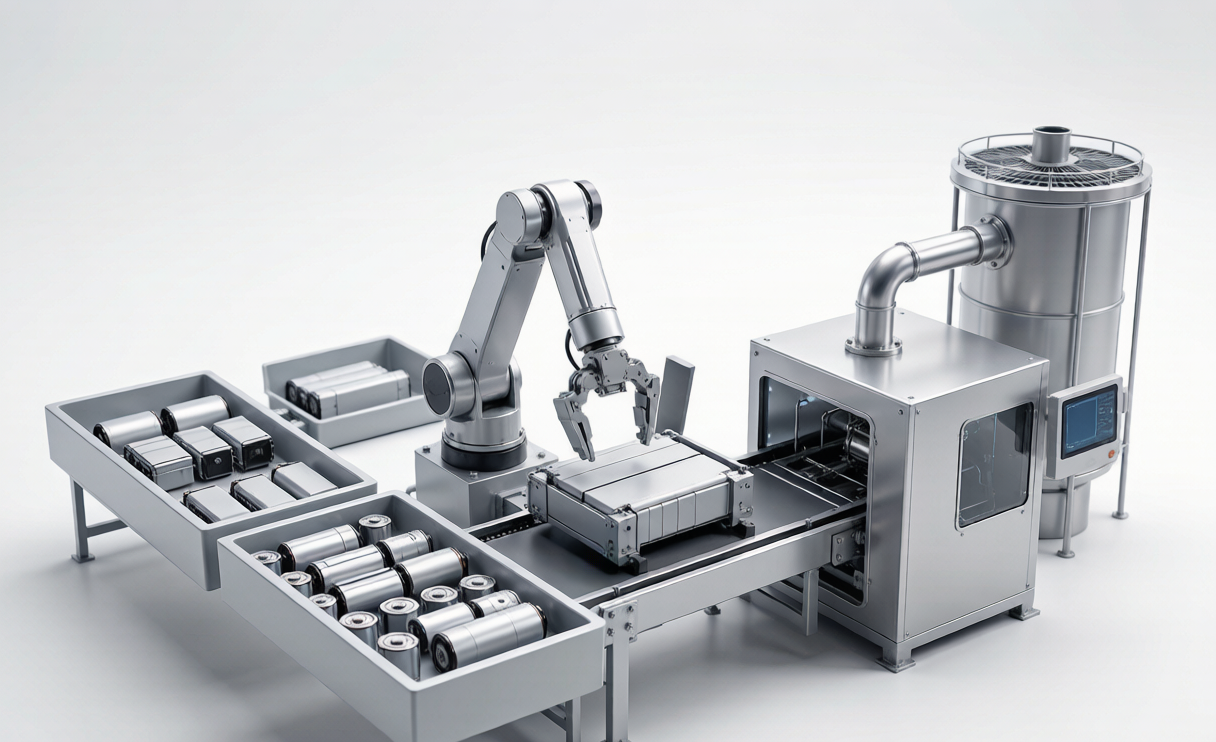
From an engineering standpoint, the sodium-ion battery recycling flow looks reassuringly conventional, which is exactly the point. Here is the path I walk customers through:
- Safe discharge and quarantine. Every returned module is discharged to a safe voltage and held in a monitored bay. Even without cobalt fire risk, a shorted cell is still a shorted cell.
- Mechanical preprocessing. Packs are shredded or hammered, then sieved. Aluminum foil, casing, and separator fragments are separated by density and magnetism. Because both collectors are aluminum, this step is unusually clean.
- Black mass recovery. The active material is isolated as a fine powder rich in sodium, iron, manganese, and phosphate. This is the fraction that matters most.
- Direct or hydrometallurgical regeneration. Instead of smelting, many Na-ion routes use a water-based leach followed by precipitation. Sodium carbonate, the same soda ash used in glass manufacturing, can be added back to rebuild cathode precursor. This is the elegant part: the process can literally turn recovered powder back into fresh cathode material.
- Closed-loop reformation. The regenerated precursor is coated, dried, and cycled. In the best cases, a recycler returns usable cathode powder to the cell maker rather than just raw metal.
The headline is that most of this map already exists for lithium. Sodium simply removes the cobalt-nickel complexity and the copper-aluminum split that drives up lithium costs.
No Cobalt, No Nickel: The Compliance Dividend
For global B2B buyers, chemistry is also a regulatory story. Cobalt and nickel sit at the center of conflict-mineral and due-diligence rules, including the EU Battery Regulation’s supply-chain transparency requirements. A sodium-ion battery sidesteps most of that exposure by design. There is nothing to trace back to artisanal mining, and there is no critical-metal surcharge tied to geopolitical supply.
In practical terms, that means a recycler’s documentation burden is lighter, and your own ESG reporting gets simpler. I have seen procurement teams choose sodium precisely because the recycling paperwork does not require a small audit team to complete.
Safety During Disassembly and Processing
Safety is where the sodium ion battery vs lithium comparison gets tangible. Lithium cells can plate metallic lithium during fast charge or cold operation, creating internal dendrites that raise short and fire risk long after the cell leaves service. Sodium intercalates differently and is far less prone to that failure mode. Sodium also reacts vigorously with water, which is why hydrometallurgy uses controlled, contained leaching rather than open tanks, but the overall thermal risk profile at the sorting line is lower.
From a standards view, end-of-life handling still follows established battery safety logic. We apply the same risk controls we would for any lithium battery during transport and storage, referencing IEC 62133 for cell safety philosophy and IEC 62619 for industrial battery system requirements, then adapt them for sodium’s specific chemistry. The point is that the playbook already exists; sodium just gives you fewer edge cases to defend against in an audit.
Recovery Rates and the Numbers Buyers Actually See
Let me put rough numbers on the table, with the usual engineering caveat that figures vary by process and feedstock purity. Mature lithium hydrometallurgy recovers on the order of 90 to 95 percent of cobalt and nickel and 80 to 90 percent of lithium in good plants. Sodium-ion routes are newer, but because the target materials are simpler, pilot lines already report very high recovery of the transition metals and a straightforward path to reuse sodium-bearing fractions as cathode precursor.
The cost angle is the real story. Removing pyrometallurgy’s energy bill and the cobalt-nickel separation steps can cut processing cost per kilogram of battery by a meaningful margin. For a fleet operator retiring thousands of modules a year, that difference compounds into real CapEx relief on the back end of the product life cycle.
How to Specify a Recycling Partner for Your Sodium-Ion Battery
If you are a B2B buyer qualifying a recycler, do not just ask for a price. Ask for proof. Here is the short list I give my own customers:
- Process transparency. Request a material-flow diagram showing where aluminum, black mass, and regenerated precursor go. Vague answers are a red flag.
- Certifications. Confirm environmental permits, and ask whether the recycler follows recognized battery safety and handling standards. Documented adherence to IEC 62133 and IEC 62619 thinking is a good signal.
- Closed-loop option. The best partners return cathode precursor, not just scrap metal. That closes the loop and lowers your next cell cost.
- Traceability. Even without cobalt, you want a chain-of-custody record for ESG and warranty purposes.
- Transport readiness. Your recycler should handle UN38.3-classified logistics or guide you through compliant shipping, even if sodium’s hazard class is gentler than lithium’s.
And if you are still in the design phase, remember that a thoughtful custom battery solution can make recycling easier from day one: standardized cell formats, snap-fit modules, and clearly labeled materials all reduce teardown cost later.
Frequently Asked Questions
Is sodium-ion battery recycling commercially available today?
Yes, though the dedicated Na-ion recycling capacity is still scaling. Most operators run sodium through adapted lithium lines today, which works well because the mechanical preprocessing is nearly identical. As sodium volumes grow through the 2020s, purpose-built hydrometallurgical routes are coming online, and several pilot plants already return regenerated cathode precursor rather than raw scrap.
Does the process recover the sodium itself?
Not always as pure elemental sodium, but the sodium-bearing fraction is typically captured and reused. In direct regeneration routes, sodium from the black mass is rebuilt into fresh cathode precursor using sodium carbonate, so the sodium effectively stays in the battery value chain instead of being discarded. That is the most economical and lowest-emission outcome.
Can sodium-ion and lithium-ion batteries share a recycling stream?
They can share the front-end mechanical sorting, but they should be segregated before hydrometallurgy. Mixing feeds complicates the leach chemistry and contaminates the recovered precursor. In practice, a good recycler keeps separate process tanks or batches for sodium ion battery versus lithium streams, even if the shredding hall is shared.
What standards apply to sodium-ion battery end-of-life handling?
There is no single sodium-specific recycling standard yet, so facilities apply the established battery framework: safe discharge and transport logic aligned with UN38.3, cell safety philosophy from IEC 62133, and industrial system requirements from IEC 62619. Buyers should ask recyclers how they adapt these standards to sodium’s chemistry and request written evidence of compliance.
The bottom line from my bench to your boardroom: a sodium-ion battery is not just cheaper to build with abundant materials, it is cheaper and safer to retire. For fleet operators, ESS developers, and OEMs watching total cost of ownership, recycling simplicity is a feature worth putting in the spec sheet.