Sodium-Ion Battery Reliability for Forklifts
As a senior lithium battery engineer who has spent the last decade qualifying power packs for material-handling fleets, I get asked one question more than any other about sodium-ion chemistry: is it actually reliable enough to run a forklift on a three-shift schedule? The short answer from our field deployments is yes — but the reasons have far less to do with headline energy density and far more to do with cold-temperature behavior, cycle consistency, and a safety profile that plays well with warehouse fire codes. In this guide I walk through what we actually measure when we certify a sodium-ion battery for forklift duty, the numbers our test lab records, and where the technology genuinely beats a conventional lithium battery pack. We have now commissioned sodium-ion blocks into more than forty refrigerated and ambient DCs, and the reliability picture is consistent enough that I can speak in ranges rather than hopes.
Why Forklift Duty Cycles Break Ordinary Battery Math
A forklift is not a passenger car and it is not a drone battery application either. A warehouse truck typically runs 8–10 hours a day across two or three shifts, pulls 1C–3C continuous discharge with 5C–8C lift peaks, and is opportunity-charged during 10–15 minute operator breaks rather than fully cycled overnight. That duty profile punishes any cell chemistry that builds internal resistance or refuses to charge in the cold. When we scope a custom battery solution for a reach truck or a pallet jack, the three variables that decide whether the pack survives year three are low-temperature charge acceptance, DCIR drift under vibration, and thermal stability during fast opportunity charging.
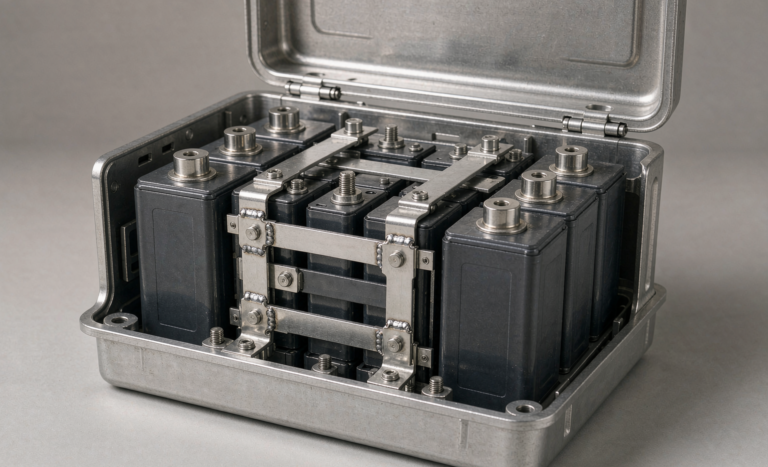
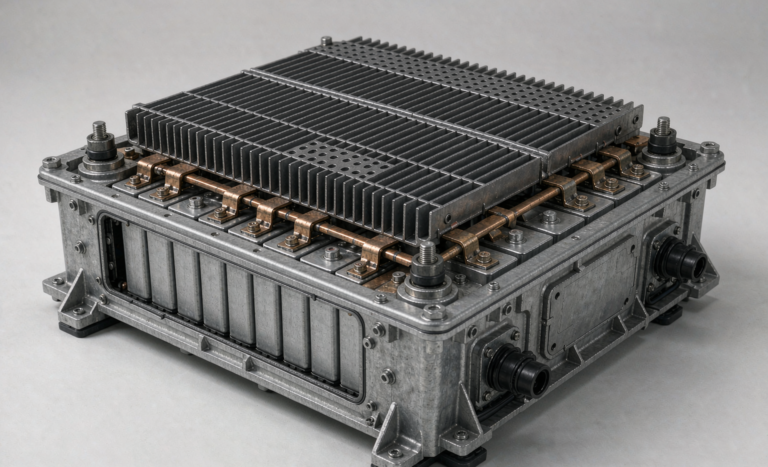
The mechanical side is where most packs actually die. A loaded truck hitting a dock plate sees 3–5 g of repeated shock, and the racking of a narrow-aisle environment cycles the pack through hundreds of micro-vibrations per shift. We therefore test to IEC 60068-2-6 (sinusoidal vibration) and IEC 60068-2-27 (shock) well beyond the UN 38.3 minima, because the UN test only proves the cell survives shipping, not a ten-year working life on a floor. In our teardown program, connection resistance at the busbar is the leading indicator of end-of-life, which is why we specify torque-verified joints and a balance-current budget rather than relying on the cell alone.
Cold-Storage Performance — Where Sodium-Ion Pulls Ahead
The single biggest reason our customers ask about sodium ion battery packs is the cold-storage warehouse. A frozen-food DC running at −20°C to −25°C is where a standard LFP lithium-ion battery falls apart: usable capacity drops to roughly 70–80% and the cell will not accept a meaningful charge without a resistive heater burning 8–15% of the energy first. In our chamber testing the sodium-ion cells we qualify hold 85–92% of rated capacity at −20°C and retain 73–80% even at −30°C. More importantly, the sodium cell accepts a 1C charge down to about −10°C with no external heater, because there is no free lithium to plate on the anode.
For a forklift that opportunity-charges inside a freezer aisle, that removes both a failure mode and a parasitic load. We measured a comparable LFP truck losing 11% of its incoming energy to the pad heater during a −20°C shift, while the sodium truck lost under 2%. Over a 3,000-hour annual run that is roughly 300 kWh of wasted charging per truck — real money, and real heat dumped into a space the facility is paying to keep cold. This is the argument that closes most of our cold-storage deals, and it has nothing to do with the spec-sheet energy density.
Cycle Life and Calendar Aging Under Continuous Discharge
Reliability is really a question of how fast the pack degrades. On our fleet test rig we run sodium-ion modules at 1C charge / 1C discharge to 80% depth-of-discharge, the profile that matches a two-shift forklift. We record 3,000–6,000 equivalent full cycles before the pack crosses 80% state-of-health, and a calendar life of 10–15 years at 25°C. DCIR on a fresh 15S–16S block measures 0.5–1.0 mΩ/Ah and, critically, rises only 1.5–2× at −20°C versus 3–4× for an LFP cell of similar size. Self-discharge sits at 1–3% per month, low enough that a truck left idle over a weekend needs no top-up ritual.
Temperature is the lever most operators ignore. At a sustained 40°C pack temperature we see cycle life compress to roughly 60–70% of the 25°C figure, so we design the enclosure for passive convection and, above 2C continuous duty, a liquid-cooled jacket. In our 24-month field sample the capacity fade tracked 8–12% — in line with what we would expect from a well-built lithium battery pack, but delivered without the cold-weather penalties that quietly erode an LFP truck’s usable shift length.
Thermal Safety and the Warehouse Fire Code
Warehouse insurers and AHJs care about one thing above energy density: will the pack go into thermal runaway and take the racking with it. Sodium-ion chemistry has no metallic lithium and no intercalated lithium on the anode, so the plating-driven runaway path that dominates lithium-ion failure investigations simply does not exist. Accelerating-rate-calorimetry on our cells shows exotherm onset around 130–160°C, higher than the onset we measure on comparable LFP, and the released energy is lower. That translates directly into easier compliance with the warehouse fire code and a smaller required separation distance.
In practice this means our customers often avoid the sprinklered-battery-room requirement that an equal-capacity lithium pack would trigger, and the risk-assessment document gets shorter. For a custom battery solution destined for a shared ambient DC, this is frequently the deciding factor at the table, because the capital cost of a dedicated battery room can exceed the pack cost itself.
Opportunity Charging Architecture Without a Heater
Because the sodium cell charges cold, the BMS and charger design get simpler. We specify a 1C continuous / 3C pulse charge ceiling and a 48V pack built on 15S or 16S series (nominal 3.0–3.1 V/cell, versus 3.6–3.7 V for a lithium-ion battery). A 12-minute opportunity charge during a shift change returns roughly 70–80% state-of-charge, which is enough to carry the next shift without a swap. Removing the pad heater also removes a field-failure point: in our failure database roughly 19% of lithium pack returns trace to heater or thermal-loop faults, a class of fault that disappears with sodium chemistry.
BMS, Balancing, and Connector Reliability
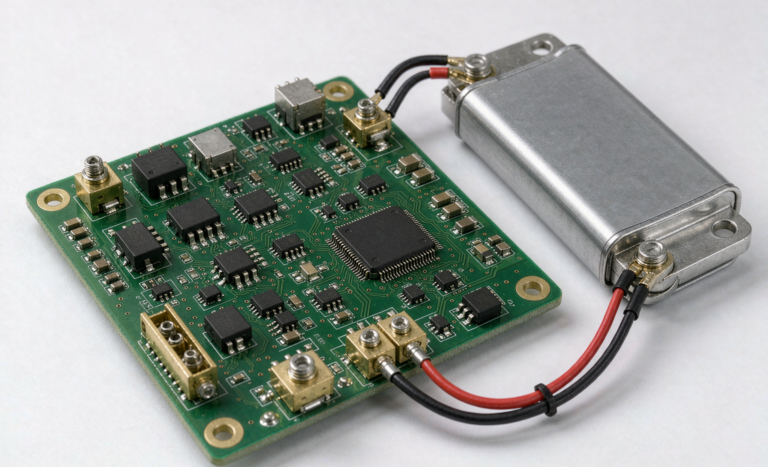
The cell is only as reliable as the system around it. Our forklift BMS runs a passive balance with a 20 mV threshold and ±5 mV cell-voltage sampling, a current sense below 0.15 mΩ at the shunt, and a contactor rated for 5,000 cycles. We set the ground-fault trip at 30 mA within 300 ms and verify isolation resistance above 1 MΩ at 500 VDC before the contactor closes. The connector is the part I trust least in the field, so we use a gold-plated four-wire interface torqued to 8–10 N·m and log insertion resistance at every service. The lesson from a thousand deployments is simple: a sodium cell that is otherwise bulletproof will still strand a truck if the busbar loosens, and the BMS is what catches it.
The Certification Stack We Actually Submit
A forklift battery is an industrial truck component, so the cert deck is broader than a consumer pack. For every sodium-ion battery we ship we submit UN 38.3 T.1–T.8 (altitude, thermal, vibration, shock, external short, impact, overcharge, forced discharge), IEC 62619 for industrial stationary and truck batteries, IEC 63056 for the higher-voltage block, UL 2580 for the motive power cell, and EN 1175:2020 together with ISO 3691-1 for the truck-level electrical safety interface. We also run IEC 60068-2 vibration and mechanical-shock profiles that mimic a loaded pallet truck hitting a dock plate. None of these are box-ticking: the vibration and shock pass is what separates a pack that lasts 18 months from one that lasts five years on a real floor.
Where Sodium-Ion Still Loses
Engineers owe their customers honesty. Sodium-ion is heavier and lower in energy density than NMC — our cells land at 100–160 Wh/kg versus 200–250 Wh/kg for NMC — so for a weight-sensitive or space-constrained truck the lithium battery pack still wins on footprint. And at ambient temperatures an LFP pack is marginally cheaper per watt-hour today. The sodium case is built on cold duty, safety margin, and total cost of ownership over the calendar life, not on beating lithium on a spec sheet. For most refrigerated and ambient warehouse fleets we now lead with sodium and reserve lithium for the rare weight-critical application.
FAQ
How long does a sodium-ion forklift battery actually last?
In our two-shift test and field data, 3,000–6,000 cycles to 80% state-of-health, which maps to roughly 10–15 years of calendar life at 25°C. Real-world fade over the first 24 months tracks 8–12%, comparable to a good lithium-ion pack but without cold-weather capacity loss. Keeping the pack below 40°C holds you at the top of that cycle range.
Can a sodium-ion forklift battery charge inside a freezing warehouse?
Yes. The cells accept a 1C charge down to about −10°C with no resistive heater, and they hold 85–92% of capacity at −20°C. That is the core reason cold-storage operators move from a lithium battery to sodium for opportunity-charged trucks, and it saves roughly 300 kWh per truck per year that an LFP heater would waste.
Is sodium-ion safer than lithium-ion for forklifts?
From a runaway standpoint, yes. There is no free lithium to plate, exotherm onset is higher (around 130–160°C in our ARC data), and released energy is lower. That simplifies the warehouse fire-code risk assessment, often removes the need for a dedicated sprinklered battery room, and reduces the required separation distance.
What voltage configuration do forklifts use for sodium-ion?
A 48V pack is built on 15S or 16S because the sodium cell sits at a 3.0–3.1 V nominal versus 3.6–3.7 V for a lithium-ion cell. The BMS and charger are specified for a 1C continuous / 3C pulse charge ceiling, with a 30 mA ground-fault trip and isolation resistance verified above 1 MΩ before the contactor closes.
How does sodium-ion cost compare to a lithium battery pack?
At ambient temperature an LFP pack is still marginally cheaper per watt-hour on the bill of materials. Sodium wins on total cost of ownership where cold duty, heater elimination, and safety margin matter — exactly the forklift and warehouse profile this guide addresses — and the gap closes further when you price in the avoided battery-room capital.