Lithium Battery for RV Systems: Performance and Sizing
When I audit recreational vehicle electrical systems, the same story comes up at almost every campsite: the owner has replaced an ageing lead-acid house bank with a lithium battery and cannot quite believe the change. As a senior lithium battery engineer at Horizon Power, I have sized and tested 12 V and 24 V house banks for everything from weekend campervans to full-time motorhomes, and the numbers are not close. A 100 Ah lithium battery for RV duty weighs roughly 12 to 14 kg and delivers about 95 percent of its rated capacity, while the equivalent 100 Ah AGM battery weighs 28 to 30 kg and should not be pushed below 50 percent state of charge. That one comparison explains why the RV market moved to LiFePO4 chemistry so quickly.
Why RV House Banks Moved to Lithium (LiFePO4)
The shift rests on four measured advantages. First is usable energy. Lead-acid is limited to roughly 50 percent depth of discharge (DoD) if you want acceptable cycle life, while LiFePO4 safely delivers 80 to 100 percent DoD. A 200 Ah lead bank therefore gives you about 1.2 kWh usable, whereas a 200 Ah LiFePO4 bank gives about 2.4 kWh from a box half the weight. You are effectively doubling usable capacity without touching the wiring.
Second is cycle life. In our bench cycling at 25 degrees Celsius, a quality LiFePO4 cell reaches 4,000 to 6,000 full cycles before falling to 80 percent of its initial capacity. An AGM battery under the same treatment is usually finished at 300 to 500 cycles. Third is charge acceptance. A lithium-ion battery absorbs bulk current at rates lead-acid cannot match, which can turn a two-hour generator run into a 45-minute one. Fourth is voltage stability. LiFePO4 holds a flat 12.8 to 13.2 V through most of its discharge curve, so inverters, fridges and control electronics do not brown out as the bank empties.
The trade-offs are real, though. A lithium battery must not be charged below 0 degrees Celsius, it needs a proper battery management system, and it costs more up front. Over a ten-year horizon the cost per usable kilowatt-hour normally favours lithium, but only when the installation is engineered correctly.
Sizing the House Bank: Loads, Watt-Hours and C-Rate
I always size from a load table rather than a rule of thumb. A typical off-grid motorhome runs an absorption fridge compressor at 40 to 70 W continuous, LED lighting at 10 to 40 W, a water pump at 60 to 120 W intermittent, roof fans at 20 to 60 W, and a 2,000 W inverter that can pull 1,700 W for short bursts to run a coffee maker or microwave.
Convert each load to watt-hours per day, then divide by the system voltage. If the daily draw is 4,800 Wh on a 12 V system, you need 400 Ah of delivered energy. Now apply the design factors: usable DoD of 0.9, inverter efficiency of about 0.9, and end-of-life capacity of 0.8. Dividing 400 by (0.9 x 0.9 x 0.8) gives roughly 617 Ah, so I would specify a 600 Ah bank rather than a 400 Ah one. Skipping those factors is the single most common sizing mistake I see.
C-rate matters as much as capacity. Continuous discharge on a deep-cycle LiFePO4 cell is typically 1C, with 2C to 3C peaks lasting a few seconds. A 600 Ah bank copes easily with a 2,000 W inverter; a 200 Ah bank is marginal, because 1,700 W at 12 V is about 140 A, or 0.7C, and the inrush of an inductive load such as a motor can briefly exceed that. When in doubt, size up rather than down, or move to a 24 V system where currents halve for the same power.
Charging Architecture for RV Lithium Batteries
An RV has three charge sources, and each needs a lithium-aware profile. From the alternator, do not tie the house bank directly to the starter battery. Use a DC-DC charger rated 30 A, 45 A or 60 A; it limits current, isolates the two banks, and applies the correct three-stage profile regardless of the vehicle voltage. Direct paralleling overcharges the house bank and can overheat a standard alternator.
From shore power, a lithium-compatible converter or inverter-charger should hold an absorption voltage of 14.2 to 14.6 V and a float of 13.4 to 13.6 V on a 12 V LiFePO4 bank. Unlike lead-acid, LiFePO4 does not need a long absorption phase, so 30 to 60 minutes at absorption is enough to top the cells and let the passive balancer equalise them. From solar, an MPPT controller beats PWM every time; MPPT recovers 15 to 30 percent more energy on cold mornings and in partial shade, which is exactly when an RV roof array is most productive.
Temperature closes the loop. LiFePO4 will not accept charge below 0 degrees Celsius because metallic lithium plates onto the anode, so many BMS units now include a low-temperature charge cutoff and an optional heater pad. Discharge is far more forgiving, which is why winter use is fine as long as charging is either blocked or warmed.
BMS, Safety and Cold-Weather Behaviour
The battery management system is not optional on a lithium battery; it is the component that makes the chemistry safe in a moving vehicle. A good BMS performs six jobs: cell over-voltage and under-voltage protection, over-current and short-circuit protection, over and under temperature protection, cell balancing, state-of-charge estimation, and communication.
For safety certification I require UN38.3 for transport, IEC 62133-2 for cell and pack safety, and UL 1973 for motive auxiliary batteries. In the marine and RV world, ABYC E-11 governs installation practice. A custom battery solution that cannot show these reports is not one I will install in a customer vehicle, no matter how attractive the price looks.
Cold weather deserves its own paragraph. At minus 20 degrees Celsius a LiFePO4 cell still delivers roughly 80 percent of its rated capacity on discharge, so winter operation is fine; it is charging that stops. Charging below 0 degrees Celsius plates lithium on the anode and permanently reduces capacity, so the BMS must block charge current below that threshold and resume only once the pack warms. If you camp in deep winter, choose a pack with integrated heating rather than trying to warm the bay yourself.
Vibration, Mounting and Installation Standards
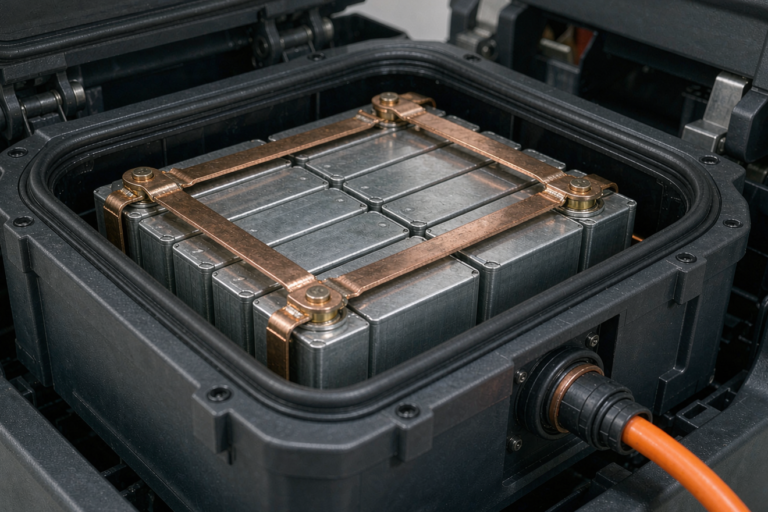
A moving vehicle is a vibration and shock environment, so the mechanical design matters as much as the cells. I specify M8 or M10 terminals torqued to 8 to 12 Nm with a visible torque mark, anti-vibration washers, and a hold-down capable of 5 to 15 g shock. Loose terminals are the number one cause of hot joints and voltage drop I find in audits, and they are entirely preventable.
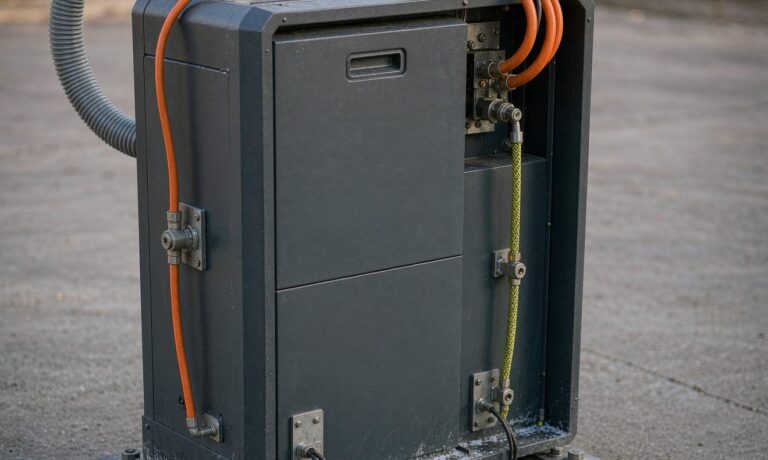
Ventilation and ingress protection matter too. Even a sealed LiFePO4 pack should sit in a bay that stays below about 45 degrees Celsius, because sustained heat accelerates capacity fade: the same cell that gives 6,000 cycles at 25 degrees Celsius may give only 3,500 at 35 degrees and under 2,000 at 45. An IP65 enclosure with an ePTFE breather valve handles condensation without letting water in, and the bank should never share a sealed compartment with a propane appliance.
Cable sizing follows voltage drop. For a 12 V system, aim for less than 3 percent drop at full inverter load, which usually means 70 to 95 mm2 cable between the bank and the inverter on a 2,000 W system. Undersized cable wastes energy as heat and makes the inverter trip on low-voltage cutoff long before the battery is actually empty.
What I Check in a Field Audit
When I commission an RV lithium battery installation I run the same five checks every time. First, absorption and float voltages measured at the terminals, not at the charger. Second, cell delta at rest: any spread above 30 mV after a two-hour rest points to a balancing problem. Third, terminal torque and temperature after a full-load run. Fourth, BMS alarm and cutoff function, verified by simulation. Fifth, low-temperature charge cutoff. A bank that passes all five will typically give 8 to 12 years of service, and I have replaced far fewer lithium packs than lead ones over my career.
Frequently Asked Questions
Can I charge a lithium battery for RV systems directly from the alternator?
Not safely by paralleling it with the starter battery. Use a DC-DC charger rated 30 A to 60 A instead. It caps the current so the alternator is not overloaded, isolates the two banks, and applies the correct 14.2 to 14.6 V absorption profile for LiFePO4. Direct connection risks overcharging the house bank and overheating the alternator on long drives.
How long will a 200 Ah lithium battery run an RV fridge?
A 200 Ah LiFePO4 bank holds about 2.4 kWh usable at 12 V. A compressor fridge drawing 50 W continuous uses about 1.2 kWh per day, so the bank alone runs it for roughly two days; add 400 W of solar and the fridge can run indefinitely in decent weather. Propane absorption fridges use far less electricity but are less efficient in hot weather.
Do I need a special charger for an RV lithium battery?
Yes. A lithium-compatible charger holds an absorption voltage of 14.2 to 14.6 V and a float of 13.4 to 13.6 V, and it must not run an equalisation cycle. Older lead-acid chargers often push 15 V or higher and will trip the BMS or stress the cells. Look for a charger or converter with an explicit LiFePO4 setting rather than a generic profile.
Is it safe to charge an RV lithium battery in freezing weather?
Charging below 0 degrees Celsius is not safe, because lithium plating permanently reduces capacity. Discharging is fine down to about minus 20 degrees Celsius at roughly 80 percent of rated capacity. Choose a pack with low-temperature charge cutoff, or one with integrated heating, if you camp in winter; never rely on ambient warmth alone to protect the cells.
How much lighter is a lithium battery than an AGM battery?
For the same nominal capacity, LiFePO4 is roughly 50 percent lighter. A 100 Ah LiFePO4 battery weighs about 12 to 14 kg, while a 100 Ah AGM unit is 28 to 30 kg. Because lithium also permits a deeper depth of discharge, you can often install half the rated capacity, cutting bank weight by up to two-thirds for the same usable energy.
How long does an RV lithium battery last?
A quality LiFePO4 pack delivers 4,000 to 6,000 full cycles to 80 percent capacity at 25 degrees Celsius, which for an RV typically means 8 to 12 years of service. Heat is the main enemy: the same pack may see only 3,500 cycles at 35 degrees Celsius and under 2,000 at 45. Keeping the bay cool and using a correct charge profile is what gets you to the top of that range.
Further Reading
References